
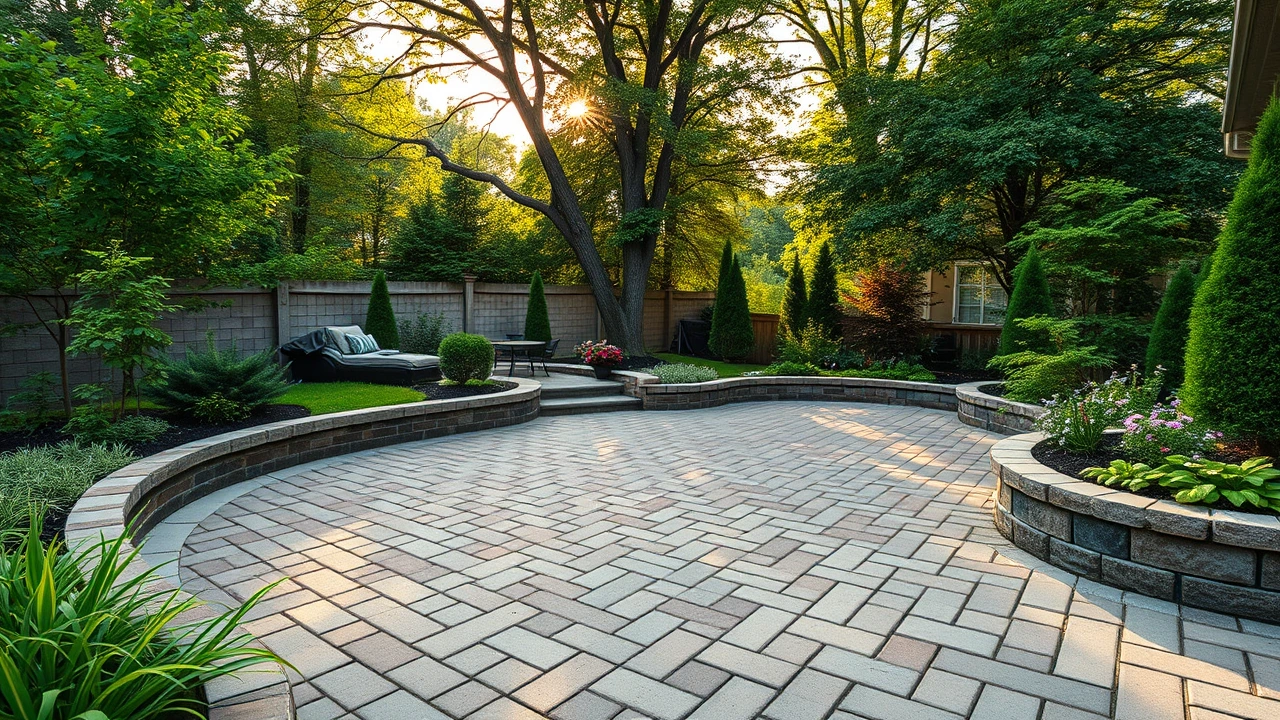
“How long will my patio last?” is the second most-asked question on a quote call, right after cost. The honest answer depends entirely on how it is built. Here are the actual numbers and what drives them.
What “lasts” actually means
A patio does not have a single failure mode. Different parts fail on different timelines. The pavers themselves rarely fail; modern concrete pavers from Belgard, Techo-Bloc, Unilock and Permacon have 25 to lifetime warranties. What fails is the base, the joint sand, the edge restraint or the surrounding hardscape. So the right question is not “when will the pavers crack” but “when will the patio start looking and feeling tired.”
The real timeline
| Timeline | What we see on Ontario residential patios |
|---|---|
| Year 0 | Crisp install, jointing fully locked |
| Year 1-5 | Settles slightly. Light efflorescence (white residue) can appear, washes off. |
| Year 5-7 | First polymeric sand re-sand often warranted; joints may have minor erosion. |
| Year 7-15 | If properly built, looks like year 1 with the re-sand done. If cheaply built, low spots and sand loss become obvious. |
| Year 15-25 | Properly built patios still look great. Cheaply built patios show sinking, weed growth in joints, edge migration. |
| Year 25-30 | Properly built patios at retirement-from-pristine. Selective paver replacement may renew them another 10+ years. |
| Year 30+ | Re-laying the same pavers on a fresh base is a real option, since concrete pavers themselves do not degrade. |
What makes a patio last 30 years
Five things, in roughly this order of importance:
Base depth. 200 mm of compacted Granular A under the bedding sand. Skimping here is the single most common reason patios fail early.
Compaction discipline. The base needs to be compacted in 75 mm lifts with a plate compactor, not all at once. Lazy compaction looks the same on day 1 and fails by year 5.
Geotextile separation fabric. Between the subgrade and the base, it prevents the base from migrating into the soil over decades.
Edge restraint. Spiked aluminum or rigid plastic edging that prevents the perimeter pavers from drifting outward.
Polymeric jointing. Real polymeric sand, properly activated, sets between the joints and locks the whole field together.
What makes a patio fail early
Same list, inverted. Insufficient base (100 mm or less). Lazy compaction. Skipped geotextile. No edge restraint. Regular sand at the joints (washes out in a year). All of these add up. Each one alone is survivable. Two or three together guarantee an early failure.
The real maintenance schedule
Properly built patios need surprisingly little. Every 1 to 2 years: light pressure wash to remove biological growth and any surface residue. Every 5 to 7 years: re-sand the polymeric joints (the sand wears down over time; a re-sand restores the joint lock and weed resistance). Every 10 to 15 years: reseal if the homeowner wants the colour-pop look (purely aesthetic; sealer is not required for performance). That is it.
How to tell if a patio is built right (without lifting a stone)
Three quick checks. Is the perimeter still tight (no gap between pavers and edge restraint)? Are the joints still firm to the touch, not crumbly? Are there no low spots when water drains across it after a rain? Pass all three at year 5 and you have a patio built to last.
Frequently asked questions
How long does an interlocking paver itself last?
Modern concrete pavers from major manufacturers (Belgard, Techo-Bloc, Unilock, Permacon) have 25-year to lifetime structural warranties. The paver material itself does not really degrade; what changes is the surface colour and the joints around it.
Will an interlocking patio crack like concrete?
Individual pavers will not crack the way a poured slab does. Concrete pavers are made under high pressure and tested for strength. The whole interlocking system is designed to flex with freeze-thaw movement; cracks at the system level are not a thing.
How often do I need to reseal an interlocking patio?
Sealing is optional. If you like the colour-deepened wet look, plan on every 3 to 5 years. If you do not seal, the patio will perform identically; it just looks lighter and more matte.
What is polymeric sand re-sanding?
Polymeric sand is the jointing material between pavers. Over 5 to 7 years it slowly erodes. Re-sanding means brushing fresh polymeric sand into the joints, activating it with light water mist, and locking everything back up. Takes a half day on a typical patio and dramatically extends life.
Can a sinking paver patio be saved?
Often yes. We can lift the affected section, fix the base underneath, and re-set the pavers. See our guide on fixing a sinking patio. The original pavers can almost always be re-used.
- Interlocking patios & driveways (service)
- Paver sealing & restoration (service)
- How to fix a sinking paver patio
Sources and further reading
- Interlocking Concrete Pavement Institute (ICPI) for paver industry standards, base-prep specifications and installer certification.
- Landscape Ontario for Ontario industry standards, member directories and consumer resources.
- Belgard, Techo-Bloc, Unilock and Permacon for paver product specifications and warranty information.
- Peace Love Landscaping installer experience across hundreds of projects in Hamilton-Wentworth, Halton and Niagara, 2008-2026.