
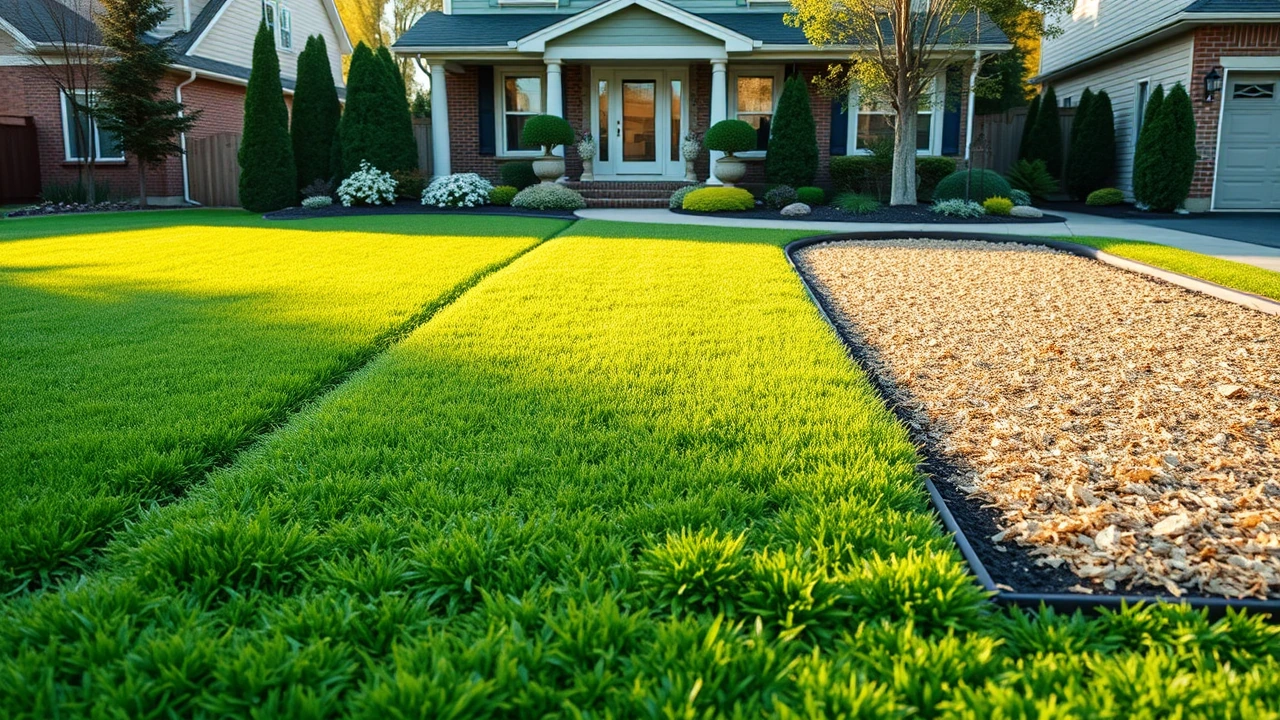
Sod, hydroseed, or plain old broadcast seed? Each one installs a lawn, but they cost different money, take different time, and demand very different watering schedules to actually root. This guide compares all three on 2026 Ontario pricing, weeks to a usable lawn, weed pressure during establishment and water demand, so you can pick the install method that fits your yard, your budget and your patience.
Quick verdict
Cheapest: traditional broadcast seed by a wide margin. Fastest usable lawn: sod, walkable in 2 weeks. Best DIY value: broadcast seed if you have patience and steady watering. Best curb appeal on day one: sod, no contest. Hydroseed sits in the middle on every axis and shines on large sloped lots where rolling sod is impractical.
Head-to-head comparison table
| Factor | Sod | Hydroseed | Traditional seed |
|---|---|---|---|
| Cost per sq ft (2026 ON, installed) | $1.50 to $3.00 | $0.30 to $0.60 | $0.10 to $0.25 |
| Establish time (usable lawn) | 2 to 4 weeks | 6 to 10 weeks | 8 to 12 weeks |
| Weed pressure during establish | Very low (mature turf) | Moderate (mulch suppresses) | High (open soil) |
| Water needs (first 4 weeks) | Daily, often twice daily | 2 to 3x daily for 3 weeks | 2 to 4x daily for 3 weeks |
| Best for | Front yards, fast results, resale | Large lots, slopes, acreage | Budget DIY, patches, overseeding |
Sod: where it wins and where it loses
Sod is mature turf grown on a farm, cut into rolls or slabs, trucked to your driveway, and laid like carpet. The day the crew leaves you have a green lawn. That instant gratification is what most Hamilton, Burlington and Oakville homeowners are paying for, and it is real. There is no slow ugly establish phase, no 8 weeks of staring at dirt while neighbours wonder if you forgot.
Pros
- Instant green lawn on install day.
- Lowest weed pressure of the three. Mature turf already shades the soil and outcompetes weed seedlings.
- Walkable at 2 weeks, mowable at 3 to 4 weeks.
- Best resale and curb appeal lift, especially on front yards visible from the street.
- Installable across a longer season (April through October in Ontario).
Cons
- Most expensive option, often 6 to 10x the cost of seed per sq ft.
- Requires aggressive watering for the first 2 to 3 weeks. Miss a day in July and you can lose a $4,500 install.
- Limited grass cultivar choice (mostly Kentucky bluegrass blends from Ontario farms).
- Heavy. Pallets are 2,500 lbs. Bad backyard access drives cost up fast.
Real-world cost range
2026 installed cost across Hamilton, Burlington and Oakville runs $1.50 to $3.00 per sq ft for basic-prep installs, and $3.00 to $5.50 per sq ft for full renovations (strip, 4 inches of triple-mix, grade, lay). A standard 1,200 sq ft front lawn lands between $1,800 and $3,600 basic, or $3,600 to $6,600 fully renovated. See our 2026 Ontario sod cost guide for the full per-neighbourhood breakdown.
Best fit
Front yards, smaller-to-medium lawns under 3,000 sq ft, anywhere visible to neighbours or buyers, and any homeowner who does not want to live with a mud patch for 2 months. Also the right call for any lawn install in late spring when summer heat is around the corner. Seed and hydroseed struggle to establish into July.
Hydroseed: where it wins and where it loses
Hydroseed is a slurry of grass seed, wood-fibre mulch, fertilizer, tackifier (a sticky binder) and water, sprayed onto prepared soil with a high-pressure hose. The green mulch coat holds moisture against the seed, shields it from sun and wind, and protects it from birds. Done right, you get a thick uniform lawn at a fraction of sod cost. Done wrong, you get green-painted dirt that washes off in the first rain.
Pros
- Much cheaper than sod, typically 4 to 6x cheaper per sq ft.
- Handles slopes and uneven terrain that would be brutal to roll sod onto.
- Wider seed-blend choice. You can spec drought-tolerant fescues, shade blends, or eco-mixes that sod farms do not grow.
- Mulch coat suppresses some weeds and holds moisture better than bare-soil seeding.
- Scales well for large lots, acreage, new-build subdivisions and commercial sites.
Cons
- Still needs 6 to 10 weeks to fill in, and looks rough for the first month.
- Requires 2 to 3 daily watering passes for the first 3 weeks. Same risk as sod if you miss a day in heat.
- Specialty equipment, so fewer Ontario contractors offer it for smaller residential jobs.
- Quality varies wildly. Cheap operators use too much water, too little tackifier, and you get patchy results.
Real-world cost range
2026 Ontario hydroseed pricing runs $0.30 to $0.60 per sq ft installed for residential jobs, with a typical minimum charge around $1,500 to $2,000 because the truck setup is the same whether you are spraying 2,000 or 8,000 sq ft. Below about 4,000 sq ft, sod and hydroseed end up surprisingly close on total cost once minimums are factored in. Above 5,000 sq ft, hydroseed pulls ahead on price by a wide margin.
Best fit
Large rural and semi-rural lots in Flamborough, Ancaster country properties, Halton Hills, west Burlington estate lots and Niagara escarpment acreage. Also any sloped backyard where rolling sod uphill is a non-starter. New-build subdivisions where the developer is finishing 30+ lots at once.
Traditional seed: where it wins and where it loses
Broadcast seed is the oldest and cheapest way to grow a lawn. Prep the soil, throw down quality seed at the right rate, top-dress with a light starter mulch (peat or straw), and water. A bag of premium Ontario lawn seed runs $35 to $80 and covers 1,500 to 3,000 sq ft. Total material cost for a 2,000 sq ft lawn lands well under $200. The catch: open soil is a free buffet for weeds, and germination depends entirely on your watering discipline.
Pros
- Cheapest by far. A weekend of DIY can install a lawn for the cost of a dinner out.
- Widest seed selection. Bluegrass, fescue, ryegrass, micro-clover blends, eco-lawns, shade blends.
- Easy to patch and overseed existing thin lawns. Same technique, smaller area.
- No specialty equipment. A spreader and a rake.
Cons
- Slowest establish. 8 to 12 weeks to a usable lawn, often longer for bluegrass.
- Highest weed pressure during establish. Crabgrass, dandelion, plantain all germinate alongside your lawn seed.
- Most fragile. Heavy rain washes seed into low spots. Hot dry wind kills germinating seedlings in hours.
- Birds eat a meaningful percentage of broadcast seed unless you mulch heavily.
- Only really works in two narrow windows: late April through early June, or late August through September.
Real-world cost range
DIY material cost for 2026 in Ontario is $0.05 to $0.15 per sq ft (seed, starter fertilizer, light mulch). Pro install with prep, seed, fertilizer and a starter mulch pass runs $0.10 to $0.25 per sq ft. Add topsoil import at $1.10 to $1.80 per sq ft if you are starting from raw subsoil or contractor backfill, which is the same line item that drives sod prices up.
Best fit
Backyards where slow establishment is acceptable, lawn repairs and overseeding (no install method beats seed for fixing existing turf), DIY homeowners with time and a sprinkler timer, and tight-budget projects on rural acreage where hydroseed minimums make small jobs uneconomic.
Which one is right for your Hamilton/Burlington/Oakville yard?
Three questions decide this almost every time: how big is the lawn, when are you installing, and how visible is it from the street.
- Under 3,000 sq ft and front-yard visible: sod. The cost gap shrinks at smaller sizes (hydroseed minimums catch up to you), and instant curb appeal is worth the premium.
- 3,000 to 8,000 sq ft, mixed front and back: sod the front, hydroseed or seed the back. This is our most common quote across Burlington and Oakville. You get the curb appeal where it matters and bank the savings on the back lawn.
- Over 8,000 sq ft, rural lot, slopes: hydroseed. Sod cost gets absurd, and broadcast seed on slopes washes out in the first thunderstorm.
- Patches, repairs, overseeding existing thin lawn: seed. Always. No exceptions.
- Hamilton Mountain or Ancaster clay soil: any method works once you have 4 inches of triple-mix on top of the clay. Skip the topsoil and all three install methods fail by year two.
- July or August install: sod with irrigation, or wait until late August. Hydroseed and seed struggle to establish in summer heat without near-continuous watering.
- Late-September install: sod or seed. Hydroseed gets dicey because the slurry needs warmer soil to bond and germinate before frost.
Common mistakes we see on quote reviews
- No topsoil line item. Quotes that lay sod or spray hydroseed directly onto stripped clay subsoil. Both will fail within 2 years. 4 inches of triple-mix is the minimum.
- Wrong season install. Mid-July sod installs without irrigation, or hydroseed sprayed in mid-October. Both burn money. Push to mid-August at the earliest, or wait until next spring.
- No starter fertilizer. Seed and hydroseed need a phosphorus-heavy starter (Ontario regulates lawn phosphorus, but new-establishment is exempt). Without it, germination is slow and patchy.
- Watering once a day in July. Sod and hydroseed need 2 to 3 watering passes daily for the first 3 weeks in summer. Once a day kills the install. Plan irrigation, or do not install in summer.
- Skipping the soil test on rural lots. Old farm land in Flamborough or Niagara can have pH issues that sabotage any install method. A $30 soil test prevents a $4,000 redo.
- Treating hydroseed as a magic trick. It is still seed. Same watering discipline as broadcast seed, just with a head start from the mulch coat.
Frequently asked questions
Can I install sod over my existing dead lawn?
Only if the existing lawn is scuffed up and the soil underneath is at least loamy. If it is compacted clay with thatch, strip it, add 4 inches of triple-mix, then lay sod. Skipping the strip-and-amend step is the single biggest cause of sod failure we see.
Will hydroseed really fill in as thick as sod?
Yes, by year 2, on a well-prepped site with proper watering. Year 1 will look thinner. By the second mowing season you cannot tell the difference between a hydroseeded and a sodded lawn.
How much will my water bill go up during establish?
For a 2,000 sq ft new install in Hamilton, expect $40 to $80 extra on the summer water bill for the 3 to 4 week establish period. Less if you install in cooler shoulder seasons. Worth budgeting for.
Is there a Ontario fertilizer rule I should know about?
Ontario restricts phosphorus in lawn fertilizer for existing lawns, but new-lawn establishment is exempt. Starter fertilizer with phosphorus is legal and recommended for the first application only.
What blend should I pick?
Kentucky bluegrass for classic full-sun front yards. Tall fescue blend for drought tolerance and lower water bills. Shade blend if more than half the lawn gets under 4 hours of direct sun. Micro-clover blend for eco-conscious lawns that need less fertilizer.
Can I walk on the lawn after install?
Sod: light traffic at 2 weeks, full use at 4 to 6 weeks. Hydroseed and seed: no traffic for 4 weeks, light traffic at 6 weeks, full use at 8 to 10 weeks. Pets and kids are the most common cause of patchy establish.
Do you do all three methods?
Yes. We sod most front yards, hydroseed acreage and slopes, and seed repairs and overseeds. Most quotes we issue mix two methods on the same property.
2026 GTA installed prices (real supplier ranges)
Installed pricing across Hamilton, Burlington, Oakville and Halton for a typical 2,000 sq ft residential job, based on our 2026 quote pipeline and public rate cards from the sod farms that deliver into our territory.
| Method | Material only, delivered | Turnkey (material + install + starter fert + first watering plan) | Notes |
|---|---|---|---|
| Sod (Kentucky bluegrass blend) | $0.45 to $0.65 per sq ft | $1.20 to $1.85 per sq ft | Manderley, Zander Sod Co., Green Horizons Sod Farm all deliver into the Hamilton/Halton area. Palletised at 500 sq ft per pallet. |
| Sod (shade-mix fine fescue) | $0.55 to $0.80 per sq ft | $1.40 to $2.10 per sq ft | Order-in item at Zander and Manderley. Best for north-facing yards and under mature-tree canopy. |
| Hydroseed (residential) | Not sold retail (contractor apply only) | $0.35 to $0.60 per sq ft | Only a handful of contractors run hydroseed trucks in the Hamilton area. Minimum job size is typically 5,000 sq ft. |
| Traditional seed (KBG blend) | $0.06 to $0.11 per sq ft (seed only) | $0.30 to $0.55 per sq ft (soil prep + seed + starter fert + straw blanket) | Seed from Sheridan Nurseries, Ontario Seed Company, or bulk from A. Fanning Ltd. (Ancaster). |
Prices exclude old-lawn removal ($0.35 to $0.55 per sq ft for sod cutting and disposal), regrading (typically $500 to $1,500 depending on volume), and irrigation-system commissioning.
Local sod farms delivering into Hamilton, Halton and Niagara
- Zander Sod Co. (Waterloo). Kentucky bluegrass, tall fescue mix and shade mix. Delivers into Hamilton, Burlington, Oakville and Halton on named routes twice a week in growing season. Minimum order 1 pallet (500 sq ft).
- Green Horizons Sod Farm (Cambridge). KBG and low-mow blend. Delivers into Ancaster, Waterdown and rural Flamborough on regular routes.
- Manderley Turf Products (Ottawa, distributed through Sheridan Nurseries Oakville and Georgetown). Higher-end blends including their salt-tolerant coastal mix (useful for boulevard-side install where road salt is a factor).
- Niagara Turf Farms (Grimsby). Route covers Grimsby, Beamsville, St Catharines and Niagara-on-the-Lake for anyone in the Niagara portion of our service area.
The Hamilton climate factor
The GTA and Niagara are in USDA Zone 6b, Ontario growing-season averages 170 frost-free days from May 3 to October 20 in Hamilton (Environment Canada 1991-2020 normals). What this means for the three methods:
- Sod can install any time from late April through mid October provided you can water it. Best installs are early May and early September.
- Hydroseed germinates in 5 to 10 days if soil temp is above 12C. Install windows: mid May through early June, and mid August through mid September. Do not hydroseed in July or August - the top 1 cm of soil dries in 4 hours in Hamilton summer heat.
- Traditional seed follows the same soil-temp rule but with a longer establishment window. Best window is September - you get cool nights, warm days, and 6 to 8 weeks of ideal growth before hard frost.
Worked cost example: 2,400 sq ft Ancaster back-and-front rebuild
Typical Meadowlands-Ancaster job: 1,400 sq ft front lawn, 1,000 sq ft back, existing failing lawn to remove, no irrigation, homeowner wants it done in one weekend.
- Sod turnkey with our crew: old-lawn removal $960, regrade $600, sod (Zander KBG blend, 5 pallets) $1,140, install labour $1,680, starter fert and topdress $220 = $4,600 total. Walkable in 2 weeks, no shoes-on-lawn ban after 4 weeks.
- Hydroseed turnkey: old-lawn removal $960, regrade $600, hydroseed application (specialist sub, 2,400 sq ft) $1,320, straw tackifier included = $2,880 total. Homeowner-usable in 10 to 12 weeks.
- Traditional seed DIY: old-lawn removal (rented sod cutter from Home Depot Ancaster) $180, KBG blend from Sheridan (25 lb) $260, starter fert $85, straw blanket (24 rolls covering) $220, plus 30 hours of labour spread over 3 weekends = $745 in materials. Homeowner-usable in 4 to 6 months, with a full weed-battle in year 1.
Want a real number for your yard? Request a free quote and we will walk the site, check your soil, and recommend the install method (or mix) that fits. For a quick budget estimate, try our sod calculator, and for full per-neighbourhood pricing see the 2026 Ontario sod cost guide.
Went with sod and it is yellowing? Diagnose new sod problems with our dormant or dead test.