
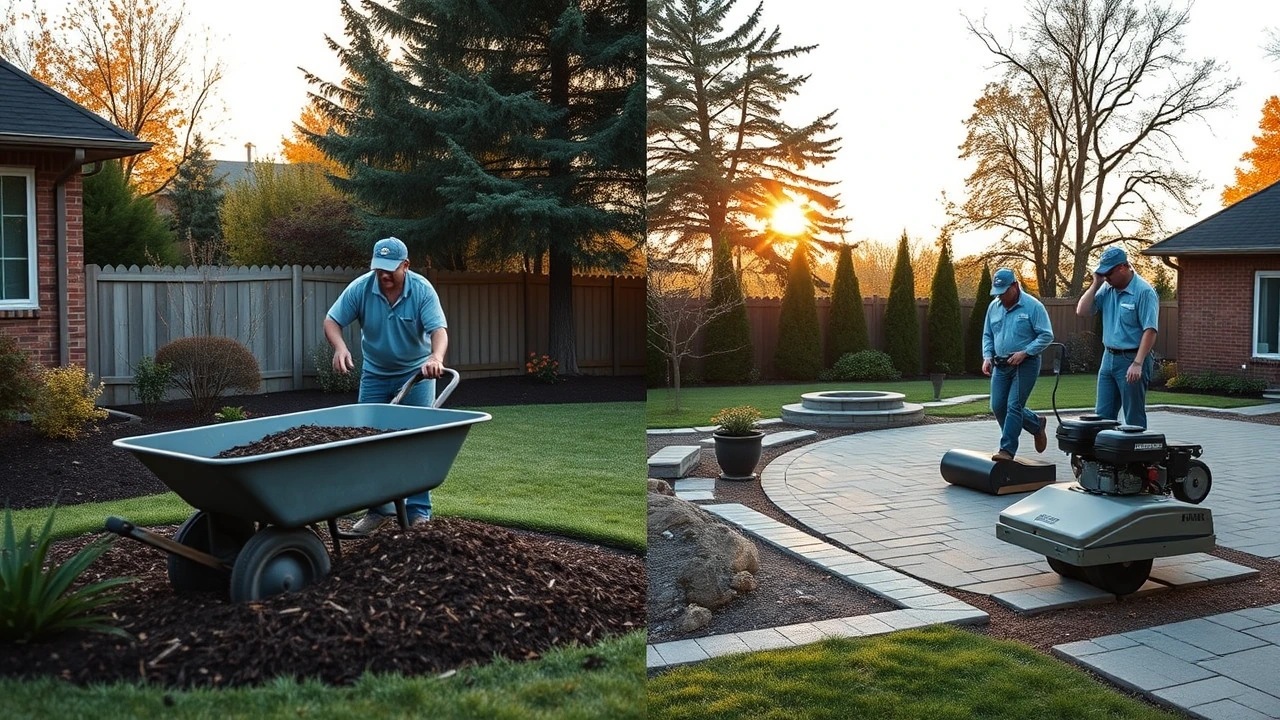
Doing it yourself can save real money on Ontario landscaping projects, but the savings are very uneven across project types. Mulching a bed yourself is almost pure win. Building a retaining wall yourself is almost always a loss once you price the tool rentals, the permit gotchas and the risk of a wall that bulges in three winters. This guide gives you a project-by-project DIY readiness table, the real cost math, and the cases where a partial DIY split saves the most.
Quick verdict
DIY wins for low-risk, low-skill, low-permit work: mulching, planting, lawn install, small fence repair. Hire a pro when the project carries structural risk (retaining walls over 600 mm, decks), permit and inspection risk (pools, fences over 2 m in some municipalities), or warranty exposure on materials. The partial-DIY split, where you do demo and cleanup and the pro does the install, is the most underrated way to save in Ontario.
Project-by-project DIY readiness
| Project | DIY-feasibility | Time investment | Permit / code risk | Cost saved vs pro | Warranty trade-off |
|---|---|---|---|---|---|
| Lawn install (sod or seed) | High | 1 to 2 weekends | Low | $1,500 to $4,000 | You eat any failed patches |
| Mulching beds | Very high | 1 day | None | $400 to $1,200 | Almost none |
| Planting (perennials and shrubs) | High | 1 to 3 days | None | $600 to $2,500 | No plant replacement warranty |
| Simple fence repair (post or panel) | High | Half day to 2 days | Low | $300 to $1,200 | Limited, your own work |
| Full deck build | Low | 3 to 6 weekends | High (permit + inspection) | $3,000 to $8,000 | No structural warranty, resale issues |
| Retaining wall (over 600 mm) | Very low | 2+ weekends, heavy tools | High (engineering, drainage) | $2,000 to $6,000 | No warranty, failure is expensive |
| Paver patio | Medium | 3 to 5 weekends | Medium (base, drainage) | $2,500 to $7,000 | No settle/heave warranty |
| Pool install | Do not | Weeks, multiple trades | Very high (permit, fence code, electrical) | Negative once errors counted | Voids manufacturer warranty |
The real skills and tools cost
The DIY savings only show up after you back out tools, materials and your own time. For a paver patio the tool rental list alone is real: plate compactor at $80 to $120 a day, masonry saw at $90 a day, level transit or laser level, wheelbarrows, screed pipes, and a delivery charge for base and sand. Three weekends of rentals run $600 to $1,000 before a single paver is laid. Add the cost of redoing a corner that did not pitch correctly and the gap to a contractor quote narrows fast.
For planting and mulch, the cost story is opposite. The tools are a shovel and a wheelbarrow you probably own, and the materials are exactly what a pro would charge at a markup. A $1,800 mulch and planting refresh quote often delivers $1,100 of materials and $700 of labour and overhead. That $700 is a clean, low-risk DIY win for any weekend that you actually want to spend outside.
For structural work, the missing tool is experience. A flat paver patio with no slump in five years comes from a properly compacted 150 mm to 200 mm base on subgrade you have judged correctly. There is no rental that substitutes for having done it forty times.
The time math nobody runs honestly
Run the time numbers before the cost numbers. A pro crew of three with a skid steer can install 400 sq ft of sod in a morning, including grading. A homeowner doing the same job alone with a rented rototiller is closer to two long days. Multiply your effective hourly rate (what you actually earn or value your weekend at) by the gap, and the savings often look different.
Patios, decks and walls compound this. A pro can pour, set or lay in days what takes a weekend warrior a month. Meanwhile your yard is unusable, your relationships with the neighbours wear thin, and the project drifts into bad weather. The “I will do it next weekend” patio that takes nine weekends is real, and it is the most expensive landscaping you can do because it costs you a season.
The honest rule: if a project takes a pro crew more than 2 days, double the elapsed time before you commit to DIY. Then add a buffer for the call-and-wait cycle on rentals, deliveries, and the inevitable second trip to the supplier.
Code, permits and inspection gotchas
Many Ontario municipalities require building permits for decks above a certain height (commonly 24 inches or 600 mm above grade), all attached decks regardless of height, fences over 2 metres in residential zones, and any pool enclosure. Retaining walls above a defined height (often 1 metre) typically need an engineered drawing. Skipping the permit can mean a stop-work order, a teardown order at resale, or denied insurance after a failure.
Pool installations are in a category of their own. Pool fence code under most Ontario municipal by-laws is strict on height, gap and self-closing gates, with inspection required before water goes in. Pool electrical is governed by the Ontario Electrical Safety Code and requires an ESA permit and inspection. DIY in this category is a route to denied insurance claims and resale headaches.
Before any structural DIY, call your municipal building department and ask the specific permit and inspection requirements. Hamilton, Burlington, Oakville and the Niagara municipalities all post their requirements online but the practical interpretation varies, and a 15 minute phone call saves a year of regret.
Warranty and insurance gap
A pro install carries a workmanship warranty (typically 2 to 5 years on hardscape installation), manufacturer warranties on the actual materials (pavers, walls, lumber), and is performed under the contractor’s liability insurance and WSIB coverage. Your DIY install carries exactly none of that. If your wall fails into the neighbour’s yard, your homeowner’s policy may not cover it because you built it.
Manufacturers void product warranties when installation does not follow their published specifications. Permeable pavers and segmental retaining wall systems have specific base, geogrid and drainage requirements. A pro crew documents installation against the spec; a homeowner rarely does. When a manufacturer asks for installation photos to honour a warranty claim, the DIY job almost always loses.
Liability is the other side. If a hired contractor injures themselves on your property, WSIB covers them. If a friend you paid cash to help you build the deck falls off it, your homeowner liability is exposed in ways most homeowners do not anticipate.
Resale value impact
Buyer agents in the GTA are increasingly cautious about unpermitted decks, walls and pools. A deck without a building permit on file can shave $5,000 to $15,000 off a sale price, or kill a deal entirely if the buyer’s lender flags it. Some Hamilton and Burlington listings now disclose whether hardscape was professionally installed and permitted, because the question is asked so often.
Soft landscaping (lawn, planting, mulch) does not raise this issue and DIY work is invisible at resale provided it looks healthy on staging day. Hardscape is the opposite: a buyer or their inspector can usually tell a DIY paver patio from a pro one within seconds, and the assumption will be the worst case. If you plan to sell within 5 years, weight resale risk heavily before DIY-ing anything structural.
The partial-DIY split that actually saves money
The most underused move in Ontario landscaping is hiring the pro for the high-risk steps and doing the low-skill labour yourself. We quote splits regularly and most homeowners do not realise it is on the table.
The patterns that work: you demo the old deck, we build the new one. You strip the sod and excavate the patio base, we lay the pavers. You haul out the old fence and dig the post holes, we set the posts and install panels. You plant the perennials, we install the irrigation. In each case you take on 10 to 30 hours of grunt work that does not need skill, and the pro takes on the precision work where mistakes are expensive.
Done right, a partial-DIY split saves 15 to 30 percent off a full pro quote without giving up the warranty on the structural elements. Ask any quote you receive for a split price. A good contractor will write one; one who refuses every time is telling you something useful.
How to apply this on your project
Pick the right line in the matrix and stay honest about your own time. For most homeowners we work with, the rule of thumb that holds up is:
- DIY freely: mulch, planting, simple lawn repair, small fence panel swaps.
- DIY with research: full lawn install, simple board-on-board fence on flat ground.
- Hire the pro: any deck, any wall over 600 mm, any patio over 200 sq ft, anything needing a permit.
- Never DIY: pool installation, pool electrical, anything load-bearing on the house.
- Always ask for a partial-DIY split quote on structural projects.
- If resale is within 5 years, weight permitted pro work heavily.
Common DIY mistakes we get called to fix
- Paver patios on a 50 mm base of stonedust, no compaction, no geotextile. Heaves within two winters.
- Retaining walls over 600 mm with no geogrid and no drainage gravel. Bulge within three years.
- Decks built without permit, bouncing on undersized joists, fasteners not approved for PT lumber.
- Sod laid directly on compacted clay with no topsoil amendment. Browns out the first July.
- Fences set in concrete without gravel base, posts rotting at the collar within 5 years.
- Pool fences built to “looks tall enough” rather than to the municipal by-law. Insurance refuses to bind.
- Plants installed in the wrong zone or wrong light. Half the bed dead by year two, no warranty.
Frequently asked questions
How much do I really save doing landscaping myself?
For soft landscaping (mulch, planting, lawn) you typically save 40 to 60 percent of a pro quote. For hardscape, the headline savings of 30 to 50 percent shrink fast once you add tool rentals, mistakes and your own time, and disappear entirely on a failed install.
Do I need a permit to build a deck in Ontario?
Most Ontario municipalities require a building permit for decks above 600 mm (about 24 inches) from grade and for any deck attached to the house. Confirm with your local building department before you start. Permits cost a few hundred dollars and protect resale.
Can I build my own retaining wall?
Walls under 600 mm with no surcharge are within reach of a careful DIYer. Anything taller, anything holding back a driveway, or anything near a property line typically needs engineering and is a poor DIY candidate. The failure cost is high.
What landscaping should I never DIY in Ontario?
Pool installations, pool electrical, anything load-bearing tied to the house, retaining walls over 1 metre, and any work that requires a permit you would not pull. The combined permit, insurance and resale risk outweighs the labour savings.
Is sod or seed easier for a DIY lawn?
Sod is faster, more forgiving and gives a finished look in a day, but costs more in materials. Seed is cheaper but needs daily watering for weeks and is vulnerable to weather. For first-time DIYers, sod is the higher-success choice.
Will a partial-DIY split actually be quoted by contractors?
Reputable contractors will quote splits where the risk allocation is clean. You doing demo and cleanup is easy to scope. You touching the base prep on a paver patio is usually a no, because the contractor cannot warranty the finish if the base is yours.
Does DIY landscaping void my home insurance?
Not automatically, but unpermitted structural work can void coverage on that structure if it fails. Liability for guests injured on DIY hardscape is also more exposed than on permitted, pro-installed work.
How long does a DIY patio actually last?
A DIY paver patio with a thin base and no edge restraint typically looks good for 2 to 3 years and starts to fail by year 4 to 5. A properly built pro patio with a 150 mm to 200 mm compacted base lasts 20 plus years.
If you are pricing a project, start with the numbers. Use our 2026 Ontario landscaping cost guide, the patio cost calculator, the sod calculator, and the backyard budget calculator to set a realistic budget. When you are ready to compare a pro quote (or a partial-DIY split) to your DIY math, request a free quote and we will walk the site with you.
2026 Hamilton and Halton worked cost comparisons
Three common project types priced against each other for a typical Hamilton/Halton property in 2026. Pro pricing pulled from our own 2026 quote pipeline; DIY pricing from Home Depot Ancaster, Beaver Valley Stone Waterdown and Connon Nurseries.
Project A: 240 sq ft flagstone patio, Ancaster back yard
| Line item | DIY | Pro (Peace Love Landscaping crew) |
|---|---|---|
| Excavation and base prep (dig 8 in, haul 4 cubic yards of soil) | $180 dumpster + 12 hours labour | $1,200 |
| Base aggregate (limestone screenings + 3/4 clear) | $620 material | $720 material + install |
| Plate compactor rental | $140 (2 day rental Home Depot Ancaster) | Included |
| Flagstone (Techo-Bloc Blu Slate, Permacon dealer) | $2,100 material + $180 delivery | $2,340 material |
| Polymeric jointing sand | $95 | $110 |
| Install labour | 30-40 hours DIY | $3,400 |
| TOTAL | $3,315 + 40 hours + tool learning curve | $7,770 turnkey, 3 to 4 working days |
DIY save: about $4,455 if you already own or can rent tools, get the compaction right (95% Standard Proctor is not eyeball-able) and don’t leave polymeric sand un-swept in the rain. We get called to fix DIY patios roughly monthly – the common failure mode is settling on inadequate base compaction, adding $2,000 to $3,500 in remedial work.
Project B: 60 linear metres of 1.8 m cedar privacy fence
| Line item | DIY | Pro |
|---|---|---|
| Cedar posts, rails, boards (Turkstra Lumber Burlington) | $4,100 material | $4,600 material |
| Post-hole digging (30 holes at 1.2 m deep) | $180 augur rental + 8 hours | $1,800 |
| Concrete (30 bags, 25 kg each) | $180 | $220 |
| Install labour (framing + boarding) | 50-70 hours over 3-4 weekends | $5,400 |
| TOTAL | $4,460 + 60 hours + property-line accuracy risk | $12,020 turnkey, 4 to 6 working days |
DIY save: about $7,560. The property-line risk is real – a fence built 8 cm over the surveyed line is a real thing we see quarterly in Hamilton and Burlington and can trigger a Property Standards complaint or a small-claims dispute. Get a legal survey done first if the boundary is uncertain (survey costs $600 to $1,200 in the GTA and is worth every dollar).
Project C: 2,000 sq ft sod install, Burlington front-and-back
| Line item | DIY | Pro |
|---|---|---|
| Old sod removal + haul | $180 sod cutter rental + $220 dump fees | $800 |
| Regrade + topdress | $420 material + 6 hours | $620 |
| Sod (Zander KBG, 4 pallets) | $1,120 delivered | $1,240 |
| Install labour | 20-24 hours (must complete same day as delivery) | $1,780 |
| TOTAL | $1,940 + one physically brutal Saturday | $4,440 turnkey, 1 to 2 days |
DIY save: about $2,500. The catch: sod has to go down the same day it arrives on the pallet or it starts to yellow. 4 pallets = 8 hours of hard physical work minimum with 2 fit adults. Rain the day of delivery is a project-killer.
Ontario permit and insurance points DIYers routinely miss
- Deck permits: Any deck over 24 in (0.6 m) above grade needs a City of Hamilton, Burlington or Oakville building permit ($240 to $580 typically) plus a Zoning Compliance Certificate for setback verification.
- Fence height by-laws: 2.0 m rear-yard max in Hamilton, 2.44 m in Burlington and Oakville. Corner-lot sight-triangle rules drop to 0.9 m for visibility. Neighbours can file a complaint if you exceed.
- Pool fencing: Any pool 24 in deep or more triggers pool-fencing compliance in all three cities. Above-ground pools count.
- Locates before digging: Ontario One Call (1-800-400-2255) is legally required before any excavation over 30 cm deep, and free. DIYers skip this constantly and hit gas lines, water services and Bell fibre.
- Tree by-laws: Hamilton’s Private Tree By-law 24-118, Burlington’s 68-2013 and Oakville’s 2017-018 all protect trees over specific DBH thresholds. Removal without permit can trigger fines up to $100,000 per tree.
- Homeowner insurance: A DIY structural build (retaining wall over 1 m, deck, pergola) that fails and injures someone is often not covered by standard homeowner policies if it was not built to code. A pro contractor’s $5M liability policy covers this.
- WSIB coverage: If you hire an uninsured “cash job” contractor and they get injured on your property, you can be personally liable. Always ask for a WSIB clearance certificate.
The partial-DIY split most GTA homeowners should actually use
The highest-ROI split in the Hamilton/Halton area on a $25K to $50K back-yard project is: pro does the base excavation, drainage, hardscape structure and any permit-triggering work; homeowner does the planting, mulching, edging touch-ups, staining and long-term maintenance. Reasoning: base and drainage failures are hidden and expensive to fix; planting failures are visible and cheap to replace. You get the pro-grade bones and save 20 to 30% on total project cost by owning the finishing work.