
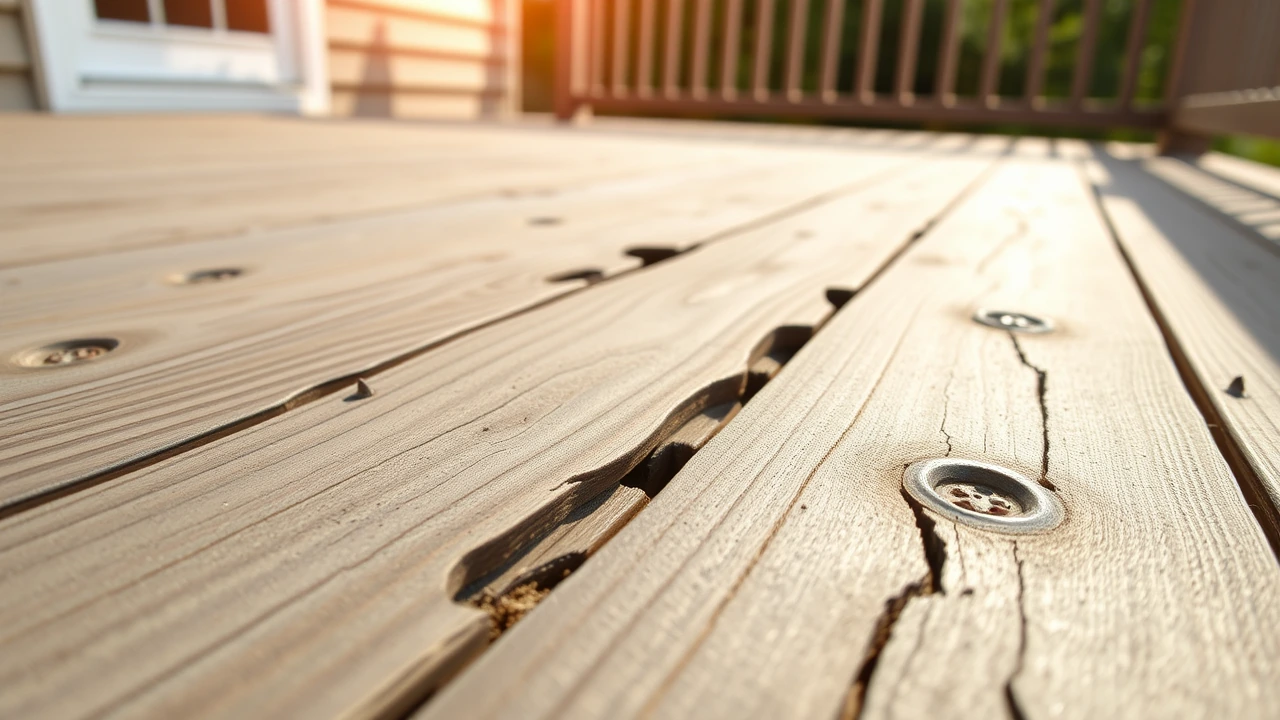
A warped, splintered or squeaky deck almost always tells a story about how it was built and how it has weathered Ontario freeze-thaw cycles. Wet-from-the-mill pressure-treated lumber dries and cups. Joists with no drainage gap trap moisture. Short fasteners back out. Shallow footings heave. Most of these have cheap fixes if you catch them in year one or two, and expensive ones if you wait until year ten. This guide walks every symptom we see on local service calls.
Quick diagnosis
If your deck is under three years old and cupping, it is almost always wet pressure-treated lumber drying out, not a build defect. If it squeaks or bounces, suspect popped fasteners or under-spec joist hangers. If one corner has dropped, suspect a shallow footing that heaved or settled. If boards splinter on top, the surface is sun-cooked and overdue for a sand and stain. Match your exact symptom in the table below before you spend a dollar.
Diagnostic table: match your symptom to the cause
| Symptom | Likely cause | DIY fix | Pro fix cost |
|---|---|---|---|
| Boards cup or crown | Wet PT drying without spacing | Re-screw, flip mild cases | $600 to $2,400 reset |
| Surface splinters | UV damage, no stain | Sand and re-stain | $3 to $6 per sq ft |
| Squeak or bounce | Popped or short fasteners | Replace with 3 in deck screws | $400 to $1,200 |
| Ledger gap at house | Lag pulled, no flashing | Stop using deck, call a pro | $1,500 to $4,000 |
| One post or corner dropped | Shallow footing heaved or settled | None, structural | $1,200 to $3,500 per post |
| Black streaks under boards | Trapped moisture, joist rot | Pull boards, inspect | $2,500 to $8,000 joist work |
| Hangers rusted or bent | Wrong nails, under-spec hanger | None, structural | $80 to $150 per hanger |
1. Wet pressure-treated lumber drying out (cup and crown)
Nine out of ten "my new deck is warping" calls in Hamilton and Burlington come back to this. Pressure-treated lumber leaves the yard saturated with preservative. If the builder fastens it green with no drying time, every board shrinks and cups as it dries through the first Ontario summer. Cedar does the same to a lesser degree. Composite does not cup but can expand and pinch if installed without gaps.
How to confirm
Look at the deck end-on. Cupped boards smile or frown across the grain. Check if there is any gap between boards. PT installed wet and tight will close to zero gap and then cup as it dries. If your deck is one to two years old and the boards are now 5/32 in apart with mild cup, you caught it normal.
How to fix
Mild cup with one screw per joist end will often pull flat with a second screw added on the high side. Severe cup means pulling and flipping the worst boards, or replacing them. If you re-screw, use 3 in coated deck screws, not the original 2 in framing nails some builders cheat with.
What it costs
A pro re-screw and reset on a 200 sq ft deck runs $600 to $1,400. Replacing 8 to 12 worst boards adds $300 to $700 in PT or $600 to $1,400 in cedar. Full resurface with new PT decking is $12 to $22 per sq ft.
2. No joist spacing or drainage gap (trapped moisture)
Code now expects board-to-board gaps for drainage and joist tape on top of every joist. Older Ontario decks have neither. Water sits on the joist, the joist rots from the top down, the fasteners lose their grip, and the deck starts to squeak and sag long before the boards fail.
How to confirm
Pull one or two boards in the wettest area, usually near a downspout or under a planter. If the top inch of the joist is dark, soft to a screwdriver tip, or has black streaks running with the grain, the joist is rotting from above.
How to fix
If the rot is surface only, sister a new 2x8 PT alongside each affected joist, install Trex Protect or G-Tape joist tape on top, then re-lay boards with a 3/16 in gap. If the joist is soft halfway through, the whole frame needs replacement.
What it costs
Joist tape and re-lay on a 200 sq ft deck runs $1,800 to $3,200. If the whole frame has to be replaced, that is a full rebuild at $34 to $64 per sq ft in PT, including tear-out.
3. Popped or short fasteners (squeak and bounce)
Smooth-shank nails back out. Always have, always will. Frost cycle pushes them up 1/16 in per winter and after five years you can catch a sock on every other board. Short screws (2 in) into 1.5 in decking only bite 1/2 in into the joist, which is not enough.
How to confirm
Walk the deck slowly. Every squeak or click is a loose fastener. Look for shiny screw heads sitting proud of the surface or rust-rimmed nail heads.
How to fix
Remove every popped nail, do not pound it back. Drive a new 3 in coated deck screw beside the old hole. For composite, use the manufacturer hidden-clip system, not face screws.
What it costs
DIY: $40 in screws and an afternoon. Pro re-fasten on 200 sq ft is $400 to $900. Add $200 if we plug and stain old nail holes.
4. Ledger pulled away from the house (stop using the deck)
This is the failure that puts people in the hospital. The ledger is the board bolted to the house that the joists hang off. If it was lagged into siding without flashing, or only screwed (not bolted), water gets behind it, the wood rots, and the bolts pull. A 1/4 in gap between the ledger and the house is an emergency.
How to confirm
Sight along the joint where the deck meets the house. Any visible gap, any rust streak running down the siding, any soft spot in the rim joist inside the basement above the deck. All red flags.
How to fix
This is not DIY. The deck must be supported, the ledger removed, the rim joist inspected and replaced if rotten, proper Z-flashing installed, and a new ledger attached with through-bolts or LedgerLOK structural screws to current Ontario Building Code spacing.
What it costs
$1,500 to $4,000 depending on rim joist condition. If the rim joist is gone, add $2,000 to $5,000 for interior carpentry.
5. Shallow footings: post heave or settling
Ontario frost line is 4 ft. Footings shallower than that lift in winter and drop in summer, slowly walking the deck out of square. We see this constantly on decks the previous owner built on patio stones, deck blocks, or 24 in sonotubes.
How to confirm
Lay a 4 ft level across the deck at each post. If one post is more than 1/2 in off from its neighbours, the footing has moved. Check at the end of winter (March) and again in August. Seasonal swing of more than 1/4 in confirms frost heave.
How to fix
Helical piles installed beside the failed footing, with a new post bracket and a temporary jack. Piles go below frost and never move. Old footing is left in place or chipped out if accessible.
What it costs
$1,200 to $3,500 per post including engineering, install and reset. Usually cheaper than rebuilding the deck, but only if the framing above is still sound.
6. Missing or bad flashing (rim and joist rot)
Even a perfect ledger installation fails without flashing. Water runs down the siding, hits the top of the ledger, and wicks in behind. Builders who skip the $40 of Z-flashing create $4,000 of repair work in year seven.
How to confirm
Look up at the underside of the deck where it meets the house. You should see a metal cap bent over the top of the ledger and tucked behind the siding. If you see caulk instead, the caulk is failing.
How to fix
Pull a few boards near the house, remove siding above the ledger, install proper Z-flashing or self-adhered membrane, replace any soft framing. Then reinstall siding and boards.
What it costs
$900 to $2,400 if framing is sound. Triple that if rot has spread.
7. Under-spec joist hangers and wrong nails
A Simpson LUS28 hanger is rated for a 2x8 joist only if you use the right Simpson nails in every hole. Roofing nails, drywall screws, or empty holes void the rating. We pull off boards and find this constantly on decks DIY-built in the early 2000s.
How to confirm
Crawl under the deck with a flashlight. Every joist hanger should have a nail in every hole, and the nails should be the short fat Simpson SD or N10 type, not drywall screws or smooth nails.
How to fix
Drive proper Simpson SD9 or SDS screws into every empty hole. Replace any rusted or bent hangers. If hangers are missing entirely on a flush-beam connection, the deck should not be used until corrected.
What it costs
$80 to $150 per hanger, $400 to $1,200 for a full audit and refit on a typical 200 sq ft deck.
Repair vs replace: how to decide
If the frame is sound and only the surface is failing, resurface. If the frame is failing or the footings have moved, rebuild. A few rules we use on every quote:
- Resurface if joists pass the screwdriver test, ledger is flashed and bolted, footings are stable, hangers are correct. Cost $12 to $22 per sq ft.
- Partial rebuild if ledger or one or two posts need work but framing is otherwise good. Cost $25 to $40 per sq ft.
- Full rebuild if joists are rotting, footings are shallow, or the deck is over 20 years old without permits. Cost $34 to $64 per sq ft in PT and $64 to $119 in composite, including tear-out and disposal of the old deck.
- Walk away if a deck inspector flags ledger failure on a deck more than 8 ft above grade. Do not use it.
How to prevent it next time
- Let kiln-dried PT or cedar acclimate two weeks on site before installing.
- Always tape the top of every joist with Trex Protect, G-Tape or equivalent.
- Use 3 in coated deck screws into the joist, never smooth-shank nails.
- Install Z-flashing behind the ledger and over the top of the ledger. Both.
- Pour footings to 4 ft, or use helical piles. Skip the deck blocks.
- Maintain a 3/16 in board gap and a 1 in gap between deck and house siding.
- Sand and re-stain every two to three years, or sooner if water no longer beads.
Frequently asked questions
Is a cupping deck a warranty issue?
Usually no. PT lumber is sold knowing it will dry and move. Most builder warranties cover workmanship for one year, not lumber movement. See our Ontario landscaping warranty guide for what is standard.
Can I flip cupped boards over?
Yes if the screws have not stripped the wood. Pull, flip, and re-screw with new holes. Mild cup will often flatten with a second screw on the high edge without flipping.
How dangerous is a squeak?
A squeak alone is not dangerous, it is a loose fastener. Combined with bounce, sway, or a visible gap at the ledger, it can be. Inspect from underneath.
Why does only one corner of my deck sag?
Almost always a footing that heaved or settled. Helical piles are the cleanest fix in Ontario clay soils.
Should I sand or pressure-wash before staining?
Sand. Pressure washing tears up soft summer wood and creates more splinters. 60 grit on a random orbital, then 80 grit, then stain within 48 hours.
What stain lasts longest in Ontario?
Penetrating oil stains like Sansin or Sikkens Cetol SRD outlast film-forming products in our freeze-thaw climate. Plan to refresh every two to three years.
Is it cheaper to resurface or rebuild?
Resurface is almost always half the cost or less, provided the frame and footings are sound. See the decision rules above.
Do I need a permit to rebuild a deck?
In most Hamilton, Burlington and Oakville jurisdictions, yes, if the deck is over 24 in above grade or attached to the house. A like-for-like board swap usually does not need one.
If your deck has any of the structural symptoms above, do not delay. Request a free quote and we will inspect ledger, footings and framing in person. For pricing context, see our Ontario deck cost guide, run numbers in the deck cost calculator, compare material life in PT vs cedar vs composite, and review what warranty you should expect on the rebuild.
Pricing the fix? See 2026 deck repair costs item by item, from boards to footings.
Cleaning before you re-stain? Follow our deck cleaning guide with safe pressure washer settings for wood and composite.
Stairs uneven or loose? See the deck stair rules inspectors check and what a rebuild costs.
Wood drying out and splitting? See how to stain and seal a deck to slow it down.
Is the underside sealed up? See why skirting without airflow rots a deck frame and how to vent it.