
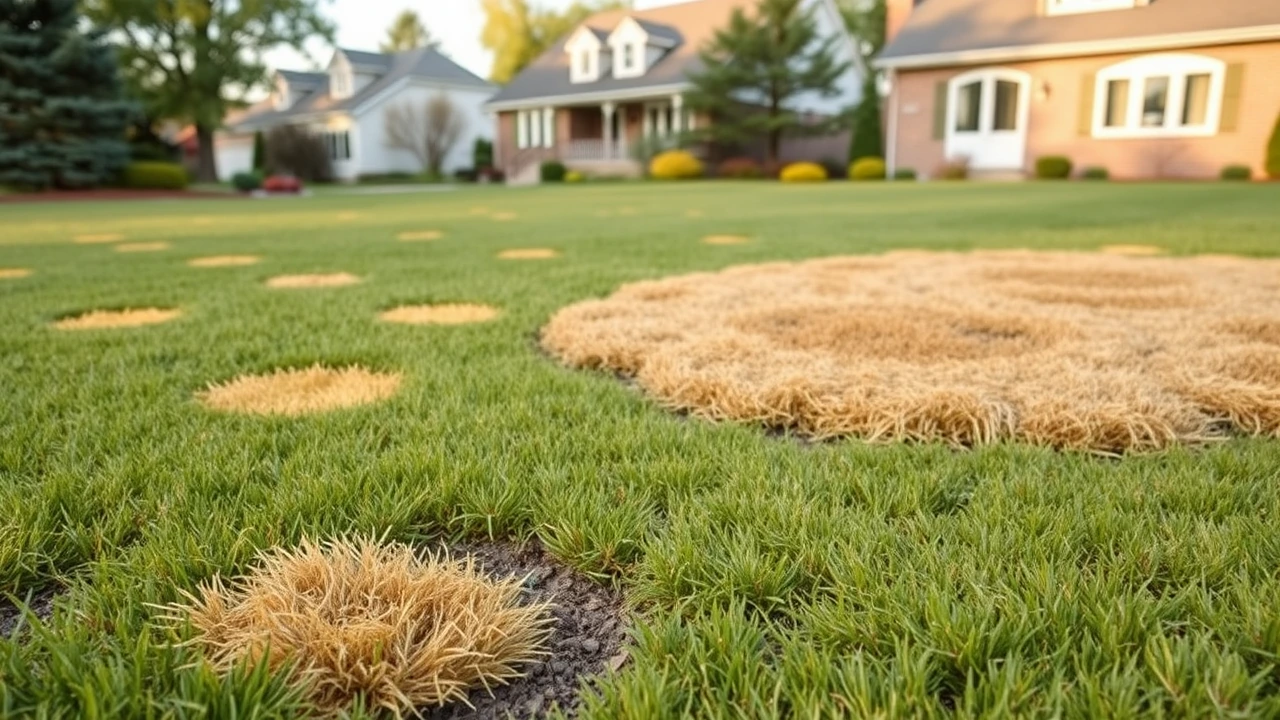
A brown lawn in Ontario almost always has one of eight causes, and the fix is completely different for each one. Treat for grubs when you really have chinch bugs and you wasted $80 and a weekend. In this guide the Peace Love Landscaping crew walks you through how to tell drought stress from grub damage from fungus, what each looks like, the quick test to confirm it, and the 2026 cost to fix it yourself or with a lawn care pro. Save the spray bottle for the actual problem.
Quick diagnosis
If your lawn turns crispy and brown in July and August across the whole yard, that is heat-and-drought dormancy. If you see irregular brown patches that pull up like loose carpet, that is grub damage. If sunny areas near sidewalks, driveways or south-facing walls turn yellow then straw-coloured in late July, that is chinch bug. Round dead spots with a dark green ring after a wet warm week point to fungus. Small round bright-green spots with brown centres are dog urine. Use the table below to narrow it.
Diagnostic table: match your symptom to the cause
| Symptom you see | Likely cause | DIY fix | Pro fix cost |
|---|---|---|---|
| Sod pulls up like carpet, you see white C-shaped grubs underneath | White grubs (June beetle, European chafer) | $40 to $120 (nematodes) | $200 to $600 |
| Sunny edges yellow then straw, spreads, lawn never recovers from heat | Chinch bug | $30 to $90 (soap flush + reseed) | $250 to $700 |
| Whole lawn crispy in July and August, greens up in September | Heat and drought dormancy | $0 (water deeply) | n/a |
| Bright green ring around dead brown circle | Dog urine | $15 (rinse and reseed) | n/a |
| Tips of grass blades ragged and brown | Dull mower blade | $10 (sharpen) | $25 to $50 |
| Spongy under foot, water beads, brown patches | Thatch over 1/2 inch | $60 to $150 (rent dethatcher) | $200 to $500 |
| Round patches with dark border after warm wet week | Fungal disease (dollar spot, brown patch) | $25 to $80 (fungicide + cultural fix) | $150 to $400 |
| Lawn never thick, weeds dominant, soil hard | Compacted or depleted soil | $80 to $200 (aerate + topdress) | $300 to $900 |
Cause 1: White grubs (June beetle and European chafer)
The most destructive Ontario lawn pest. Adults lay eggs in June and July, larvae feed on grass roots through late summer and fall, and then again in early spring. Skunks and racoons rip up the lawn to eat the grubs. By September you have brown patches that lift up like a rug.
How to confirm
Cut a 1 sq ft flap of suspect lawn and peel it back. Count the white C-shaped grubs. More than 5 per sq ft means treat. Less than 3 means leave it alone. Animal digging at night and patches that roll up are the giveaway.
How to fix
Apply beneficial nematodes (Heterorhabditis bacteriophora) in late August through mid September when soil is over 15 C. Water the lawn before and after application. Reseed damaged patches with a sun and shade mix in early September. Ontario banned cosmetic pesticides in 2009 so chemical grub control is not available for homeowners.
What it costs
DIY nematodes for a 2,000 sq ft lawn: $40 to $120. Plus seed and topsoil for repair: $40 to $80. Pro nematode application: $200 to $600 depending on lawn size.
Cause 2: Chinch bug
A tiny black-and-white sucking insect that loves hot, dry, sunny lawns. South-facing slopes, lawns next to driveways and sidewalks, and skinny strips by the road get hit first. Damage shows in mid to late July and is often mistaken for drought.
How to confirm
Cut both ends off a tin can, push it 2 inches into a yellowing patch near the border between dead and green grass, fill with water, hold for 10 minutes. Chinch bugs float up. More than 20 per can means treat. You can also part the grass at the patch edge and look for small fast-moving insects at thatch level.
How to fix
Soak the affected zone with insecticidal soap solution (5 tbsp dish soap in 1 gallon water per 250 sq ft). Reseed damaged areas with endophytic ryegrass or fescue mix - endophytic seed resists chinch bug naturally. Raise mowing height to 3 inches and water deeply once a week.
What it costs
DIY treatment and reseed: $30 to $90. Pro chinch bug treatment and overseed: $250 to $700.
Cause 3: Heat and drought dormancy
Kentucky bluegrass, which makes up most Ontario lawns, naturally goes dormant in heat and drought. It looks dead, but it is not. Brown straw-coloured grass that does not pull up easily and greens back up after rain or cooler weather is dormant, not dying.
How to confirm
Tug a handful. Dormant grass stays rooted, dead grass pulls up. Crowns at soil level still feel slightly green and firm, not crispy and grey. If the whole lawn went brown together in late July and you have not watered, this is it.
How to fix
Nothing dramatic. Water deeply (1 inch per week) once a week, ideally early morning. Do not mow dormant lawns. Avoid fertilizer and weed killers on dormant turf. Recovery happens naturally in September.
What it costs
Free, plus your water bill. If you want to prevent dormancy, the cost is your $50 to $150 summer water spend.
Cause 4: Dog urine spots
High nitrogen and salt content burns the grass directly under the spot, then a bright green ring forms around it as the surrounding grass uses the diluted nitrogen. Almost always small (4 to 12 inches), round, and concentrated in favourite dog spots.
How to confirm
Pattern: round, small, with a green halo. Location: you have a dog, or your neighbour does. Frequency: keeps coming back in the same spots.
How to fix
Rinse spots with water within 8 hours of the dog peeing. Scrape out the dead patch, topdress with 1/2 inch of compost or topsoil, reseed with the same grass type, water daily for 2 weeks. Train the dog to a mulch or pea-gravel zone if possible.
What it costs
$15 in seed and a bag of topsoil. No pro fix needed.
Cause 5: Dull mower blade
An overlooked one. A dull blade tears grass instead of cutting it, the torn tips dry out and turn brown, and from 6 feet away the lawn looks faintly brown or tan even though the roots are healthy.
How to confirm
Bend down and look at the cut tip of an individual blade. Clean square or angled cut means sharp. Ragged, frayed, whitish or brown tip means dull. Lawns mown by dull blades also have a slight grey haze after cutting.
How to fix
Sharpen the blade or replace it. Most homeowners should sharpen at the start of the season and once more in July, or after every 25 hours of mowing.
What it costs
DIY sharpen with a file: $0. New blade: $25 to $50. Pro sharpening service: $15 to $25.
Cause 6: Thatch buildup
Thatch is the layer of dead grass between soil and green growth. Under 1/2 inch is healthy. Over 1/2 inch and water, air and nutrients cannot reach the roots. Lawn feels spongy, browns out in heat, fertilizer stops working.
How to confirm
Cut a 3 inch deep wedge from the lawn. Look at the brown spongy layer at the top of the soil. If it is over 1/2 inch thick, you have a thatch problem.
How to fix
Rent a power dethatcher or core aerator in April or September. Power-rake the lawn, collect the debris, topdress with 1/4 inch of compost, overseed. Mow at 3 inches going forward (short cuts encourage thatch).
What it costs
DIY dethatcher rental: $60 to $150 for a day. Pro dethatch and overseed for 2,000 sq ft: $200 to $500.
Cause 7: Fungal disease
Ontario summers with warm wet nights bring dollar spot (silver-dollar-sized round patches), brown patch (larger irregular brown rings) and red thread (pinkish web on grass tips). Common after thunderstorm weeks, on over-watered lawns, or where fertilizer was applied right before heat.
How to confirm
Round or ringed brown patches that appeared within a few days of warm wet weather. Look for a dark border, pink fluff (red thread) or grey water-soaked spots in early morning dew. Often clusters in shaded or poorly drained areas.
How to fix
First, fix the cause. Water deeply but less often, in the morning only. Mow when grass is dry. Reduce nitrogen for the rest of the season. For active outbreaks apply a home-permitted fungicide like Bordo or Garden Sulphur. Most fungal damage recovers on its own in 4 to 6 weeks once conditions change.
What it costs
DIY fungicide and cultural fix: $25 to $80. Pro lawn-care fungus treatment: $150 to $400.
Cause 8: Compacted or depleted soil
Ontario clay subsoils compact under foot traffic, kids, dogs, and snow plough piles. Roots cannot penetrate, water runs off, fertilizer leaches without uptake, weeds (which tolerate compaction) take over. Lawn is thin, hard underfoot, and slow to recover from any damage.
How to confirm
Push a screwdriver into damp soil. If it stops in the first 2 inches, the soil is compacted. Standing water after rain, exposed roots, and dandelion or plantain dominance also point to compaction.
How to fix
Core aerate in April or September. Topdress with 1/4 inch screened compost. Overseed with quality Ontario blend (KBG, fescue, ryegrass). Repeat aeration yearly until soil structure improves.
What it costs
DIY core aerator rental and compost: $80 to $200. Pro aerate, topdress and overseed for 2,000 sq ft: $300 to $900.
When to call a pro vs DIY
Most lawn problems are DIY-fixable once you have correctly identified the cause. The reason to call a pro is either diagnosis you cannot make confidently, or scale that is too big for a weekend.
- DIY if: under 4,000 sq ft, you can confirm the cause with the tests above, you have a weekend free
- Call a pro if: multiple causes overlapping (grub + fungus + compaction), repeated failures of your own treatments, or the lawn is over 6,000 sq ft
- Call a pro if: over 40 percent of the lawn is dead and you are considering re-sodding rather than reseeding. See our sod cost guide
- Get a soil test before any major intervention. Soil test through the University of Guelph runs $25 to $60 and answers half the diagnosis questions for you
How to prevent it next time
- Mow at 3 inches, never scalp. Tall grass shades soil, blocks weeds, builds deeper roots
- Sharpen your mower blade twice a season
- Water deeply (1 inch) once a week, early morning, not light daily sprinkles
- Core aerate every spring or fall on compacted soils, every 2 years otherwise
- Topdress with 1/4 inch compost annually and overseed any thin areas in early September
- Use endophytic grass seed (resists chinch and other insects naturally)
- Apply beneficial nematodes preventively in late August if you live in a known grub area (most of Hamilton, Halton, Niagara)
Frequently asked questions
Is my brown lawn dead or just dormant?
Tug a handful. Dormant grass holds in the soil and the crown at soil level still has some green. Dead grass pulls up easily and the crown is grey and brittle. Dormant lawns recover with September rain. Dead lawns need reseeding or sod.
How do I tell grub damage from chinch bug damage?
Grub damage lifts up like a rug because roots are gone, and you will find white C-shaped larvae underneath. Chinch bug damage stays rooted but the grass dies from the top down on sunny edges. Use the tin-can flush test for chinch.
Can I fix a dead lawn without re-sodding?
Yes if under 40 percent is dead. Power-rake the dead patches out, topdress with compost, overseed in September or late April, water daily for 2 weeks then weekly. Over 40 percent dead, see our sod vs hydroseed vs seed guide.
When should I reseed my Ontario lawn?
Early September is best (soil warm, weed pressure dropping, fall rain). Late April is second-best. Mid-summer reseeding fails 9 times out of 10.
How much does it cost to fix a brown lawn in Ontario?
DIY most causes: $25 to $200 total. Pro lawn-care service for the season (4 to 6 visits including aeration, overseed, fertilizer, insect control): $400 to $1,200 for an average suburban lot. Full re-sod runs $1.50 to $3 per sq ft. See sod calculator.
Will fertilizer fix a dying lawn?
Only if the cause is nitrogen deficiency, which is rare. Fertilizing a lawn with grubs, chinch, fungus or compaction makes the problem worse. Diagnose first.
Is dog urine permanently damaging my lawn?
No. Rinse spots within 8 hours, reseed dead patches in September, and consider a designated mulch potty zone. The damage is purely cosmetic and fully repairable.
Are grub control products banned in Ontario?
Chemical pesticides for cosmetic lawn use are banned. Beneficial nematodes are legal, effective and what every Ontario pro uses for grubs. Apply late August to mid September.
If your lawn has been dying for two seasons in a row, or you are tired of guessing, the Peace Love Landscaping crew offers lawn diagnosis, repair and full-season lawn care maintenance across Hamilton, Burlington, Oakville and the Niagara region. Request a free quote and we will tell you exactly which of the eight causes is yours before we sell you a treatment. For larger repair jobs, our sod cost guide and sod calculator set realistic 2026 budget expectations, and the sod vs hydroseed vs seed comparison helps you choose the right re-establishment method.
Want to prevent this next year? Read the maintenance-timing guide with month-by-month tasks for Hamilton, Halton and Niagara yards.
Thinking about handing it over? See 2026 Ontario lawn care pricing for mowing, fertilizing, aeration and overseeding.
Is the lawn brand new sod? New sod yellows for different reasons than an established lawn. See the new sod guide.