
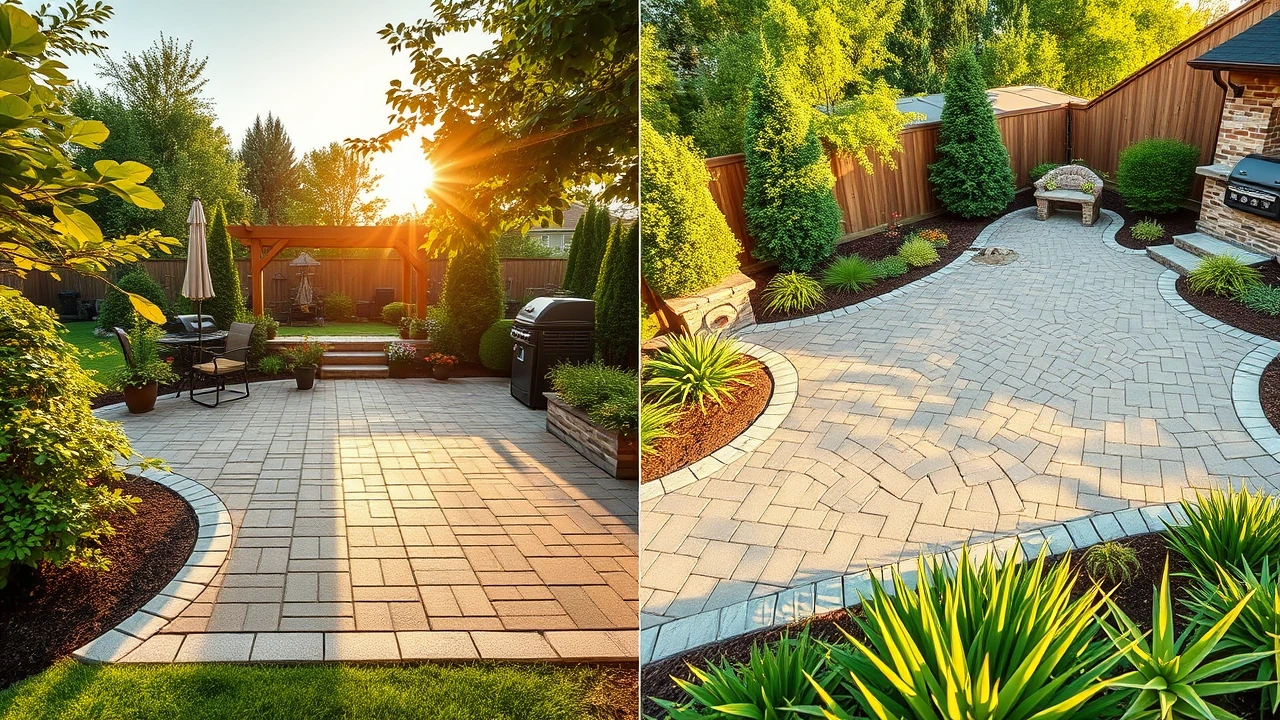
Both options land in a similar price band. Both can look great. But in Ontario's freeze-thaw climate, they age very differently. Here is the honest comparison.
The headline comparison
| Factor | Stamped Concrete | Interlocking Pavers |
|---|---|---|
| Installed cost per sqft | $22-$34 | $22-$40 |
| Typical 300 sqft patio | $6,600-$10,200 | $6,600-$12,000 |
| Expected lifespan in Ontario freeze-thaw | 20-30 years | 30-40 years |
| Freeze-thaw performance | Cracks at expansion joints by year 5-8 | Designed to flex; no cracking |
| Repairability | Crack repair is visible patch | Individual pavers can be lifted and replaced |
| Look | Continuous surface; can mimic flagstone/brick | Joints visible; many patterns available |
| Resale value impact (Ontario data) | Modest positive | Stronger positive (perceived as premium) |
Freeze-thaw: why this matters in Ontario
Ontario gets 60+ freeze-thaw cycles per winter. Water gets into any micro-cracks in concrete, freezes, expands and widens them. After five to eight winters, even properly installed stamped concrete shows hairline cracking, especially at the expansion joints. Pavers do not have this problem because the entire surface is jointed; water freezes in the polymeric sand jointing but the individual stones flex with the movement and never crack.
This is the single biggest reason we recommend pavers over stamped concrete in our market. In a milder climate (the Vancouver coast, the US southeast) the trade-off is different. In Hamilton, it really is not.
When stamped concrete actually wins
Three cases. Aesthetic priority: if you really want a continuous, jointless surface (a slate or flagstone look without visible joints), stamped concrete delivers that and pavers cannot. Existing surface: if you are pouring concrete anyway (around a pool, for a driveway extension), stamping it is a low-cost upgrade that adds visual interest. Very low-stress installs: a small front walk that gets foot traffic but no heavy load might do fine with stamped concrete for twenty years.
When pavers clearly win
Driveways. Large patios where any crack will look terrible. Lots with grade changes. Any project where you might want to extend or modify the surface later (lifting and re-laying individual pavers is easy; cutting into stamped concrete is messy). Sites with mature trees where root movement is a possibility.
Repair reality check
When stamped concrete cracks, you have three options: ignore it (the crack widens), repair it with a colour-matched concrete patch (visible), or saw-cut the affected section and re-pour (expensive). When a paver sinks or one paver gets damaged, we lift it out, fix the base under it and re-set it in an hour. That difference is the single biggest argument for pavers in our climate.
What about cost?
People assume stamped concrete is the cheaper option. Today, that is no longer true. Stamped concrete in Ontario in 2026 runs $22 to $34 per square foot installed at a standard finish, and interlocking pavers run $22 to $40. The two overlap across most of the range. Premium pavers cost more than stamped concrete, and basic pavers cost about the same. Stamped concrete also needs resealing every 2 to 3 years, which narrows the gap over time. There is no longer a clear price winner.
Frequently asked questions
Which lasts longer in Ontario, stamped concrete or pavers?
Pavers. Properly installed interlocking pavers last 30 to 40 years in Ontario freeze-thaw, against 20 to 30 years for well-built stamped concrete. Stamped concrete often shows hairline cracking within the first several winters, and unlike pavers it cannot be repaired invisibly.
Is stamped concrete cheaper than pavers?
Only slightly. Stamped concrete in Ontario in 2026 runs $22 to $34 per square foot installed and interlocking pavers $22 to $40. Premium pavers cost more, while basic pavers cost about the same as stamped concrete.
Can stamped concrete be repaired if it cracks?
Cracks can be patched with a colour-matched concrete material, but the repair is always visible. Larger damaged sections need saw-cutting and re-pouring, which rarely matches the original pattern perfectly.
Do pavers shift over time?
Properly installed pavers (200 mm compacted base, polymeric sand jointing, proper edge restraint) stay locked for decades. The pavers that shift were almost always installed on insufficient base or without edge restraints.
Which is better for a driveway?
Pavers, almost always. Driveways take repeated vehicle loads and freeze-thaw stress that stamped concrete cracks under within 10 years. Paver driveways routinely last 30 years or more in Ontario.
Sources and further reading
- Interlocking Concrete Pavement Institute (ICPI) for paver industry standards, base-prep specifications and installer certification.
- Landscape Ontario for Ontario industry standards, member directories and consumer resources.
- Belgard, Techo-Bloc, Unilock and Permacon for paver product specifications and warranty information.
- Peace Love Landscaping installer experience across hundreds of projects in Hamilton-Wentworth, Halton and Niagara, 2008-2026.
Need the numbers? See 2026 stamped concrete pricing per square foot by finish level, plus the long-run resealing cost that changes the comparison.