
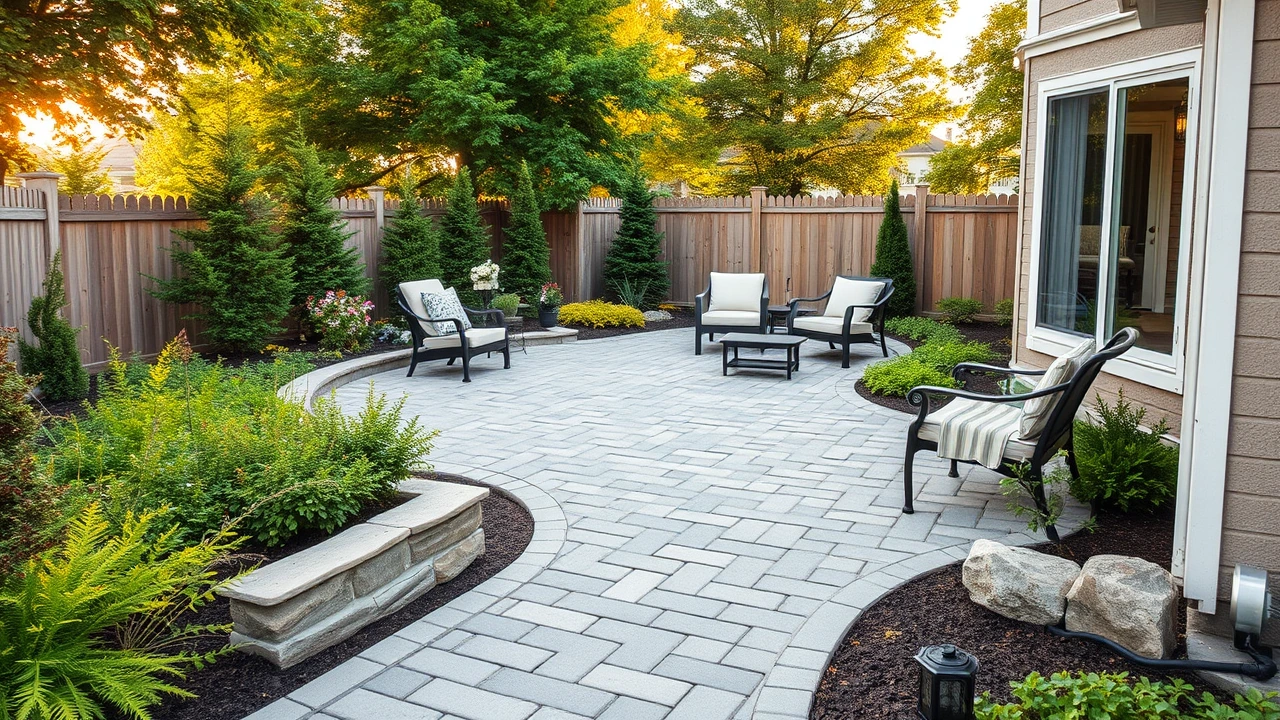
"Paver patio" is the single most-quoted project in our market. Here is what actually drives the price, how to read a quote, and where the corners get cut on cheap installs.
What goes into a paver patio
Five layers. From the bottom up: compacted subgrade (the native soil, levelled and compacted), geotextile (separation fabric so the base does not migrate into the soil), compacted granular base (typically 150 to 200 mm of Granular A on residential patios), bedding sand (20 to 25 mm of clean concrete sand for paver seating), and the pavers themselves, with polymeric sand swept into the joints to lock them. Edge restraints hold the perimeter.
Price breakdown by paver grade
| Project type | Per sqft installed (CAD) | Per m² installed (CAD) | What drives the price |
|---|---|---|---|
| Economy grey/charcoal paver, level lot, good access | $22 - $28 | $235 - $300 | Bread-and-butter installs |
| Mid-grade paver with surface texture or colour blend | $28 - $34 | $300 - $365 | Most popular price point |
| Premium tumbled or textured paver, intricate pattern | $34 - $40 | $365 - $430 | Higher-end residential, design-led |
| Permeable paver | $28 - $48 | $300 - $515 | Deeper open-graded base and larger void aggregate |
Those figures cover excavation, geotextile, compacted base, bedding sand, pavers, polymeric sand, edge restraint and disposal on a straightforward site. Most companies also carry a minimum job size, so a small landing or walkway will not be priced purely per square foot.
What pushes a paver patio above the range
Access issues: A lot with no rear access means hand-barrowing or a small skid-steer. Add 10 to 20%. Grade changes: A sloped lot needs a small retaining wall or step. That is a separate line item, not part of the patio rate. Excavation depth: Clay soil or settled fill requires more excavation than fruit-belt loam. Demolition: Removing an existing concrete pad or interlocking patio adds $4 to $8 per square foot ($43 to $86 per square metre) for demolition and haul. Design complexity: A circular or curved patio needs more cuts and more waste than a rectangular one.
Where cheap installs cut corners (and what it costs you later)
The five places we see corners cut, in rough order of severity:
1. Base depth. 100 mm of base instead of 200 mm. Saves a couple hundred dollars on the install, costs you a sunken patio in three to five years. The single most common shortcut.
2. Skipping geotextile. A $200 line item that prevents base migration into the soil. Skipping it costs you a patio that develops low spots in five to seven years.
3. Sand instead of polymeric sand at joints. Regular sand washes out in the first heavy rain. Polymeric sand sets like mortar between the joints and stays for years. A no-brainer, but cheap quotes still skip it.
4. No edge restraint. Without proper edging the perimeter pavers shift outward year after year. Spiked aluminum or plastic edging is cheap; skipping it is permanent.
5. Cheap paver brand. Branded Belgard, Techo-Bloc, Unilock and Permacon pavers have warranties (typically 25 years on residential pavers). Generic pavers sometimes do not, and quality varies wildly.
Worked example: a 300 sqft Hamilton backyard patio
To make the numbers concrete, here is how a typical Hamilton job breaks down in 2026: a 300 sqft (about 28 m²) patio, mid-grade Belgard paver in a grey-and-cream blend, level lot with reasonable rear access.
- Excavation and base prep (200 mm Granular A, compacted, with geotextile): $2,700
- Materials (pavers, bedding sand, polymeric sand, edge restraint): $2,600
- Installation labour: $3,300
- Site cleanup and disposal of excavated material: $600
- Total: $9,200 (about $31 per sqft or $330 per m², in the mid-range for this paver class)
Frequently asked questions
How much does a 20x20 paver patio cost in Ontario?
A 20x20 foot (400 sqft, roughly 37 m²) paver patio in Ontario in 2026 typically runs $8,800 to $16,000 properly installed, with mid-grade pavers usually landing around $11,200 to $13,600. The exact number depends on paver selection, base prep depth and site access.
Are interlocking pavers worth the money over concrete?
For most homeowners, yes. Pavers cost a little more than stamped concrete upfront, $22 to $40 per square foot against $22 to $34, but last longer in Ontario freeze-thaw (30 to 40 years against 20 to 30) and can be individually lifted and re-laid if anything sinks. See our stamped concrete vs paver comparison.
How long does a paver patio installation take?
Most 25 to 40 m² patios take three to six working days from excavation to finished patio, depending on access and weather. Larger or more complex builds with walls or steps run seven to ten days.
Do I need a permit for a paver patio?
In most Ontario municipalities, a ground-level residential patio under a certain size (varies by city) does not need a permit. Patios that affect drainage to public lands, work over a property line, or projects with retaining walls above a threshold height do. We check the local rules before quoting.
Will my paver patio sink over time?
A properly built one (200 mm base, compacted, edge-restrained, polymeric sand) should stay tight for 30 to 40 years on a typical Ontario residential lot. The patios that sink were almost always built on insufficient base. See our guide on fixing a sinking patio.
Get a free patio quote
- Interlocking patios & driveways (our service page)
- Hamilton-Wentworth landscaping
- Stamped concrete vs interlocking pavers
Sources and further reading
- Interlocking Concrete Pavement Institute (ICPI) for paver industry standards, base-prep specifications and installer certification.
- Landscape Ontario for Ontario industry standards, member directories and consumer resources.
- Belgard, Techo-Bloc, Unilock and Permacon for paver product specifications and warranty information.
- Peace Love Landscaping installer experience across hundreds of projects in Hamilton-Wentworth, Halton and Niagara, 2008-2026.
Comparing materials? See our head-to-head breakdown: Interlock vs concrete vs natural stone patios with 2026 cost, lifespan and maintenance side by side.
Already have a sinking or settling patio? Read our diagnostic walk-through: match symptoms to root causes with DIY-fix steps and realistic pro-repair cost ranges.
Building a walkway not a patio? See our flagstone vs pavers vs concrete walkway comparison.
Considering an interlock driveway? See our head-to-head asphalt vs interlock vs concrete driveways.
Renovating an existing patio instead? See our patio renovation cost guide to price repair against replacement.
Weighing natural stone? See 2026 flagstone patio pricing by construction method and stone type.
Not sure how big to build? See patio ideas and a sizing table before you price it.
Looking for a cheaper option? See patio stones and slabs, sizes and costs against interlocking pavers.