
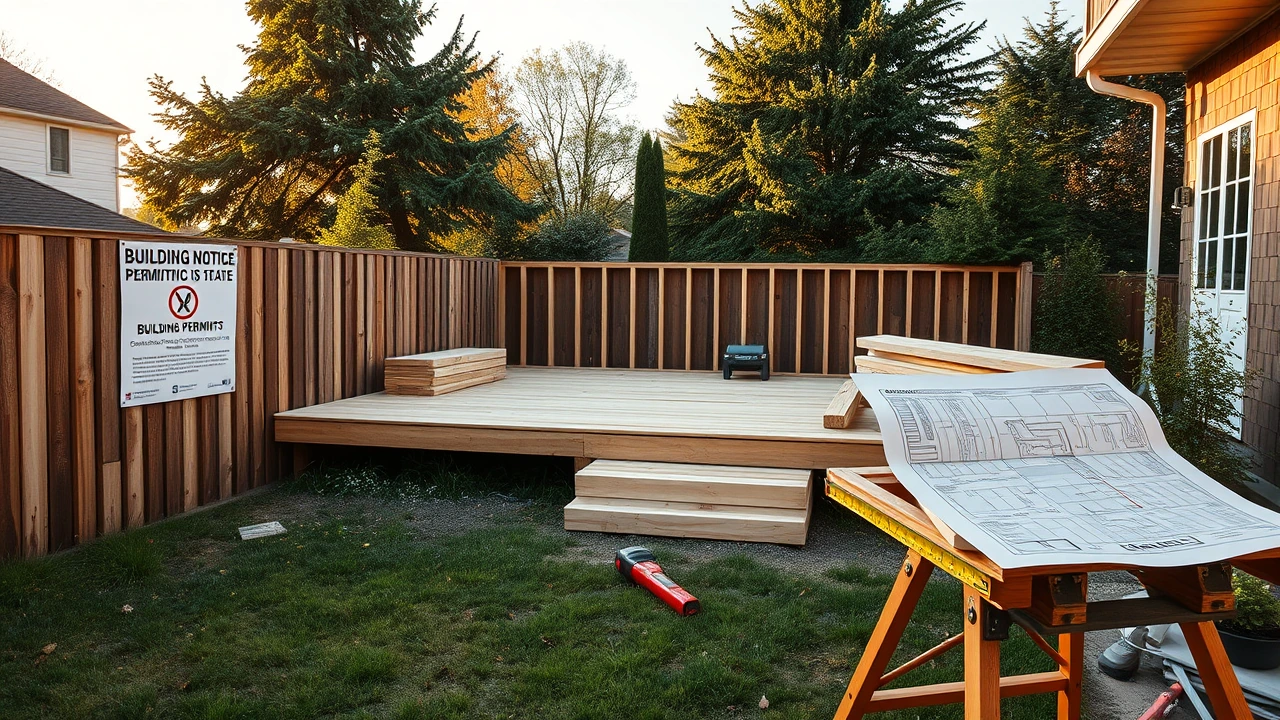
Most homeowners assume permits only apply to additions and renovations, then discover at the worst possible moment that their new pool, deck, or three-foot retaining wall needed one too. In Hamilton, Burlington and Oakville, the thresholds are consistent with the Ontario Building Code but each city layers on its own zoning by-laws, fence rules, tree protections, and site alteration permits. This guide walks through what triggers a permit in each city as of 2026, what it costs, how long approval takes, and which projects you can build without paperwork.
Need help navigating Hamilton, Burlington or Oakville permits on your specific project? Our team handles the permit path, lot-grading review and inspection coordination as part of every build. No paperwork on you.
Request a free quote or call after a site visit.
Want a real budget number for your specific project? Use our 2026 Ontario calculators (Hamilton, Halton, Niagara data baked in):
- Landscaping cost guide (Ontario)
- Backyard renovation cost calculator
- Retaining wall cost calculator (Canada)
- Deck cost calculator
- Fence cost calculator
Or request a free quote for a line-item estimate on your property.
Quick verdict
As of 2026, all three cities require a building permit for decks over 108 square feet or more than 24 inches above grade, for any pool that can hold over 600mm of water, for retaining walls over one metre tall, and for fences taller than the residential maximum, usually 2 metres in rear yards. Pool enclosure permits are separate and mandatory before water goes in. Always confirm with your city, by-laws and fees change yearly. Plan for 2 to 6 weeks for permit review, longer if zoning variances are involved.
What needs a permit in Hamilton, Burlington and Oakville
| Project | Hamilton | Burlington | Oakville | Typical cost | Timeline |
|---|---|---|---|---|---|
| Deck over 108 sq ft or 24" high | Yes | Yes | Yes | $200 to $600 | 2 to 4 weeks |
| Pool (any in-ground or large above) | Enclosure permit | Enclosure permit | Enclosure permit | $300 to $800 | 3 to 6 weeks |
| Fence over 2 m (residential) | Yes, variance | Yes, variance | Yes, variance | $200 to $500 | 4 to 8 weeks |
| Pool fence (1.5 m Hamilton, 1.2 m Oakville) | Bundled with pool | Bundled with pool | Bundled with pool | Included | With pool |
| Retaining wall over 1 m | Yes | Yes | Yes | $250 to $700 | 2 to 5 weeks |
| Driveway widening / curb cut | Yes | Yes | Yes | $150 to $500 | 3 to 6 weeks |
| Site alteration / regrading | If >30 cm | If >30 cm | If >30 cm | $200 to $1,000 | 4 to 8 weeks |
| Tree removal (private) | By-law applies | Private tree by-law | Private tree by-law | $100 to $400 | 2 to 6 weeks |
Fences
The 2 metre rule
In Hamilton, Burlington and Oakville, residential fences in rear and side yards can typically be built up to 2 metres (about 6 feet 7 inches) without a permit, provided they comply with the local fence by-law on materials, sightlines, and corner-lot visibility. Front yards are capped lower, usually around 1 metre. Anything taller requires a minor variance through the Committee of Adjustment, which adds weeks and a public notice step.
Pool fences are different
If you have a pool, the enclosure must meet the pool enclosure by-law: at least 1.5 metres tall in Hamilton (By-law 16-184) and at least 1.2 metres in Oakville (By-law 2006-071), continuous around the water, with self-closing, self-latching gates. Burlington has its own Pool Fence By-law 074-2005, so confirm its dimensions with the city. This is a safety code requirement separate from the general fence by-law and is inspected before the pool is filled. Existing 6-foot fences usually qualify but gate hardware almost never does and is the most common failure point on inspection day. As of 2026, confirm exact dimensions with your municipality, by-laws are reviewed annually.
Decks and platforms
The 108 square foot and 24 inch thresholds
Under the Ontario Building Code as adopted by all three cities, a deck attached to a house, or any platform more than 24 inches (roughly 600 mm) above adjacent grade, requires a building permit. A second commonly cited threshold is 108 square feet (10 square metres) of platform area. In practice, almost any usable deck triggers one or both. Floating decks under both thresholds, with no attachment to the house, can often be built permit-free but still need to respect setback and lot coverage rules.
What the permit reviews
The plan examiner checks footing depth (1.2 m minimum to avoid frost heave in our region), beam and joist sizing, guard height (1.07 m for decks over 5.9 feet above grade), stair rise and run, and zoning setbacks from property lines. Submit a site plan, framing plan, and elevation. Many homeowners hire a designer to prepare drawings, which typically runs $400 to $900. Confirm current 2026 fees and thresholds with your city before applying.
Pools
Pool enclosure permits
All three cities require a pool enclosure permit for any pool that can hold more than 600 mm of water. This includes inground pools, most above-ground pools, and large hot tubs without locking lids. The permit covers fencing, gates, and any building openings that face the pool. You cannot fill the pool until the enclosure passes inspection. Working without a permit can void your home insurance entirely, an expensive surprise for owners who learn this after a claim.
Timeline reality
Pool projects from quote to swim usually run 8 to 16 weeks because the enclosure permit (3 to 6 weeks), building permits for any cabana or pool house, electrical permits, and grading approvals stack sequentially. Most owners book pools in winter for late-summer completion. As of 2026 in Hamilton, Burlington and Oakville, always confirm enclosure dimensions and submission requirements with the city, fees and forms change.
Retaining walls
The 1 metre threshold
Any retaining wall over 1 metre (about 3 feet 4 inches) in exposed height requires a building permit in all three cities. The reason is engineering: walls above this threshold carry significant lateral load, and failure can damage neighbouring property or injure people. Permit applications above 1 metre typically need stamped engineering drawings showing soil conditions, drainage, geogrid placement if needed, and footing design.
Terraced walls and the workaround that is not a workaround
Some homeowners try to avoid the permit by terracing a tall slope into two sub-1 metre walls. This only works if the walls are genuinely independent, separated horizontally by enough distance that the upper wall does not load the lower. Cities know the trick and inspect carefully. A failed retaining wall is one of the most expensive landscape problems to fix, often $20,000 plus. The permit is worth it.
Driveways, curb cuts and site alteration
Widening and new curb cuts
Widening an existing driveway, adding a second driveway, or cutting a new curb requires city approval in all three municipalities. Hamilton, Burlington and Oakville all regulate maximum driveway width based on lot frontage, and curb cuts are work on the city road allowance, which requires a road occupancy or right-of-way permit. Typical processing is 3 to 6 weeks.
Site alteration and grading
If your project moves more than about 30 cm of grade over a meaningful area, or alters drainage patterns toward a neighbour, you likely need a site alteration permit. This catches a lot of larger backyard transformations: lifting a low corner, building up a sunken patio area, or excavating for a sport court. Halton Region has stricter rules where conservation authority lands or natural heritage features are involved.
Tree by-laws
Private tree protection
Burlington and Oakville both have private tree by-laws that protect mature trees on private property, typically those with a diameter at breast height (DBH) over 20 cm. Removal without a permit can trigger fines in the thousands per tree. Hamilton's private tree protection is more limited but still applies in many wards. Always survey trees before you finalize a design, an oak in the wrong spot can change your patio layout entirely.
How to apply this on your project
Build the permit timeline into your project schedule from day one so paperwork never becomes the bottleneck.
- Identify every permit-triggering element at the design stage, not after.
- Add 4 to 6 weeks to your schedule for permit review, longer if variances are needed.
- Hire a designer or contractor who handles the application, do not DIY unless you understand zoning.
- Apply in winter for spring builds, permit offices are slowest April through June.
- Keep the permit and inspection records, they transfer to future buyers and protect resale value.
Common mistakes we see on quote reviews
- Starting work and trying to "fix it later" with a retroactive permit, which the city may refuse.
- Assuming "small deck" means no permit, when 24 inches above grade is the actual trigger.
- Buying an above-ground pool at a big-box store and skipping the enclosure permit.
- Building a 1.1 metre retaining wall to avoid the threshold, then failing inspection on the measured height.
- Cutting a mature oak before checking the tree by-law, then facing a $5,000 fine.
- Hiring a contractor who says "we don't bother with permits in this neighbourhood."
- Forgetting that pool enclosures must be inspected and signed off before water goes in.
Frequently asked questions
Does a floating ground-level deck need a permit?
Usually no, if it is under 108 square feet, under 24 inches above grade, and not attached to the house. It still must respect setback and lot coverage rules.
How long does a deck permit take in Burlington?
Typically 2 to 4 weeks for a straightforward residential deck submission. Complex designs or zoning issues can extend this. Confirm current 2026 timing with the city.
Do I need a permit for interlock or a flagstone patio?
No, hardscape at grade does not require a building permit. It can still trigger site alteration rules if you change drainage significantly.
What happens if I build without a permit?
Work orders, fines, forced removal, and major problems at resale when the city or buyer's lawyer pulls records. Insurance can also deny related claims.
Can my contractor pull the permit?
Yes, and a good one will. Confirm it is in your name as the property owner, you are ultimately responsible.
Are pool fence rules the same in all three cities?
No. Self-closing, self-latching gates are required everywhere, but heights differ: Hamilton requires at least 1.5 metres and Oakville at least 1.2 metres. Gap rules differ too, and Oakville generally limits openings to 38 mm. Always confirm with your city.
Do I need a permit to remove a tree in my backyard?
In Burlington and Oakville, often yes for any tree over 20 cm DBH on private property. Hamilton rules vary by area. Check before you cut.
How much do permits add to a project?
Permit fees themselves are small, $200 to $1,000. The bigger cost is design drawings, $400 to $1,500, and the time, 2 to 8 weeks.
2026 permit fees and processing times by city
Fees change with the annual by-law budgets each January. Numbers below reflect published rate cards as of Q3 2026. Always verify on the City's own portal before applying.
| Project type | Hamilton | Burlington | Oakville |
|---|---|---|---|
| Deck over 24 in (0.6 m) above grade | $260 base + $2.20 per sq m | $240 base + $2.10 per sq m | $280 base + $2.30 per sq m |
| Above-ground pool (over 24 in deep) enclosure | $220 pool enclosure permit | $210 pool enclosure permit | $260 pool enclosure permit |
| In-ground pool + enclosure | $540 to $780 combined | $520 to $760 combined | $620 to $880 combined |
| Retaining wall over 1.0 m exposed height | $220 + engineered drawings | $210 + engineered drawings | $240 + engineered drawings |
| Detached shed 15 to 55 sq m | $240 to $420 | $220 to $400 | $260 to $440 |
| Private tree removal permit (protected trees) | $340 to $580 per tree | $180 to $360 per tree | $200 to $420 per tree |
| Zoning compliance certificate | $120 | $110 | $140 |
| Standard processing time | 10 to 15 business days | 10 to 20 business days | 15 to 25 business days |
The city-by-city bylaw references you will actually need
- Hamilton Zoning By-law 05-200 (as amended through 2026) - governs setbacks, coverage, height, fence limits.
- Hamilton Private Tree By-law 24-118 (2024) - protects trees over 12.7 cm DBH on private residential lots.
- Hamilton Property Standards By-law 10-221 - governs maintenance obligations that come up after project completion.
- Burlington Zoning By-law 2020-136 - the current comprehensive zoning code.
- Burlington Private Tree By-law 68-2013 - protects trees 20 cm DBH plus in specific overlays.
- Burlington Fence By-law 76-2010 - 2.44 m rear-yard max, sight-triangle 0.9 m.
- Oakville Zoning By-law 2014-014 - current comprehensive zoning.
- Oakville Private Tree Protection By-law 2017-018 - protects trees 15 cm DBH plus on all private property.
- Oakville Site Alteration By-law 2003-071 - triggers when you move more than 60 cubic metres of fill.
Step-by-step: pulling a deck permit in Hamilton
- Draw your site plan. Show property lines (from your legal survey), house footprint, existing driveways and easements, and the proposed deck outline with distances to all property lines. Setback in most residential zones: 1.2 m from side lot, 7.5 m from rear (varies by zone).
- Draw the deck plan and elevation. Framing plan showing beam sizes, joist spacing, post locations, footing depth (minimum 1.2 m below grade for frost protection in Hamilton), guard height (36 in for decks under 6 ft high, 42 in above), and stair details.
- Pay the fee. $260 base plus $2.20 per sq m of deck area. Paid through the Hamilton eBuild portal.
- Submit for zoning review first. A Zoning Compliance Certificate ($120) confirms the plan meets setback and coverage before the full building permit review starts. This step catches 60% of rejections early.
- Wait 10 to 15 business days for building permit review. Common revisions: undersized beams for span, footing depth called out but not detailed, missing guard height on stairs.
- Post the permit onsite before starting. Legally required. Inspectors will check.
- Schedule the framing inspection before you deck-board over the joists. Hamilton inspectors book 3 to 5 days out. Do not board over until pass.
- Schedule the final inspection once the guards, stairs and skirting are done. Once passed, the permit closes and the file is your record for insurance and future resale.
Common rejection reasons we see on GTA permit reviews
- Missing legal survey. An online property-line estimate from Geowarehouse is not a survey. Legal survey costs $600 to $1,200 in the GTA and is required for most setback-sensitive projects.
- Footing depth called out but not detailed. "4 ft footings" is not a spec. Show diameter (typically 200 to 300 mm), depth to bottom of footing (minimum 1.2 m in Hamilton frost line), and reinforcement if any.
- Grade elevations missing. For any project near a property line, show existing grade at 5 m intervals and any proposed grade change.
- Beam span oversized for lumber grade. Standard SPF #2 has different span tables than PT SYP. Show the species and grade.
- Retaining wall over 1.0 m without engineered drawings. Non-negotiable. Structural engineer stamp required. Expect $1,200 to $2,800 for stamped drawings.
- Pool enclosure gate hardware not detailed. Self-closing, self-latching, a lock, the latch height the by-law requires, and a gate as tall as the enclosure. Missing this spec is the number one pool permit rejection.
Real-world timelines: what our clients experience
- Small deck (under 20 sq m) in Hamilton: permit submitted to approved in 12 to 16 business days on average. Add 3 to 6 weeks lead time to book our crew after approval.
- Retaining wall over 1 m in Burlington: engineered drawings 2 to 3 weeks, then permit 15 to 25 business days, then 4 to 8 week build lead time. Total: 8 to 14 weeks from first call to shovel.
- In-ground pool in Oakville: zoning review 2 weeks, then combined pool + enclosure permit 20 to 30 business days, then 6 to 10 week install lead time in summer. Total: 12 to 18 weeks.
- Tree removal permit under Hamilton By-law 24-118: 2 to 4 weeks with an arborist report. Add compensating planting requirement (usually 1 to 2 replacement trees per removed protected tree).
Permits feel like friction but they protect your investment, your insurance, and your resale. If you are planning a fence, deck, or pool this season, read our fence cost guide, deck cost guide, and pool cost guide for 2026 pricing. We work across Hamilton, Burlington, and Oakville, handle permit applications for our clients, and never start work without paperwork in hand. Request a free quote and we will map the permit path for your specific project.
Drawing deck stairs for a permit? See the Ontario Building Code stair rules for rise, run, handrails and guards.