
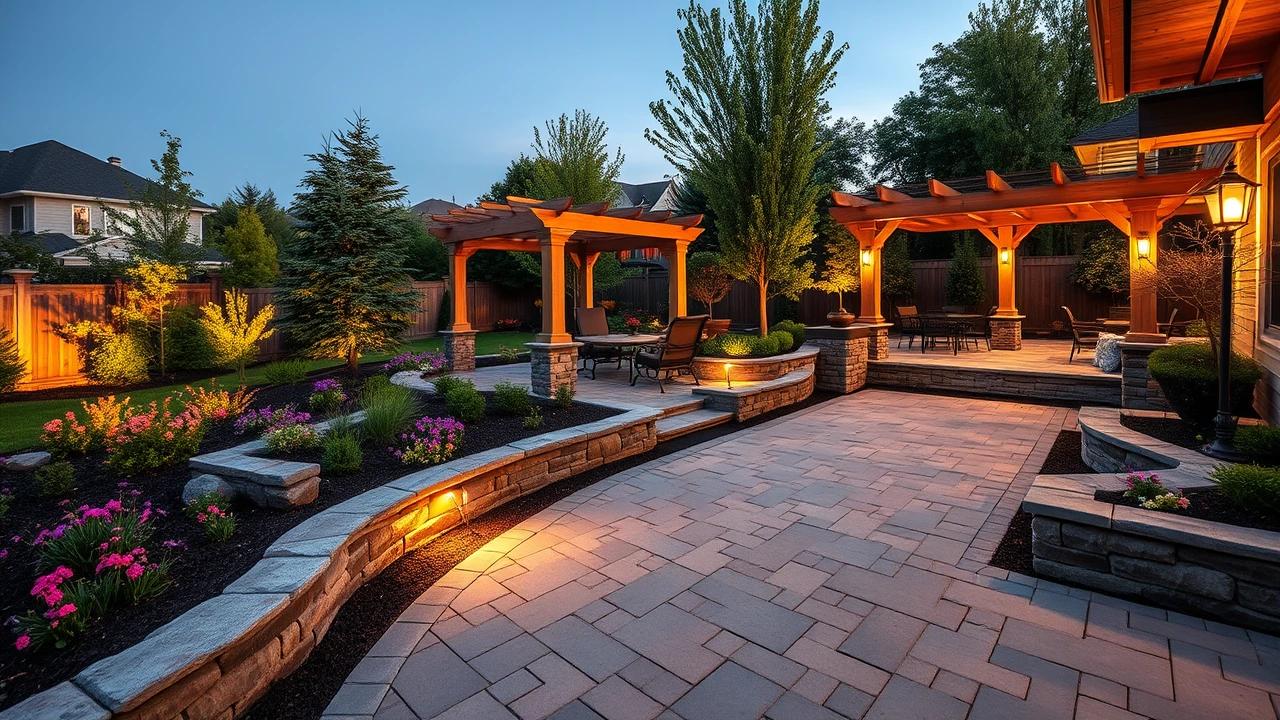
Milton is one of the trickiest design towns in the GTA west, and most homeowners do not realise it until they have lived through their first full season in a new Mattamy or Heathwood backyard. The lots are deep, narrow, fenced on three sides, and almost always delivered with a thin layer of bare clay and a roll of construction sod thrown on top. The newer pockets around Beaty, Willmott, Hawthorne Village, Bristol Survey, Coates, Scott, Bowes, Cobban and Ford repeat the same pattern: builder-grade grass, no trees, a single utility tap and a 1.5 m grade change from the patio door to the rear fence. Old Milton south of Main Street is the opposite problem: mature trees, heritage frontages, narrow side yards under 900 mm, and gardens that have drifted through three owners of half-finished ideas. A real landscape design fixes both. It maps the lot, decodes how you actually use the outdoors, and gives you a phased plan that grows in over 3 to 5 seasons instead of an Instagram render that collapses by year two.
Quick verdict for Milton homeowners
For a real landscape design in Milton in 2026, expect to budget $1,500 to $3,500 for a 2D conceptual plan on a typical Mattamy or Heathwood backyard, $3,500 to $7,500 for a full 3D rendered master plan with planting schedule and lighting layout, and $7,500 to $15,000+ for a fully detailed CAD set on an estate or ravine-edge lot in Cobban or Ford. Design fees are almost always credited back, fully or partially, against a build contract with the same firm. A design takes 3 to 6 weeks from site visit to issued plan. Skip the design and you will spend two seasons rebuilding what you already paid to install. Always get a written scope showing site survey, concept revisions, planting schedule and irrigation and lighting layout before signing.
2026 Milton landscape design cost
Prices below are 2026 design fees only for Milton residential lots. They cover site visit, base survey, concept development, agreed revisions, final planting schedule and a coordinated set of drawings. Build costs are separate and quoted from the issued plan. Design fees are usually credited 50 to 100 percent against a Peace Love Landscaping build contract.
| Scope tier | Deliverable | Design fee | Best fit | Timeline |
|---|---|---|---|---|
| Refresh | 2D conceptual sketch, planting refresh list, single revision | $1,500 to $3,500 | Beaty or Willmott rear-yard planting refresh, Old Milton front bed redesign | 3 to 4 weeks |
| Mid-yard plan | 2D master plan with hardscape footprint, planting schedule, two revisions | $3,500 to $5,500 | Most Hawthorne Village and Bristol Survey backyards, Coates new-build phasing | 4 to 5 weeks |
| Full-yard plan | 2D plus 3D rendering, lighting layout, irrigation zoning, three revisions | $5,500 to $7,500 | Scott and Bowes entertaining yards, Cobban builder-finished lots | 5 to 6 weeks |
| Estate | Full CAD master plan, 3D walkthrough, phased construction set, structural details | $7,500 to $15,000+ | Ford ravine lots, Old Milton heritage rebuilds, Niagara Escarpment Plan parcels near Kelso | 6 to 10 weeks |
To sanity check the numbers against the build side, read the full landscape design cost guide for Ontario and the backyard layout planning guide for how the design feeds into the build.
Common Milton landscape design projects we draw
Phased new-build backyards in Beaty, Willmott and Hawthorne Village
Most of Beaty, Willmott and Hawthorne Village are Mattamy and Heathwood builds from the last 15 years, handed over with a strip of construction sod over compacted clay and zero structure. The mistake homeowners make is trying to build the entire yard in one season on a $40,000 budget that the yard actually needs $90,000 to finish. We design these as phased master plans: Phase 1 is the rear patio, primary lawn area and the spine of the planting beds with the bones (eastern redbud, serviceberry, a couple of structural evergreens), Phase 2 the side-yard paths, fence-line privacy planting and lighting, Phase 3 the fire feature, secondary patio or pergola. Each phase stands on its own visually so the yard never looks half-built, and the design holds the long view together across 3 to 5 seasons. Soil is amended at every phase because builder clay in Milton needs 4 to 6 inches of triple mix worked in before anything roots properly.
Heritage front-yard redesigns in Old Milton
Old Milton south of Main Street and east of Bronte has narrow lots with century homes, mature silver maples or honey locusts, and front gardens that have been pieced together by three owners. The design challenge is editing rather than adding. We survey what stays (the mature trees, the brick steps, the cast iron railings) and what goes (the overgrown junipers, the failing peonies, the dwarf Alberta spruce that has outgrown its spot), then rebuild the bed lines around the heritage architecture. Planting palettes lean on serviceberry, eastern redbud, oakleaf hydrangea, native switchgrass and little bluestem, and we use a 2D plan plus elevation sketches rather than a full 3D, because the heritage context reads better as drawings than as a render. Front-yard work in Old Milton has to respect Town of Milton boulevard rules and any heritage permit requirements.
Estate and ravine-edge designs in Cobban, Ford and near Kelso
The newer pockets of Cobban and Ford, plus the older estate lots running west toward Kelso and the Niagara Escarpment, get the full design treatment: a CAD master plan, 3D rendering and a phased construction set. Lot sizes here run half an acre and up, with grade changes of 2 m to 4 m, view corridors out to the escarpment, and Niagara Escarpment Plan area considerations on anything within the regulated boundary. We design these as multi-zone yards: an entertaining terrace at door level, a transitional lawn or meadow, a destination zone (fire pit, plunge pool, viewing deck) at the rear, and natural-edge planting tying it all into the escarpment context. Native species do the heavy lifting: eastern redbud and serviceberry for spring structure, switchgrass and little bluestem for summer and fall texture, oak and bur oak for the long-horizon canopy. If your lot sits inside the Niagara Escarpment Plan boundary, the design package has to be permit-ready before any structural work mobilises.
Mid-yard plans for Bristol Survey, Coates, Scott and Bowes
The mid-decade Mattamy and Heathwood pockets through Bristol Survey, Coates, Scott and Bowes are the sweet spot for a full 2D plus 3D rendered master plan. Lots are typically 35 to 45 ft wide and 100 to 110 ft deep, with the back door 1 m to 1.5 m above grade, an east or west exposure, and one or two existing trees the builder left in place. We design these with a 300 to 500 sq ft rear patio, a structured lawn panel for kids or dogs, a perimeter planting band 1.2 m deep with three-season interest, low-voltage lighting on the path and the key plant masses, and a phased planting schedule so the homeowner can plant 30 percent in year one and the rest as the budget allows. The 3D rendering matters more here than on a heritage lot because the homeowner cannot visualise a finished yard from a 2D sketch when the existing yard is blank sod. For homeowners still choosing perennial palettes, our best perennials for Ontario gardens guide is the right starting point.
Why DIY plans fail in Milton (and what we do differently)
The four failure modes we see again and again on Milton DIY landscape plans repeat every season. First, no base survey: homeowners measure off the deck and the fence by eye, miss the 600 to 900 mm grade change from door to rear yard, and end up with a patio that ponds against the foundation or a planting bed that sits two steps below the lawn. Second, wrong plant palette for Zone 6b and 7a Milton: imported nursery photos of plants that need Zone 7b or warmer, or thirsty perennials picked for an Instagram look that cannot survive a Milton clay summer without daily watering.
Third, no phasing strategy: a single-season build on a new Mattamy backyard that uses the entire budget on the patio and leaves zero money for planting, lighting or irrigation, then a five-year fight to retrofit those systems through finished hardscape. Fourth, no soil work: builder-grade clay in Beaty or Hawthorne Village is 6 to 8 inches of compacted fill over native clay, and nothing roots into it without amendment. We do it differently on every Milton plan: a real site survey with laser level, a planting palette built from native and proven Zone 6b and 7a species, a phased schedule that matches the homeowner budget across 3 to 5 seasons, and a soil amendment spec written into the build documents. The plan is a tool, not a poster.
The Milton landscape design timeline
- Free on-site visit. We walk the lot, photograph the existing yard from every corner, probe the soil, measure grades, note sun and wind, and talk through how you actually want to use the yard across the year. You leave with a realistic Milton 2026 design fee band.
- Base survey and brief. We laser-level the lot, mark key utilities and trees, and write a one-page design brief that captures the budget, the must-haves, the nice-to-haves, and the phasing window.
- Concept design. First-pass 2D concept with two or three layout options, planting palette direction, hardscape footprint and rough build cost ranges. We review on site or over a video call.
- Revisions and 3D rendering. Two to three revision rounds to land the layout, then 3D rendering on the mid-yard and full-yard tiers so you can see the finished space before any soil moves.
- Final plan and planting schedule. Issued PDF plan, planting schedule with quantities and sizes, lighting and irrigation zoning, and a phased construction set if the yard is being built over multiple seasons.
- Build handoff. The same crew that designed the plan builds it, so the spec on paper matches the spec on site. Design fee credits against the build contract per the agreed terms.
Permits and bylaws for landscape design in Milton
The Town of Milton does not require a building permit for most residential landscape design and at-grade installation work. The triggers that do require a permit or review: a structure attached to the dwelling above 600 mm (decks, pergolas tied to the house), any pool installation (which falls under the pool enclosure bylaw), retaining walls above 1 m, and any work that changes lot grading enough to require Town of Milton lot-grading re-certification. New Mattamy and Heathwood subdivisions are released with an active lot-grading certificate, and a redesign that re-routes surface water can void it.
For Milton lots inside the Niagara Escarpment Plan boundary (large stretches west of Tremaine Road toward Kelso and beyond) or on regulated Conservation Halton lands, the design has to be permit-ready and the review can add 6 to 12 weeks to the timeline. We handle the permit pathway, lot-grading review and any escarpment commission coordination as part of the design package. Our regional landscaping permits guide covers the full Halton permit landscape in detail.
Frequently asked questions
How long does a Milton landscape design take?
3 to 6 weeks from site visit to issued plan on most Milton residential lots. A refresh-tier 2D plan can land in 3 weeks, a full 3D rendered master plan typically runs 5 to 6 weeks, and an estate or ravine-edge CAD set can take 8 to 10 weeks because of the level of detail and any escarpment commission coordination.
Do I really need a 3D rendering for my Milton backyard?
On a new Mattamy or Heathwood lot with no existing structure, yes. The homeowner cannot visualise the finished space from a 2D sketch when the existing yard is blank construction sod. On a heritage Old Milton lot with mature trees and existing brick, a 2D plan plus elevation sketches usually reads better because the context is already there.
Is the design fee credited against the build cost?
Yes, partially or fully. On most Peace Love Landscaping projects, 50 to 100 percent of the design fee credits back against a build contract with our crew. The exact credit is written into the design agreement.
What native plants do you specify for Milton Zone 6b and 7a?
Eastern redbud and serviceberry for spring structure and four-season interest, switchgrass and little bluestem for summer and fall texture, oakleaf hydrangea and ninebark for shrub layers, and bur oak or swamp white oak where the lot can carry a canopy tree. These species survive Milton clay summers and freeze-thaw winters without daily watering, and they support local pollinators and birds.
Can you phase the build across multiple seasons?
Yes, and on new Mattamy or Heathwood backyards we usually recommend it. A 3-phase build (hardscape and structure in year one, primary planting and lighting in year two, secondary patios and features in year three) keeps the budget realistic and lets the planting mature in stages. The master plan holds the long view together so the yard never looks half-built.
Do you handle lighting and irrigation in the design?
Yes on the full-yard and estate tiers. Low-voltage lighting layouts cover path, accent and architectural lighting with fixture schedules and transformer sizing. Irrigation zoning maps drip and rotor zones to planting areas and lawn panels. Both are coordinated with the hardscape spec so cables and lines run in the right sequence.
What if my Milton lot is inside the Niagara Escarpment Plan area?
The design package has to be permit-ready before any structural work mobilises, and the review process can add 6 to 12 weeks. We coordinate with the Niagara Escarpment Commission and Conservation Halton on regulated parcels, and we keep the planting palette and structural elements within the policy framework so the plan clears review without redesign.
Can you design just one part of the yard, like the front?
Yes. Refresh-tier 2D plans are scoped to a single zone (front yard, rear bed line, side-yard pathway) and run $1,500 to $3,500. If the homeowner later expands to a full-yard plan, the refresh work folds into the larger scope and the fee is reconciled.
Ready to talk about your Milton landscape design? Request a free quote and we will book a site visit, usually within 2 business days. While you are scoping, the landscape design service page covers our full process, the landscape design cost guide sanity-checks the budget, the backyard layout planning guide walks through how design feeds into build, and the best perennials for Ontario gardens guide is the right starting point for the planting palette. If you are also weighing hardscape for the same yard, our Milton interlocking patios page covers the build side.