
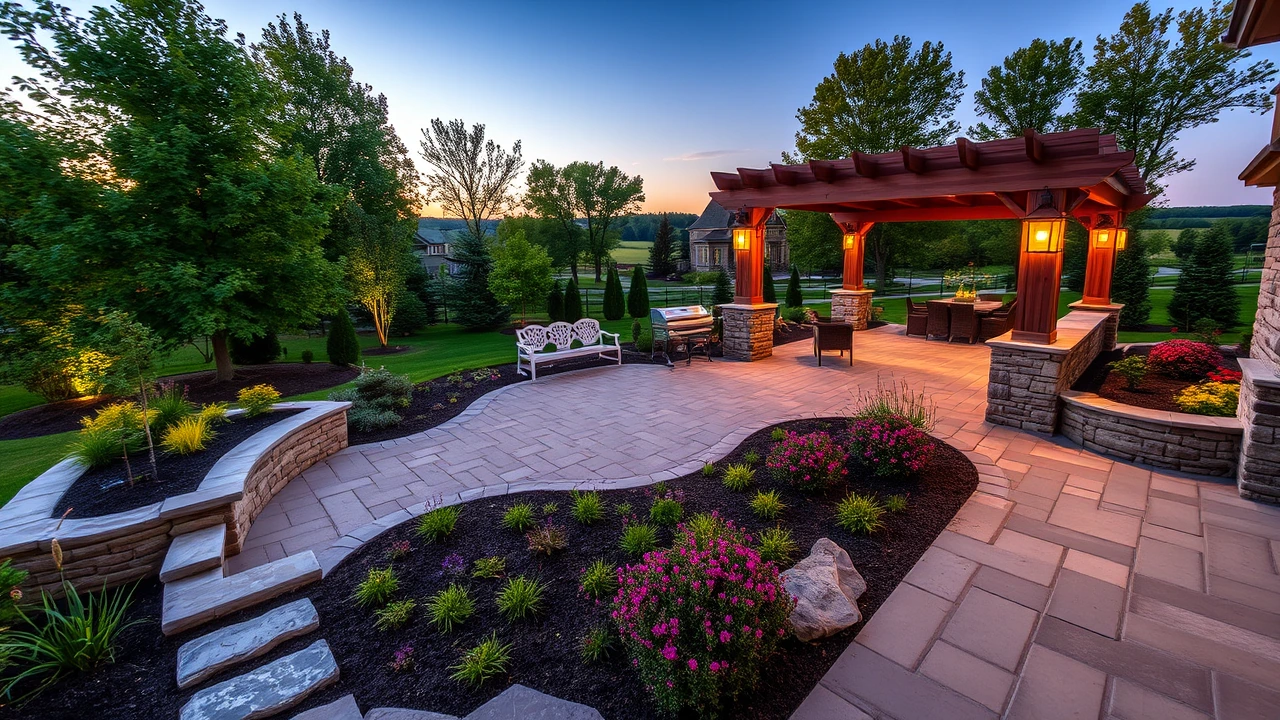
Halton Hills is one of the most design-driven landscape markets in the GTA west, and also one of the trickiest to permit. Georgetown and Acton sit on rolling glacial till that drains well but bakes hard in August. Glen Williams runs through a valley along the Credit River with mature canopy and natural-stone outcrops shaping every yard. The rural concessions north of Steeles, through Limehouse and Speyside out toward Crawford Lake, sit inside the Niagara Escarpment Plan area where any structure, grading change or significant planting can trigger a Niagara Escarpment Commission development permit. Estate lots through Ballinafad and the 10th Line carry half-acre to five-acre yards that need a real master plan and a phased build strategy, not a single weekend of work. Across all of Halton Hills, Zone 6a winters and clay-loam pockets in the lower valleys mean the design has to respect both the soil and the climate, not just the homeowner brief.
Quick verdict for Halton Hills homeowners
For a real, build-ready landscape design package in Halton Hills in 2026, expect to budget $2,000 to $4,000 for a refresh-scope concept plan, $4,000 to $10,000 for a mid-yard master plan with planting and hardscape details, $10,000 to $25,000 for a full-yard CAD master plan with 3D renderings and lighting plan, and $25,000 to $60,000 for an estate-lot package on the Halton Hills concessions or in the Niagara Escarpment Plan area where multiple consultants, NEC permits and phased build documents are required. Design timelines run 4 to 10 weeks from site visit to final drawings on most jobs, longer if NEC review is in scope. Always get a written scope showing deliverables, revision rounds and whether construction documents are included before signing.
2026 Halton Hills landscape design cost
Prices below are turnkey design fees for Halton Hills in 2026, including site survey, soil and drainage assessment, concept development, 2D plan drawings, plant lists, hardscape detailing and revision rounds. They do not include build costs, NEC application fees, or stamped engineering for retaining walls over 1 m.
| Tier | Scope and deliverables | Design fee | Timeline | Best fit |
|---|---|---|---|---|
| Refresh | 2D concept plan, planting palette, single hardscape area, 1 revision | $2,000 to $4,000 | 4 to 6 weeks | Georgetown infill yards, Acton bungalow refreshes, focused front-yard makeovers |
| Mid-yard | 2D master plan, full planting plan, hardscape details, lighting concept, 2 revisions | $4,000 to $10,000 | 6 to 8 weeks | Most Georgetown family yards, Acton mid-block lots, Glen Williams valley homes |
| Full-yard CAD | CAD master plan, 3D rendering, planting plan, hardscape details, low-voltage lighting plan, 3 revisions | $10,000 to $25,000 | 8 to 10 weeks | Premium Georgetown homes, larger Glen Williams ravine lots, build-ready packages |
| Estate | Multi-zone CAD master plan, multiple 3D renderings, phasing strategy, NEC permit support, consultant coordination | $25,000 to $60,000 | 10 to 20 weeks | Rural concession estate lots, Limehouse and Speyside NEC properties, Ballinafad acreage |
To sanity-check the design budget against the eventual build cost, read our landscape design cost guide and the backyard layout planning guide for how to brief a designer properly.
Common Halton Hills landscape design projects we deliver
Georgetown family-yard master plans
Most of Georgetown, from the older streets around Mountainview and Main through the newer subdivisions out toward Delrex, has 40 to 60 ft lot fronts and rear yards in the 1,500 to 4,000 sq ft range. The brief is almost always the same: a real patio for entertaining, a defined lawn for the kids, planted screening from the neighbour, and paths that do not turn into mud tracks in April. We deliver a 2D master plan on a measured site survey, a Zone 6a planting palette built around sugar maple, eastern white cedar hedges, serviceberry and switchgrass, a hardscape detail sheet showing paver type and base depth, and a low-voltage lighting concept. The plan is build-ready: any reputable Halton Hills contractor can quote off it without guessing.
Glen Williams valley-home natural-stone designs
Glen Williams sits in a Credit River valley with mature canopy, century homes and natural-stone outcrops everywhere you look. The wrong design here looks like a Mississauga subdivision dropped into a heritage village. The right design leans into the local material: dry-laid Wiarton limestone or Owen Sound ledgerock walls, gravel and stepping-stone paths instead of monolithic pavers, naturalised plantings of white pine, sugar maple and native fern under canopy, and any patio or retaining wall integrated into existing stone outcrops rather than ignoring them. We work with the Conservation Halton review process on lots near Credit River tributaries, and we draw the planting plan to favour deep-rooted natives that can hold the valley slopes through spring runoff. Glen Williams designs almost always include a phased build because the budget covers more than one season.
Rural concession estate master plans (Limehouse, Speyside, Ballinafad)
North of Steeles, the concessions out through Limehouse, Speyside and toward Crawford Lake sit inside the Niagara Escarpment Plan area, where any new structure, significant grading, tree removal or pond construction can trigger a Niagara Escarpment Commission development permit. Estate lots here run half an acre to five acres, with long truck-access driveways, well and septic constraints, and frequently a regulated Conservation Halton feature crossing the property. We deliver multi-zone CAD master plans that handle the arrival sequence (driveway, motor court, entry garden), the primary entertaining zone (patio, fire pit, pool deck if applicable), the kitchen-garden or productive zone, and the naturalised buffer to the back of the lot. Phasing matters: a five-acre Halton Hills design is built across three to five seasons, not in one summer. We document the phasing on the master plan so each year delivers a complete, livable zone.
Acton refresh-scope front-yard redesigns
Acton, the older streets through Main, Mill and Church, is where compact 40 to 50 ft frontages on century-and-a-half homes need careful front-yard design more than a sprawling backyard plan. The brief is curb appeal, a defined front walk that does not heave on Acton clay-loam, and a porch landing that respects the house. We deliver a 2D concept plan with a Zone 6a planting palette suited to the heritage character (boxwood, hydrangea paniculata, hostas under canopy, switchgrass at the edges), a hardscape detail sheet for the walk and porch landing, and one round of revisions. The Acton refresh is the common starting point for homeowners testing the design process before a full master plan.
Why DIY landscape design fails in Halton Hills (and what we do differently)
The four failure modes we see again and again on DIY Halton Hills designs are predictable. First, no site survey: the homeowner sketches a plan on graph paper without measured grades, property lines, easements or buried services. By the time the build crew arrives, the patio sits 200 mm off the property line, the retaining wall is on the wrong side of the easement, and the design has to be redrawn on the fly. Second, wrong plant palette for Zone 6a: Pinterest-driven plant lists pulled from US zone 7 or 8 sources, with plants that die in the first Halton Hills winter or get hammered by the spring frost runs in the rural concessions.
Third, missed NEC and Conservation Halton triggers: a homeowner draws a pond, pool or retaining wall inside the Niagara Escarpment Plan area without realising a development permit is required, and the build stops cold. Fourth, no phasing strategy on estate lots: a five-acre rural plan that assumes everything gets built in one summer. We do it differently: measured site survey, Zone 6a native-first planting plan, NEC and Conservation Halton triggers checked at concept stage, and an explicit phasing strategy on every estate-lot master plan.
The Halton Hills landscape design timeline
- Free on-site visit. We walk the property, photograph existing conditions, measure key dimensions, talk through how you want to use the space, and identify any NEC, Conservation Halton or heritage triggers. You leave with a realistic Halton Hills 2026 design fee band.
- Site survey and base plan. We produce a measured site plan with property lines, existing trees, grade spot elevations, utilities, easements and any regulated features. This is the foundation every later drawing sits on.
- Concept design. Two to three concept directions in 2D, each with a planting and material palette. We meet to review, you pick a direction, and we proceed to the master plan.
- Master plan and CAD drawings. Full 2D CAD master plan with planting plan, hardscape details, lighting concept, and on full-yard and estate tiers, 3D renderings of the key spaces. Two to three revision rounds depending on tier.
- Permit and consultant coordination. If the project triggers NEC, Conservation Halton, Town of Halton Hills heritage review or stamped engineering for retaining walls, we coordinate the application and supporting drawings.
- Build handoff or build delivery. The master plan ships as a build-ready package. You can take it to any reputable Halton Hills contractor for quoting, or hand it to our build crew for a single-source design and build with a phased schedule for estate lots.
Permits and bylaws in Halton Hills
The Town of Halton Hills does not require a building permit for most at-grade landscape work that does not involve a structure over 10 sq m, a retaining wall over 1 m, a deck attached to the dwelling, or a pool enclosure. The triggers that do require permits or approvals: any structure over 10 sq m (a pergola, pavilion or cabana), a retaining wall over 1 m which then requires stamped engineering and a building permit, a pool installation which triggers the pool enclosure bylaw, and any work changing lot drainage onto a neighbour. Town of Halton Hills tree-preservation bylaws apply on lots above a certain size and inside the urban area boundaries, and significant tree removal can trigger compensation planting requirements.
For Halton Hills properties inside the Niagara Escarpment Plan area (which covers a large share of the rural concessions through Limehouse, Speyside, Glen Williams escarpment edges and out toward Crawford Lake), the Niagara Escarpment Commission development permit process applies to a much broader scope: new structures, significant grading, pond construction, vegetation removal and even some hardscape work. NEC review can add 8 to 16 weeks to the design timeline and frequently requires additional consultants (ecologist, hydrogeologist) for specific site conditions. Conservation Halton review applies on lots within regulated areas near Credit River tributaries and other watercourses, and can add 4 to 8 weeks. We handle the permit path, consultant coordination and inspection sign-off as part of the design and build process. For the full picture across the region, see our landscaping permits guide.
Frequently asked questions
Do I need a 3D rendering for my Halton Hills design?
Not always. For a Georgetown refresh or an Acton front-yard redo, a clean 2D master plan with a strong planting palette is usually enough to make a confident decision. For a full-yard Glen Williams design or a rural-concession estate plan with multiple zones, a 3D rendering of the key spaces (patio, pool deck, entry garden) is worth the extra fee because it surfaces sight-line and scale issues before the build crew arrives. We recommend renderings on the full-yard CAD and estate tiers as standard, and offer them as an add-on at the refresh and mid-yard tiers.
What native plants work best in Halton Hills landscapes?
For Zone 6a Halton Hills, our default native palette runs sugar maple and red maple for canopy, eastern white cedar for hedging and screening, white pine on larger lots, serviceberry and chokeberry as ornamental shrubs, switchgrass and little bluestem as structural grasses, and a perennial layer of black-eyed susan, purple coneflower, native asters and woodland phlox. Glen Williams valley lots add white trillium, wild ginger and native fern under canopy. Read our best perennials for Ontario gardens guide for the full perennial palette.
How long does a Halton Hills design project take?
4 to 6 weeks for a refresh-scope concept, 6 to 8 weeks for a mid-yard master plan, 8 to 10 weeks for a full-yard CAD package with 3D renderings, and 10 to 20 weeks for an estate-lot master plan that includes NEC or Conservation Halton review. Most design timelines run longer than homeowners expect because revision rounds and consultant coordination take real calendar time. We start design in the winter for spring and summer builds.
Will I need a Niagara Escarpment Commission permit?
If the property is inside the Niagara Escarpment Plan area, almost certainly yes for any new structure, significant grading, pond, pool or major vegetation change. We check the NEC mapping on every Halton Hills design intake before scoping fees, and we factor the application timeline (typically 8 to 16 weeks) into the design schedule. The application is part of our scope on estate-tier projects, with consultant coordination handled in-house.
Can you phase the build across multiple seasons?
Yes, and on estate-lot designs we strongly recommend it. A typical phasing strategy delivers Phase 1 (arrival sequence and primary entertaining patio) in Year 1, Phase 2 (pool, secondary patio or kitchen garden) in Year 2, and Phase 3 (naturalised buffer, lighting, final planting) in Year 3. The master plan documents each phase with its own scope and budget, so each season ships a complete, livable zone instead of leaving the yard half-finished.
Do you include lighting plans in the design?
Low-voltage lighting concepts are included as standard on the full-yard CAD and estate tiers, and as an add-on at the mid-yard tier. The lighting plan shows fixture locations, transformer placement, run lengths and wattage budget, and we coordinate with a low-voltage installer on the build. Path lighting, downlighting from canopy trees, and accent uplights on key feature plants and stone walls are the three workhorse layers in a Halton Hills design.
Can the design integrate with natural-stone walls or existing stone outcrops?
Yes, and in Glen Williams it is the default approach. Existing stone outcrops, century farm-stone foundations and natural ledgerock get integrated into the design rather than buried under new construction. We work with dry-laid Wiarton limestone or Owen Sound ledgerock for new walls, matching the colour and texture to existing site stone wherever possible. The result reads as one continuous Halton Hills valley landscape, not a new build glued onto an old yard.
What happens after the design is delivered?
You own the drawings. Take them to any Halton Hills contractor for competitive build quotes, hand them to our build crew for a single-source design and build, or sit on them for a season while you finalise the budget. The master plan is yours to use on your schedule.
Ready to talk about your Halton Hills landscape design? Request a free quote and we will book a site visit, usually within 2 business days. While you are scoping, the Halton Hills landscaping hub shows the rest of what we build in town, the landscape design service page walks through deliverables and tiers, and the landscape design cost guide plus backyard layout planning guide help you brief us properly. The best perennials for Ontario gardens guide is the planting reference we work from, and once the design lands, Halton Hills patio installation is usually the first build phase.