
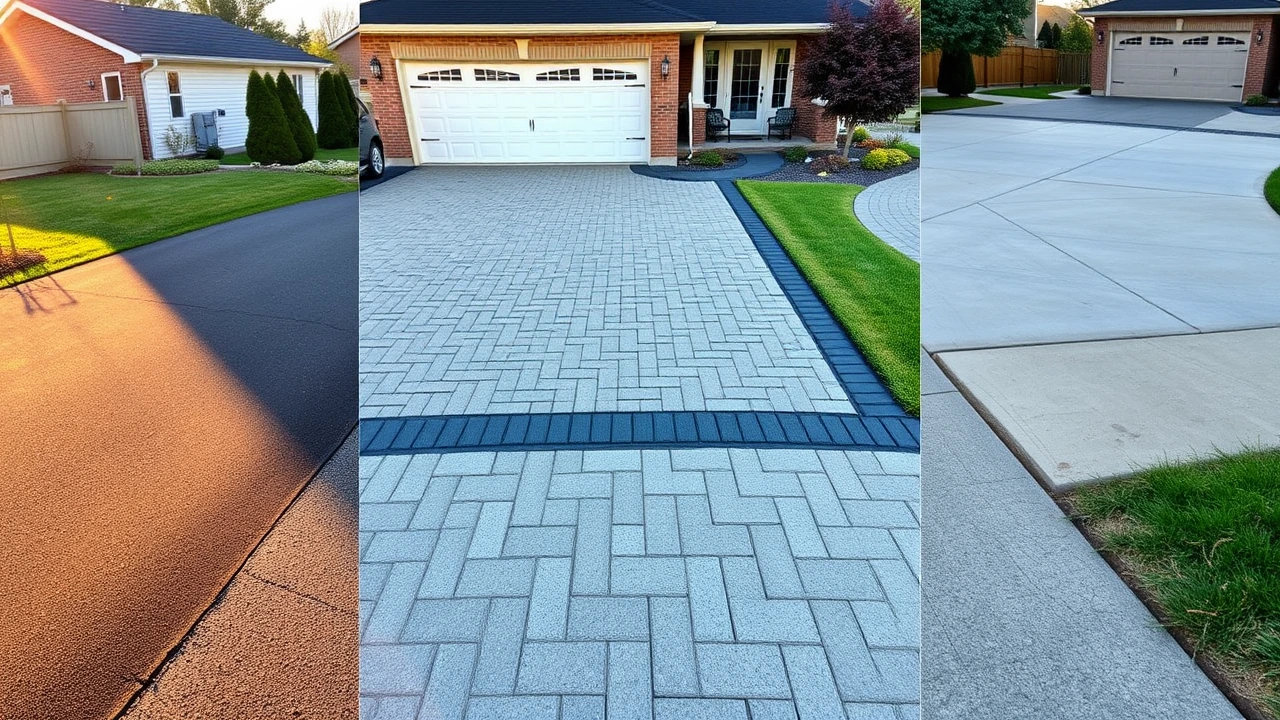
Picking a driveway material is one of the bigger outdoor decisions a homeowner makes. Get it right and it lasts 25 to 40 years with minor upkeep. Get it wrong and you are paying for repairs every other spring. The big three in Ontario are asphalt, interlocking pavers and poured concrete. Each has a real strength, a real weakness and a price tag that has shifted in 2026. Here is what the Peace Love Landscaping crew tells Hamilton, Burlington and Oakville homeowners when they ask us to compare them honestly.
Quick verdict
Asphalt is the cheapest up front and the easiest to repair, but you are resealing it every 2 to 3 years and replacing it inside 20. Interlock is the most expensive up front and the most forgiving in our freeze-thaw climate because individual pavers can be lifted and reset. Poured concrete sits in the middle on price but is the worst of the three when Ontario road salt and frost get under it. If budget is tight, asphalt. If you want it to look great in 2046, interlock.
Head-to-head comparison table
| Factor | Asphalt | Interlock pavers | Poured concrete |
|---|---|---|---|
| Cost per sq ft (installed, 2026) | $8 to $15 | $24 to $42 | $14 to $23 |
| Lifespan | 15 to 20 years | 30 to 40+ years | 20 to 30 years |
| Maintenance | Reseal every 2 to 3 years | Polymeric sand top-up every 3 to 5 years | Sealer every 4 to 5 years, crack fill |
| Look options | Black, one finish | Hundreds of colours, patterns, borders | Grey, stamped or broom finish |
| Winter salt resistance | Good | Excellent (proper sealer) | Poor, salt scales the surface |
| Repairability | Patch and reseal, visible | Lift and reset individual pavers, invisible | Hard, patches always show |
| Best for | Long rural drives, tight budget | Visible front drives, character homes | Modern flat lots, no salt exposure |
Asphalt driveways
Asphalt is hot-mix bitumen rolled over a compacted gravel base. It is the default driveway across most of Hamilton and the surrounding suburbs because it goes in fast, costs the least and handles Ontario freeze-thaw better than people give it credit for, as long as it was installed on a proper base.
Pros
Cheapest of the three by a wide margin. Installed in a single day on most residential drives. Easy to patch when it cracks. Black surface melts snow faster on sunny February days, which actually helps.
Cons
Needs resealing every 2 to 3 years to stay black and resist water infiltration. Goes soft in 30 degree summer heat, so heavy trailer jacks and motorcycle kickstands can leave divots. Looks dated next to a stone house. Edges crumble if no proper shoulder is installed.
Real-world cost range
$8 to $15 per sq ft installed in the Hamilton, Halton and Niagara area in 2026. A typical 600 sq ft two-car driveway runs $4,800 to $9,000.
Best fit
Long rural drives where total square footage rules out interlock, rental properties, tight-budget rebuilds and any drive where looks matter less than getting cars off the street.
Interlocking paver driveways
Interlock is individual concrete pavers set in a sand bed over a deep compacted gravel base, with polymeric sand swept into the joints. It is the most expensive option up front because it is the most labour-intensive, but it is the only material on this list where damage is repairable without it being obvious afterward.
Pros
Longest lifespan, often 30 to 40+ years with basic care. Survives Ontario freeze-thaw better than poured concrete because each paver moves independently. Damaged pavers can be lifted and replaced one at a time. Huge range of colours, patterns and borders that lift a house from average to standout. Resists road salt well when sealed.
Cons
Highest up-front cost. Needs polymeric sand top-up every 3 to 5 years to keep weeds out of joints. A bad install (thin base, no edge restraint) will fail in 5 years, so installer choice matters more than for any other material.
Real-world cost range
$24 to $42 per sq ft installed in 2026. A 600 sq ft drive runs $14,400 to $25,200. Premium textured or extra-large pavers push the top end higher. See our full interlock cost guide for current Ontario ranges.
Best fit
Front-of-house drives on character homes, lots with visible curb appeal, and any homeowner planning to stay 10+ years.
Poured concrete driveways
Concrete is a continuous slab poured on a gravel base with control joints cut every 8 to 10 ft. Common in newer builds because builders can pour it quickly, but it has a tougher relationship with Ontario winters than most homeowners realize.
Pros
Clean modern look, especially on contemporary builds with grey or white brick. Can be stamped or stained for higher-end finishes. Reflective surface keeps the front of the house brighter.
Cons
Worst of the three for Ontario road salt. Sodium chloride that drips off your car eats the surface, causing scaling and pitting that no sealer fully prevents. Cracks are very hard to hide because patches never colour-match. Repairs typically mean replacing whole slab sections.
Real-world cost range
$14 to $23 per sq ft installed in 2026 for a standard broom finish. Stamped concrete pushes $22 to $34. A 600 sq ft drive runs $8,400 to $13,800 plain, more for stamping.
Best fit
Modern homes, covered drives, garages where most of the slab stays under a roof, or properties where the owner never uses winter salt and is meticulous about sealing.
Which one is right for your driveway?
The right call comes down to four Ontario-specific realities most websites skip.
- Winter salt. If you or the city salts heavily in your area, concrete is the riskiest. Asphalt handles salt fine. Sealed interlock handles it well.
- Freeze-thaw cycles. Hamilton and Niagara see 40+ freeze-thaw cycles each winter. Interlock flexes with the ground. Concrete cracks. Asphalt flexes too but gets brittle as it ages.
- Grading and slope to the street. Steep drives need extra thickness in the base regardless of surface. On a 1 in 6 or steeper slope, ask any contractor specifically how they handle the transition to the road and the storm water runoff. A weak base is what causes most "driveway failed in 5 years" stories.
- How long you are staying. Under 7 years, asphalt is the financially smart pick. Over 15 years, interlock pays back the up-front premium in not having to redo anything.
Want a real number for your specific lot? Our interlocking patios and driveways service page walks through what is included in a full install, and the interlock cost guide covers 2026 Ontario pricing in detail.
Common mistakes we see on quote reviews
- Skinny gravel base. Anything less than 8 inches of compacted 3/4 clear in our climate fails fast, regardless of surface. Ask every quote for base depth in writing.
- No edge restraint on interlock. Pavers walk outward without proper PVC or steel edge restraint pinned into the base. Joints open, weeds win.
- Sealing new asphalt too early. Wait at least 6 months for new asphalt to cure before the first sealer coat. Sealing too early traps oils and shortens lifespan.
- Stamped concrete without proper sealer schedule. The pattern looks great year one and disappears year four if you skip resealing every 3 to 4 years.
- Ignoring drainage. Any driveway that ponds water at the garage door will fail at the threshold first. Grade should fall 1 to 2 percent toward the street.
- Comparing quotes on per sq ft alone. A $9 per sq ft asphalt quote with 4 inches of base is more expensive than a $12 per sq ft quote with 10 inches of base, once you replace the cheap one in 8 years.
Frequently asked questions
What is the cheapest driveway material in Ontario?
Asphalt by a wide margin at $8 to $15 per sq ft installed in 2026, roughly half the cost of poured concrete and a third of premium interlock.
What is the longest-lasting driveway?
Interlock pavers installed on a proper 10+ inch base routinely last 30 to 40 years because individual pavers can be lifted and reset as the ground moves.
Does road salt damage interlock?
Less than concrete. Quality concrete pavers are rated for freeze-thaw and salt, and a good sealer adds extra protection. Avoid cheap unsealed pavers if you salt heavily.
How often should I seal an asphalt driveway?
Every 2 to 3 years after the first 6 month cure. Sooner if you see colour fading or hairline cracks starting.
Can you install interlock over an existing asphalt or concrete driveway?
We do not recommend it. The old surface will not drain or move the same as a properly prepped gravel base, and you will see settling within a few years. Tear out, regrade, install fresh.
Which driveway adds the most resale value?
Interlock on a visible front drive consistently shows up in Hamilton and Halton listings as a feature buyers notice. A tired asphalt drive can knock 1 to 2 percent off list price.
How long does a new driveway take to install?
Asphalt is usually 1 to 2 days. Concrete is 2 to 3 days plus 5 to 7 days of curing before driving on it. Interlock takes 3 to 7 days depending on size and pattern complexity.
Need a real driveway quote, not a guess? The Peace Love Landscaping crew installs asphalt, interlock and concrete driveways across Hamilton, Burlington, Oakville and Niagara. Request a free quote and we will walk the site, check grading and drainage, and give you flat prices on the materials that actually make sense for your lot. For interlock specifically, start with our 2026 Ontario interlock cost guide or the interlocking patios and driveways service page.
Need the numbers? See 2026 driveway pricing per square foot for each material, plus the base depth spec that decides how long it lasts.