
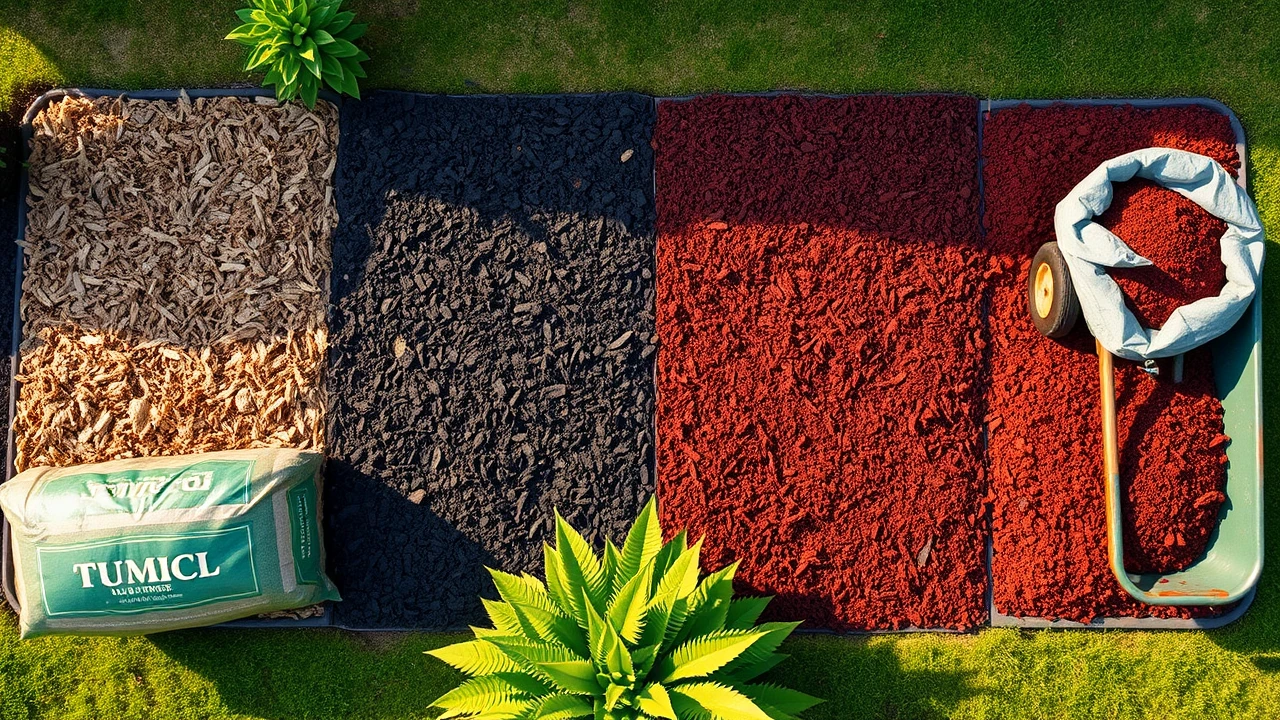
Mulch looks simple until you stand in the garden centre staring at a wall of bags and a yard of bulk piles, all priced differently. The right choice depends on how big your beds are, what you want it to look like in October, whether kids play near it and how much you actually want to be reloading wheelbarrows. Here is how the Peace Love Landscaping crew decides between bulk and bagged, cedar, hardwood and dyed across Hamilton, Halton and Niagara jobs in 2026.
Quick verdict
For beds bigger than about 200 sq ft, bulk mulch wins on price and waste, full stop. Cedar is the premium pick for front beds where you want colour to hold and that classic smell. Hardwood is the workhorse for back beds, slopes and tree rings where you care more about soil building than looks. Dyed black or red is fine for curb appeal but fades fast and is not what you want around playsets.
Head-to-head comparison table
| Factor | Bulk cedar | Bulk hardwood | Bulk dyed (black/red) | Bagged (any) |
|---|---|---|---|---|
| Cost per yard (delivered) | $65 to $95 | $45 to $70 | $50 to $80 | $110 to $160 equivalent |
| Lifespan (colour) | 1 to 2 seasons | 1 season then greys | 2 to 3 seasons | Same as bulk equivalent |
| Maintenance | Top up annually | Top up annually, breaks down faster | Top up every 2 to 3 years | Same, more lifting |
| Look options | Natural reddish brown | Brown, fades to grey | Jet black, brick red, brown | All of the above |
| Best for | Front beds, foundation plantings | Tree rings, back beds, slopes | Curb-appeal beds, contrast with light stone | Tiny beds, condos, top-ups |
Bulk cedar mulch
Cedar is what most Hamilton and Burlington homeowners picture when they say "nice mulch". It has a natural reddish brown tone, a clean cedar smell for the first few weeks and a fibrous texture that knits together on slopes instead of washing away in the first heavy rain. It is the mulch we recommend for visible front beds, foundation plantings and anywhere you walk past every day.
Pros
Holds colour better than plain hardwood, resists matting, smells great, gently repels some insects thanks to natural cedar oils, and breaks down slowly so you are not redoing it every spring.
Cons
Costs 30 to 50 percent more than hardwood. The slow breakdown is great for looks but adds less organic matter to clay soil. Some folks find the smell strong for the first week.
Real-world cost range
Bulk cedar runs $65 to $95 per yard delivered in the Hamilton, Halton and Niagara area in 2026, depending on supplier and distance. One yard covers about 100 sq ft at 3 inches deep.
Best fit
Front-of-house beds, three-season patios, anywhere the mulch is part of the design.
Bulk hardwood mulch
Hardwood is shredded bark and wood from oak, maple and mixed deciduous trees. It is the cheapest real mulch you can buy in bulk and the best soil builder of the three because it breaks down faster. We use a lot of it on tree rings, back-yard beds nobody sees from the street, and slopes where we want it to lock in fast.
Pros
Lowest cost per yard, excellent for building organic matter in heavy Hamilton clay, knits to slopes well, and feeds soil microbes that help shrubs and perennials.
Cons
Fades to a dull grey by August. Breaks down faster so you are topping up every spring. Cheaper grades can include chunks of wood you do not want, so buy from a known yard.
Real-world cost range
$45 to $70 per yard delivered in 2026. Same 100 sq ft per yard at 3 inches.
Best fit
Tree rings, vegetable garden paths, back beds, slopes, anywhere you care more about soil and weed suppression than long-lasting colour.
Bulk dyed mulch (black or red)
Dyed mulches are usually recycled wood fibre coloured with iron-oxide or carbon-based dyes. The dyes themselves are not toxic, but the wood base can sometimes include pallet wood, so quality varies a lot by supplier. The big advantage is colour that holds for two to three seasons, which is why you see it on so many builder show-home beds.
Pros
Longest-lasting colour of any mulch, sharp contrast with light stone and pavers, and you can re-edge beds less often because the colour still looks fresh.
Cons
Wood base is lower quality than cedar or hardwood, so it adds less to your soil. Red can clash with red-brick houses. We do not recommend it around vegetable gardens or kids playgrounds.
Real-world cost range
$50 to $80 per yard delivered in 2026, slightly more than hardwood for the dye.
Best fit
Curb-appeal beds, commercial properties, contrast plantings with light limestone or grey pavers.
Bagged mulch (any type)
Bagged mulch from a box store or garden centre is the exact same stuff as bulk in most cases, just packaged in 2 cubic foot bags. The convenience is real if you have a sedan, a tiny bed and no driveway space for a delivery. The cost is not.
Pros
No delivery to schedule, no tarp on the driveway, easy to store leftovers in the garage, and you can buy exactly what you need for one bed.
Cons
Roughly double the price per cubic foot once you do the math. A yard of mulch is 13.5 bags at 2 cubic feet each, so $5 a bag is already $67 just for the mulch, before tax and your back.
Real-world cost range
$4 to $7 per 2 cu ft bag in 2026, which works out to roughly $110 to $160 per yard equivalent.
Best fit
Beds under 100 sq ft, condo planters, top-ups mid-summer, and anyone without driveway space for a bulk drop.
Which one is right for your yard?
The decision usually shakes out along three lines: bed size, soil and who is using the space.
- Bed size. Under 100 sq ft total, bagged is fine. 100 to 300 sq ft, bulk delivery is worth it. Over 300 sq ft, bulk is a no-brainer.
- Soil. Hamilton, Stoney Creek and Ancaster clay loves hardwood mulch because the breakdown adds organic matter. Sandy pockets in Burlington and Oakville do fine with cedar.
- Drainage and slopes. On any slope steeper than about 1 in 8, cedar and hardwood both knit better than dyed chips, which can float away in a heavy summer storm.
- Playgrounds and kids. Skip dyed mulch around play structures. CCA-treated wood is not legal in new playground mulch in Ontario, but cheap dyed mulch sometimes uses recycled construction wood with unknown history. For play areas, use certified playground wood fibre or rubber mulch instead.
- Look. Red-brick house, lean cedar or brown dyed. Grey or beige house, anything works. Modern black-trim house, jet-black dyed against light gravel or limestone looks sharp.
Not sure how much you need? Run your beds through our mulch and topsoil calculator first so you order one delivery instead of three.
Common mistakes we see on quote reviews
- Ordering by the bag for a 500 sq ft bed. You will pay double and lift 60+ bags. Get a bulk drop.
- Volcano mulching around trees. Piling mulch up the trunk traps moisture and rots the bark. Keep a 2 inch gap from the trunk.
- Spreading over weeds and skipping the prep. Mulch suppresses new weed seed, it does not kill established weeds. Pull them or scuff them with a hoe first.
- Mixing fresh dyed mulch into vegetable beds. Use composted hardwood or certified garden compost there instead.
- Going too deep. More than 4 inches starves roots of oxygen, especially on clay. Three inches is the sweet spot.
- Forgetting to refresh the edge. A crisp spade-cut edge makes a $300 mulch job look like a $1,500 garden refresh.
Frequently asked questions
How many yards of mulch do I need?
One cubic yard covers about 100 sq ft at 3 inches deep. Measure each bed in square feet, add them up, divide by 100, round up. Or use our mulch calculator linked above.
Is cedar mulch really better at repelling bugs?
The natural oils in fresh cedar do gently deter some insects for the first few weeks, but it is not bug-proof. Treat it as a small bonus, not a pest-control strategy.
Will dyed mulch stain my concrete or interlock?
Fresh dyed mulch can leach colour on light pavers if it sits wet against the stone. Keep a 2 inch gap between mulch and your driveway or patio edge, or use a clean steel edge.
How often should I replace mulch in Ontario?
Top up annually with cedar or hardwood to maintain 3 inch depth. Dyed mulch can stretch 2 to 3 years before a full refresh because the colour holds longer.
Can I put mulch over landscape fabric?
We rarely recommend it. Fabric fails after a few years, mulch ends up rooted into it and you cannot replant without ripping the whole bed out. Use mulch alone at 3 inches.
What is the best mulch for tree rings?
Plain hardwood at 3 inches, kept 2 inches off the trunk. Feeds the soil, looks fine in a back-of-house ring, and matches what most arborists recommend.
Is bulk mulch safe to handle?
Yes. Wear gloves for splinters and a dust mask if you are sensitive. Avoid dyed mulch around food gardens and playgrounds.
If you would rather not lift 30 wheelbarrows on a Saturday, the Peace Love Landscaping crew installs mulch across Hamilton, Burlington, Oakville and Niagara every spring. Request a free quote and we will measure your beds, recommend the right type and give you a flat price including delivery and install. Need to figure out volume first? Our mulch and topsoil calculator takes two minutes.
Considering stone instead? See rock vs mulch and landscaping rock costs for Ontario yards.
Filling raised beds? See what bulk and bagged soil actually costs per bed in our raised garden bed guide.