
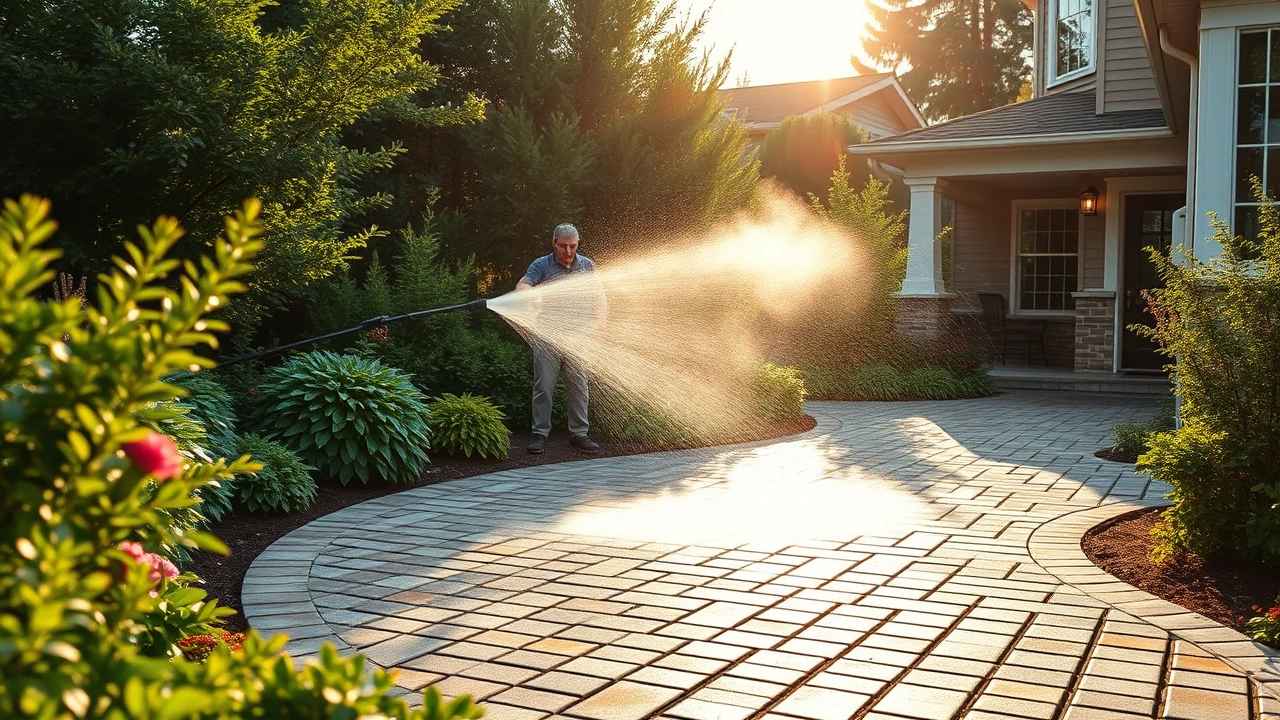
Cleaning an interlocking patio is mostly easy and occasionally tricky. The wrong technique can damage the joints, blow out the polymeric sand and leave you needing a $400 re-sand. Here is how to do it without that.
Annual routine (5 minutes per m²)
Sweep the patio. Use a stiff bristle broom to clear leaves, debris and surface dirt. Most years, that is 90% of the cleaning. If the surface needs a refresh, hose it off with a garden hose and let it dry. Done.
When to escalate to pressure washing
Pressure wash only when sweeping and hosing have not worked. Signs you need to: visible biological growth (green or black streaks from algae or moss), embedded surface dirt that has accumulated over multiple years, or after a heavy yard renovation that left soil tracked across the patio.
Pressure washer settings that do not destroy the joints
Three rules. Pressure: 1500 PSI maximum. Most consumer pressure washers go up to 2000-3000 PSI. Dial it down. Tip: 25-degree fan tip (often colour-coded green). Never the zero-degree pinpoint (red) on pavers; it will destroy joint sand and can pit soft pavers. Distance: hold the wand 30 cm above the surface. Closer than that and you start blasting joint sand out.
Move in a steady sweeping motion, parallel to the joints where possible, not perpendicular. Work in 1-2 m² sections, rinsing as you go.
Stains and how to treat them
| Stain type | Safe approach |
|---|---|
| Biological growth (green/black) | Oxygen bleach diluted per label, brush in, rinse. Or a paver-specific cleaner. |
| Oil and grease | Cat litter to absorb, then a degreaser made for masonry. Multiple applications often needed. |
| Rust (from outdoor furniture, BBQs) | Oxalic-acid-based rust remover labeled safe for concrete/pavers. Test in a hidden spot. |
| Efflorescence (white residue) | Often goes away on its own. Persistent cases: an efflorescence cleaner from a paver supplier. Not muriatic acid. |
| Mortar or grout splatter | Mortar dissolver from a masonry supplier. Or careful chiseling. Time-consuming. |
| Red wine, food spills | Hot soapy water and a brush within 24 hours usually does it. |
Things that will damage your patio
Muriatic acid. Eats away the cement binder in concrete pavers. Sometimes recommended for efflorescence; do not use it on pavers.
Chlorine bleach. Can discolour concrete pavers and kills any beneficial planting in adjacent garden beds.
Wire brushes. Scratch the surface texture on textured pavers. Use bristle, not wire.
De-icing salt with calcium chloride. Aggressive on concrete pavers. Use sodium chloride (rock salt) or sand for traction in winter.
Zero-degree pressure washer tip. Even at low PSI, the concentrated stream is too aggressive. Always use a fan tip.
If you blew out the joint sand: what now
Common after the first aggressive pressure wash. The fix is straightforward. Let the patio dry completely. Sweep new polymeric sand into the joints, working it down with a stiff broom until the joints are full. Mist with water to activate. The polymeric sand sets back like a fresh install. A 30 m² patio re-sand uses 2 to 3 bags of polymeric sand and takes about two hours.
Frequently asked questions
Can I use a pressure washer on an interlocking patio?
Yes, but at lower pressure than you would for concrete or siding. 1500 PSI maximum, 25-degree fan tip, 30 cm from surface. Higher pressure or closer distance blasts out joint sand.
How do I get green stuff off my pavers?
Biological growth (algae, moss) responds to oxygen bleach diluted per label or a paver-specific cleaner. Apply, brush in, let dwell 5 to 10 minutes, rinse. May need a second application for thick growth.
What is the white powder on my pavers?
Efflorescence: calcium deposits leaching out of the concrete paver as it cures. Common in the first 1 to 2 years of a new install. Usually disappears on its own with weather exposure. Persistent cases respond to efflorescence-specific cleaners.
Can I use bleach to clean pavers?
Oxygen bleach (sodium percarbonate, less aggressive) is fine and effective. Chlorine bleach can discolour pavers and damage adjacent plantings. We recommend paver-specific cleaners over either.
How often should I clean my paver patio?
Light sweep weekly during use season. Full clean (hose + maybe pressure wash) once a year, usually in spring after the snow melt. Stain spot treatments as needed. Total time investment: roughly an hour per year on a typical patio.
- Paver sealing & restoration (service)
- Interlocking patios & driveways (service)
- How long does an interlocking patio last?
Sources and further reading
- Interlocking Concrete Pavement Institute (ICPI) for paver industry standards, base-prep specifications and installer certification.
- Landscape Ontario for Ontario industry standards, member directories and consumer resources.
- Belgard, Techo-Bloc, Unilock and Permacon for paver product specifications and warranty information.
- Peace Love Landscaping installer experience across hundreds of projects in Hamilton-Wentworth, Halton and Niagara, 2008-2026.
White haze on your pavers? Read our diagnostic walk-through: match symptoms to root causes with DIY-fix steps and realistic pro-repair cost ranges.
Season-by-season cleaning calendar for Ontario patios
| Month | Task | Why |
|---|---|---|
| April (post-melt) | Sweep off winter salt residue with a stiff broom. Rinse with garden hose (no pressure washer yet). | Salt residue etches the paver top layer if left through spring rain cycles. Rinse before it dries and crystallises. |
| May | Inspect joints. Top up polymeric sand in any joint that lost sand over winter (typically 5 to 10% of joints on a 3-year-old patio). | Empty joints are ant and weed highways. Top-up now costs $65 per bag; wait until August and you are looking at full re-sanding. |
| June | Apply pre-emergent weed control (Ban-compliant corn gluten meal or iron-based selective) if weeds pushed through last year. | Corn gluten works 10 to 14 days before germination. Timing beats pulling weeds all summer. |
| July | Spot-clean any bird-drop, oil or food spills within 48 hours. | Organic acids etch pavers, especially the softer concrete-composite lines like Techo-Bloc Blu and Unilock Beacon Hill. |
| August | Pressure-wash the patio using the settings in the section below. Only if pavers are visibly stained. | Late summer is optimal - joints are dry, no frost risk to re-sanding. |
| September | Full re-sand of any pressure-washed joints. Apply polymeric sand, activate with fine mist, cure 24 hours. | Missing this step is why pressure-washed patios blow out over the following winter. |
| October | Blow leaves off weekly. Wet leaves left on pavers stain within 3 to 4 days. | Chestnut, oak and walnut tannins are the worst offenders. Common in older Ancaster and Dundas neighbourhoods. |
| November (pre-freeze) | Optional: apply water-based paver sealer if the surface has visible wear or fading. | Sealer refreshed every 3 to 5 years extends paver life by 5 to 10 years. Not required for undamaged patios. |
| December to March | Shovel snow with a plastic-edged shovel (not metal). Use CMA (calcium magnesium acetate) or magnesium chloride deicer, not rock salt, if you deice at all. | Rock salt (sodium chloride) accelerates spalling of concrete pavers. CMA and MgCl are pricier ($22 to $35 per 8 kg bag) but paver-safe. |
Products we recommend (and where to buy in the Hamilton area)
Cleaners
- Techni-Seal Efflorescence Cleaner - the reliable choice for the white haze that appears in year 1 or 2 on new patios. $28 to $34 per bottle at Beaver Valley Stone Waterdown and Permacon dealers.
- Sure-Klean Vana Trol - for organic staining from leaves, food and beverages. $52 per gallon at Beaver Valley Stone. Do not use on limestone or natural stone patios.
- Simple Green Concrete Cleaner - general-purpose. Available at Home Depot Ancaster and Canadian Tire Burlington. $18 per bottle.
- Dishwashing liquid + warm water - the actual first line for most residential stains. Works surprisingly well.
Sealers
- Techno-Bloc Concentrated Sealer - water-based, satin finish, colour-enhancing. $84 to $115 per gallon (covers 12 to 18 sq m). Best matched to Techo-Bloc pavers.
- Alliance ConSANDtrate joint stabiliser - not a full sealer, but locks polymeric sand joints for 3 to 5 years. Useful on patios with recurring joint blowout.
- Ghostshield Siloxa-Tek 8500 - premium penetrating sealer for anti-spalling on softer concrete pavers. Preferred for pool-surround jobs. $135 per gallon.
Polymeric sands
- Techniseal RG+ polymeric sand - our default. Grey and beige, works with 3 to 25 mm joints. $28 to $42 per 20 kg bag.
- Sakrete Sand-Lock Polymeric - retail-friendly, available at Home Depot Ancaster and Lowe's Burlington. $26 per bag. Slightly less durable than Techniseal but easier to buy.
- Alliance G-Sand - premium polymeric for wider joints and vehicular applications.
Common stain types we see in Hamilton and Burlington yards
Tannin stains (leaves, chestnut, walnut, oak, black birch)
Brown to black stains from decomposing leaf litter. Common in older Ancaster, Dundas, Westdale (Hamilton) and Roseland (Burlington) streets with mature deciduous canopy. Treatment: dilute oxygen bleach (OxiClean or equivalent) 1 cup per 4 L warm water, brush in, dwell 20 minutes, rinse. Repeat once if needed. Avoid chlorine bleach - it lightens some paver colours.
Iron staining from garden furniture legs
Orange to rust-brown circular marks under wrought-iron furniture. Get worse each winter. Treatment: F9 BARC iron cleaner or Prosoco Sure Klean Ferrous Stain Remover, both available at Beaver Valley Stone Waterdown. Apply per label, rinse thoroughly. Move furniture off pavers over winter or add rubber leg cups.
Efflorescence (white haze)
Calcium hydroxide leaching from the paver body. Normal on new patios; usually clears in 6 to 12 months of weathering. Techni-Seal Efflorescence Cleaner speeds it up. Do not use muriatic acid - it damages the paver surface and voids most manufacturer warranties.
Oil and BBQ grease
Absorbent clay cat litter poured on fresh spill, left 24 to 48 hours, then swept off. Follow with alkaline degreaser (Simple Green Concrete Cleaner). Set spills: poultice with baking soda + water, cover with plastic wrap taped down, dwell 3 days, remove.
Salt spalling (winter road salt or misapplied deicer)
Not really a stain - it is pitting and surface crumble. There is no clean-up fix; damaged pavers must be replaced. Prevention is switching to CMA or magnesium chloride deicer in the future.
The full patio rescue: what pro cleaning costs in 2026
- Basic pressure wash + re-sand (40 sq m Hamilton patio): $580 to $840
- Pressure wash + stain treatment + re-sand (organic staining): $840 to $1,240
- Full restoration: pressure wash + polymeric re-sand + sealer application: $1,480 to $2,400
- Paver replacement (efflorescence damage or salt spalling): $85 to $140 per sq m for the swap-out, plus $2 to $6 per sq m for colour-matched replacement pavers if the original run is discontinued.
Sealing it afterwards? See 2026 cleaning and sealing costs for interlock across Hamilton, Burlington and Oakville.
Deck needs a clean too? See how to clean a wood or composite deck without lifting the grain or voiding a warranty.