
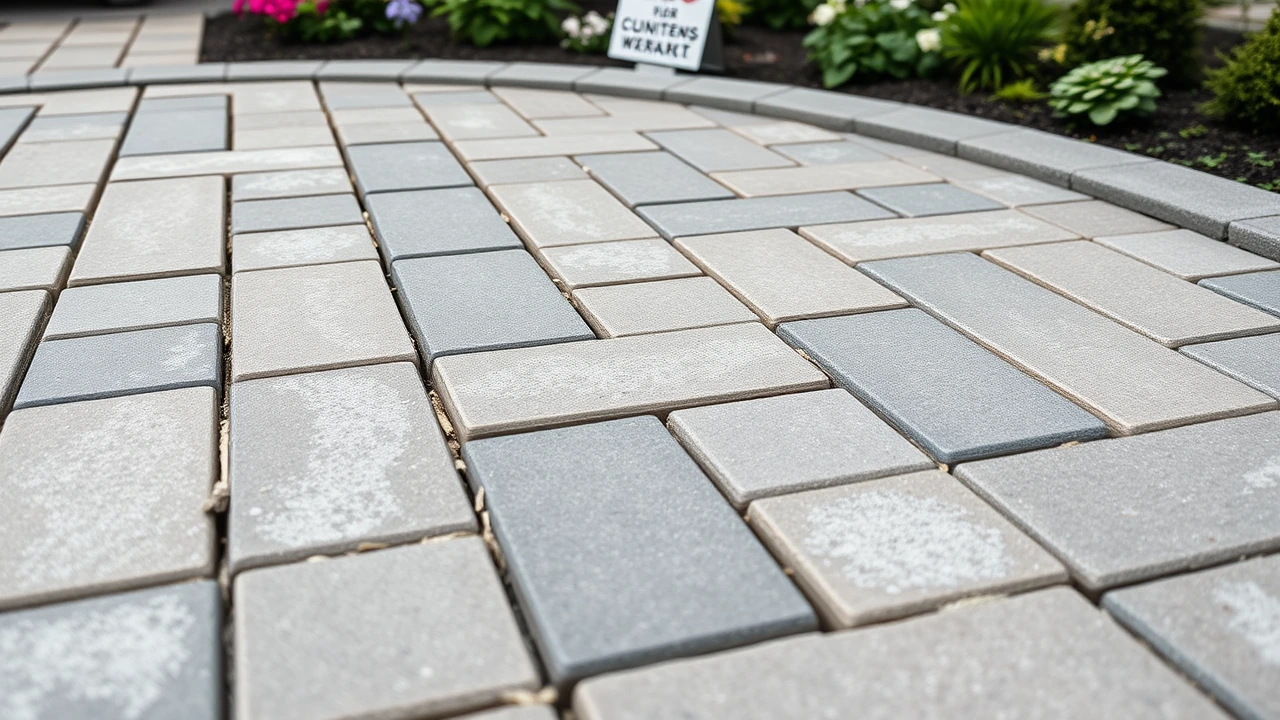
If your brand new paver patio looks like someone dusted it with flour, you are not looking at a defect. You are looking at efflorescence, the most misdiagnosed cosmetic issue on Ontario interlock. It is a normal chemistry reaction in cured concrete, it usually clears on its own in 6 to 18 months, and the most common "fix" we see homeowners try (muriatic acid or premature sealing) actually traps the problem in for years. Here is the 2026 diagnostic from our Hamilton, Burlington and Oakville crews.
Quick diagnosis
Efflorescence is calcium hydroxide migrating out of the concrete paver, reacting with CO2 in the air and depositing as calcium carbonate on the surface. It looks white, chalky and patchy. On new pavers it is normal and almost always self-clears within 6 to 18 months of weather and foot traffic. If it persists past 18 months, you have a moisture path under the patio feeding it. Never seal a paver that is still effloresceing, you will lock the haze in permanently.
Diagnostic table: match your symptom to the cause
| Symptom | Likely cause | DIY fix | Pro fix cost |
|---|---|---|---|
| White haze on pavers under 12 months old | Normal primary efflorescence | Wait, rinse, light broom | $0, do nothing |
| White ring around joints only | Polymeric sand cure residue | Damp microfibre buff | $0 to $200 service call |
| Haze returns every spring on year 2+ | Secondary efflorescence, moisture below | Efflorescence remover + reseal | $400 to $1,200 clean and seal |
| Streaky white running downslope | Water washing under patio | Fix drainage source first | $1,200 to $3,500 base repair |
| Patchy cloudy film after old sealer | Trapped efflorescence under sealer | Sealer stripper, restart | $1.80 to $3.60 per sq ft strip and reseal |
| White stain after pressure washing | You stripped the surface paste | Wait for re-cure, do not repeat | $0 to $400 if re-sanded |
| Acid burn / etched dull patches | Muriatic acid used too strong | None, surface damage permanent | $5 to $9 per sq ft replace pavers |
1. What efflorescence actually is
Concrete pavers are made from Portland cement, sand and aggregate. As the cement cures, calcium hydroxide (free lime) forms inside the paver. Moisture moves through the paver capillary network, carries dissolved calcium hydroxide to the surface, the water evaporates, and the calcium reacts with CO2 in the air to form calcium carbonate, a white, chalky crystal. That is the haze you see.
How to confirm
Spray a small area with clean water. Efflorescence darkens dramatically and almost disappears while wet, then comes back as it dries. Sealer haze, dirt, and sand residue behave differently. If wet-and-disappears is your test result, you have efflorescence.
How to fix
Primary efflorescence (under 12 months) does not need a fix. UV, rain and traffic break down the calcium carbonate and the paver self-clears. Resist the urge to scrub it with anything stronger than water and a stiff broom.
What it costs
Zero. Time is the active ingredient.
2. The normal vs problem timeline
Primary efflorescence appears within weeks of install and peaks in the first spring after a wet winter. It typically fades 60 to 90 percent by month 12 and 95 percent by month 18 in Ontario freeze-thaw climate. Secondary efflorescence is what shows up in year 2, year 3 or after a wet spring on a patio that previously looked fine, and that one is a symptom of water moving through the system.
How to confirm
Check your install photos for the date. If the patio is under 18 months old and the haze is general, you are on the normal curve. If the patio is 2+ years old and the haze is patchy, ringed around joints, or worse on the downhill side, you have secondary, and water is the cause.
How to fix
Secondary efflorescence: stop the water before treating the surface. Check polymeric sand integrity (no open joints), edge restraint still tight, base not eroded, and that drainage is moving water off the patio not under it. Only after the moisture source is fixed do you clean and seal.
What it costs
Diagnosis and base repair: $1,200 to $3,500 for typical 200 sq ft patio with one bad edge. Clean and seal after fix: $400 to $1,200 depending on size and sealer grade.
3. Accelerated cleaning, the right way
If you cannot wait the 12 to 18 months, you can clean efflorescence with a purpose-built efflorescence remover. The keyword is "purpose-built". Do not start with muriatic acid. Muriatic is hydrochloric acid at 30 percent, it strips the paver paste layer, brings MORE efflorescence to the surface a month later, and burns plants, skin and grout.
How to confirm
You have already confirmed efflorescence with the wet test in step 1. Test any cleaner on a hidden paver (under a planter, behind a step) for 24 hours before doing the full patio.
How to fix
Use a manufacturer-named efflorescence remover. The three the trade trusts in Ontario are Techniseal Efflorescence Cleaner, SEK Surebond Efflorescence and Calcium Cleaner, and Surebond SB-200. They are buffered acids, much safer than raw muriatic. Pre-wet the patio, apply per label (usually 1:4 dilution), agitate with a stiff nylon brush, dwell 3 to 5 minutes, do not let it dry, rinse thoroughly with low-pressure water. Neutralise with a baking soda rinse if the label calls for it.
What it costs
DIY product + brush: $80 to $180 for a 200 sq ft patio. Pro clean: $1.50 to $3 per sq ft.
4. When sealing helps and when it hurts
This is where most Ontario homeowners go wrong. Sealing a paver that is still pushing efflorescence locks the calcium carbonate under the sealer film, and you get a permanent cloudy haze that only chemical stripping will remove. The rule we follow: pavers must be a minimum 60 days from install before any sealer, and they must show zero new efflorescence in the 7 days before sealing.
How to confirm
Pressure-wash and let dry fully. Watch for 7 days of dry weather. If no new haze appears, sealing is safe. If haze redevelops, wait another month. In Ontario, the practical sealing windows are late May to early July and late August to early October, when the surface is warm and dry.
How to fix
If you sealed too early and have trapped haze, you have to strip the sealer. Use a paver-safe sealer stripper (Techniseal Sealer Stripper, Surebond SB-1300), follow the label, then re-clean with efflorescence remover, let weather for 30 days, and reseal with a breathable, solvent-based acrylic or a water-based hybrid. Avoid cheap big-box "wet look" sealers that build a thick film, those are the worst trappers.
What it costs
Strip and reseal: $1.80 to $3.60 per sq ft installed. Fresh clean, re-sand and seal on clean pavers: $1.20 to $2.50 per sq ft.
5. The pressure washer trap
Homeowners reach for the pressure washer the day the haze appears. A 3,000 PSI tip held 6 inches from the surface strips the cement paste layer off the paver, exposes more aggregate, and brings even more efflorescence to the surface over the next 30 days. It also blasts polymeric sand out of the joints, which then lets water under the patio and triggers secondary efflorescence.
How to confirm
If you can see exposed pebbly aggregate where the paver used to look smooth, you have stripped the paste. The patio will look duller and chalkier than before.
How to fix
Stop washing. Let the paver re-cure for 6 to 12 months under normal weather. Re-sand joints with fresh polymeric sand (do not skip this) and resist sealing until you confirm no new efflorescence in a 7 day window. If you must clean again, use 1,500 PSI maximum with a 25 degree tip held 12 inches off the surface, fan-pattern, never dwell.
What it costs
Re-sanding 200 sq ft: $150 to $400 DIY, $400 to $900 pro. Sealer once safe to apply: $300 to $700.
When to DIY vs call a pro
DIY is fine if the patio is under 18 months old, the haze is general and lifting with water, and you are willing to wait. DIY cleaning with a named efflorescence remover is fine on patios under 400 sq ft. Call a pro when:
- The patio is 2+ years old and haze is returning every spring
- Joints are open or sand is washed out
- You see streaky haze running downslope, indicating water under the slab
- You already sealed too early and have trapped haze
- You used muriatic acid and now have etched patches
- The patio is over 400 sq ft or has multiple grades
How to prevent it next time
- Wait a minimum 60 days, ideally 6 months, after install before sealing
- Run a 7-day dry-weather test before any sealer goes on
- Never use raw muriatic acid on pavers, ever
- Keep pressure washing under 1,500 PSI with a 25 degree tip held 12 inches off the surface
- Use real polymeric sand and refresh it every 4 to 6 years to keep joints sealed
- Make sure water drains off the patio, not under it (slope 1 to 2 percent away)
- Choose a breathable sealer, not a thick film-builder, especially on Ontario freeze-thaw patios
Frequently asked questions
How long until efflorescence goes away on its own?
6 to 18 months in Ontario climate. The first spring after install usually shows the worst of it, then UV, rain and traffic clear it.
Is efflorescence a defect I can claim under warranty?
No. Every major Ontario paver manufacturer (Techo-Bloc, Permacon, Unilock, Brampton Brick) calls it a normal phenomenon in their warranty docs, not a defect.
Can I use vinegar to clean efflorescence?
Mild cases yes, diluted 1:4 with water, but it is far weaker than purpose-built removers and you will need multiple passes. Stronger acetic acid concentrations can etch the paver, so do not exceed 1:4.
Should I seal pavers at all?
Optional. Sealing deepens colour, makes spills easier to clean, and stabilises joint sand, but it requires reapplication every 3 to 5 years. Unsealed pavers last just as long structurally.
What is the difference between primary and secondary efflorescence?
Primary is from the original paver cure, appears in the first 18 months, self-clears. Secondary is moisture-driven, appears years later, signals a water path under the patio that needs fixing.
Will a darker paver hide efflorescence better?
No, it makes it more visible. The whiter the haze contrast against the paver colour, the more obvious. Charcoal and black pavers show it worst.
Can I just paint over it?
Do not. Concrete paint or stain over an unstable surface peels within a season, and you still have the underlying chemistry running. Treat the cause.
Does polymeric sand cause efflorescence?
It can leave a brief white residue around joints that looks similar, but that is cure dust and washes off in a few rains. True efflorescence comes from the paver itself.
White haze on a brand new patio is heartbreaking until you understand it is just chemistry doing its thing. If you are dealing with stubborn efflorescence, trapped sealer haze, or a patio that has gone cloudy after 2+ years across Hamilton, Burlington, Oakville, Halton or Niagara, request a free quote and our crew will diagnose primary vs secondary, recommend the right product, and tell you whether sealing is even a good idea on your install. Related reading: how to seal pavers, how to clean an interlocking patio, paver patio cost in Ontario and why is my interlock patio sinking.
Want the broader cleaning routine? Read our interlocking patio cleaning guide for the full maintenance routine that prevents stain recurrence.
Planning to seal once it clears? See 2026 paver sealing pricing including how long to wait on new pavers before sealing.