
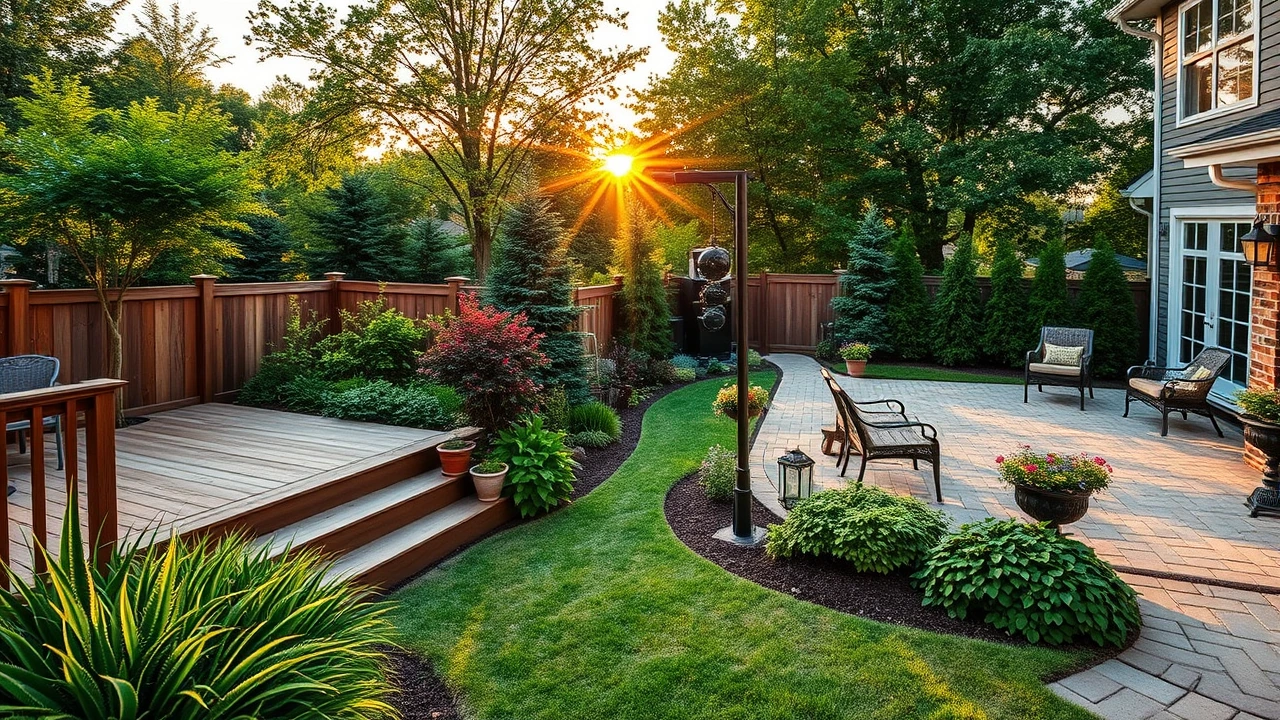
"Should I build a deck or a patio?" is one of the most common questions on a first consultation. The answer is rarely either/or; many Ontario yards work best with both, but knowing the trade-offs helps you decide which to invest in first.
The core trade-offs
| Factor | Deck | Patio (interlocking) |
|---|---|---|
| Best when grade is... | Above grade (door is high) | At or near grade |
| Typical lifespan | 25-30 yr (composite), 15-20 yr (pressure-treated) | 30-40 yr |
| Maintenance | Wood: yearly staining; composite: low | Very low; resand joints every 5-7 yr |
| Cost installed | $60-$110 per sqft (composite) | $22-$40 per sqft (interlocking pavers) |
| Feel underfoot | Soft, warm in summer | Hard, cool in summer |
| Heat retention | Less heat absorption | Absorbs and re-radiates heat |
| Design freedom | Easy to build complex shapes | Easier to integrate with garden + walls |
| Permit needs | Yes for raised structures | Usually no for ground-level |
When to choose a deck
The single best reason to build a deck is grade. If your back door sits 60+ cm above the surrounding ground, a deck is the cleanest, fastest, most cost-effective way to bridge that height. Building a patio at the same level would require massive fill, retaining walls and grading that costs many times the price of a deck.
Other good reasons: you want a softer surface for kids; you live somewhere your bare feet care about (composite decking does not get as hot as concrete or stone in direct summer sun); you want a multi-level outdoor space; you have great mature trees and want to wrap a structure around them.
When to choose a patio
The single best reason to choose a patio is lifespan with minimum maintenance. A properly built interlocking patio looks the same on day 9,000 as it did on day 1, with one re-sand of the polymeric joint sand every five to seven years. A wood deck needs annual or biennial staining and will need replacement boards in fifteen years. Composite decks are better but still cost roughly 2 to 3 times what a patio costs per square foot installed.
Other good reasons: your back door is close to grade and the patio flows directly to the yard; you want to integrate with retaining walls or garden beds (much easier with hardscape); you want maximum durability under outdoor furniture, BBQs and foot traffic; you want the lowest-fuss option long-term.
The hybrid: deck plus patio
Most Ontario yards we work with end up with both. A small deck at the back door for immediate access (especially if there is grade), stepping down to a larger patio that becomes the main entertaining space. This combination plays to both surfaces' strengths and is the most common configuration in mid-sized Hamilton, Burlington and Oakville backyards.
Frequently asked questions
Is a deck or a patio cheaper to install?
A patio is usually cheaper per square foot ($22-$40 for interlocking pavers vs $30-$55 for pressure-treated and $60-$110 for composite decking). But on a high-grade lot, a patio at the same level as the back door requires retaining walls and fill that can cost more than a simple deck. The grade decides the cost more than the surface choice.
Does a deck or a patio add more home value in Ontario?
Both add value; pavers typically score slightly higher on resale because of the perceived premium feel and lower maintenance. But a well-built deck on the right lot can outperform an over-built patio. Fit-to-lot matters more than surface type.
How long does a composite deck last vs a paver patio?
Composite decks: 25 to 30 years. Pressure-treated wood decks: 15 to 20 years. Paver patios: 30 to 40 years. Patios edge out decks on raw lifespan, but the gap is smaller than people think with modern composite decking.
Can I build a deck and a patio on the same yard?
Yes, very common. A deck off the back door, stepping down to a patio, with a railing or planter between them is one of the most popular configurations in our market. Both surfaces can do what they each do best.
Which is more eco-friendly?
Paver patio, generally. Concrete and stone last longer with less maintenance, and at end-of-life the pavers can be re-used. Composite decking is plastic-based but lasts longer than wood. Wood decks use renewable material but need stain/sealer and shorter life.
Sources and further reading
- Interlocking Concrete Pavement Institute (ICPI) for paver industry standards, base-prep specifications and installer certification.
- Landscape Ontario for Ontario industry standards, member directories and consumer resources.
- Belgard, Techo-Bloc, Unilock and Permacon for paver product specifications and warranty information.
- Peace Love Landscaping installer experience across hundreds of projects in Hamilton-Wentworth, Halton and Niagara, 2008-2026.
Leaning toward a deck? See deck ideas and costs for Ontario yards.
Leaning toward a patio? See patio ideas and sizes with 2026 costs.
Building the deck? See deck skirting ideas and costs for the gap underneath.
Leaning toward a low deck? See how a floating deck on blocks is built and when the Code allows it.