
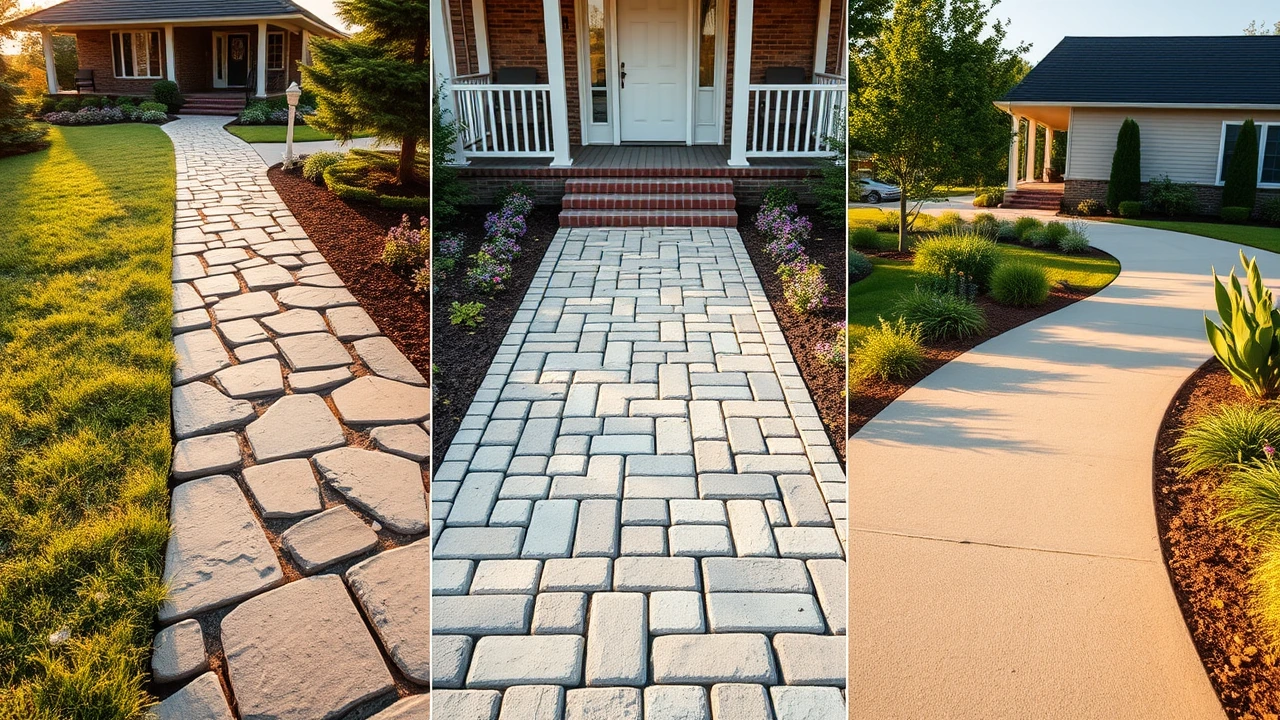
Front walkways in Ontario take a real beating. Freeze-thaw cycles, road salt, clay soil that swells and shrinks, plus snow shovels scraping the surface every January. The three materials we get asked about most are natural flagstone, manufactured concrete pavers and poured concrete. Each one wins on a different metric, and the right pick depends on your budget, your curb appeal goals and how much winter maintenance you actually want to do.
Quick verdict
If you want the best curb appeal and a one-of-a-kind look, natural flagstone wins. If you want the best value for money with a wide design range and easy spot repairs, concrete pavers win. If you want the lowest install cost and a clean modern slab, poured concrete wins, as long as you accept that cracks are when, not if. For most Hamilton and Burlington front walks we install, concrete pavers are the sweet spot between price, durability and resale.
Head-to-head comparison table
| Factor | Flagstone | Concrete pavers | Poured concrete |
|---|---|---|---|
| Install cost (2026 ON) | $30 to $55 per sq ft | $22 to $38 per sq ft | $12 to $22 per sq ft |
| Lifespan | 50+ years | 30 to 40 years | 15 to 25 years |
| Maintenance | Low. Re-sand joints every 3 to 5 years | Low. Re-sand joints, occasional sealer | Medium. Seal cracks, expect resurfacing |
| Look options | One natural look, varied colours | 200+ shapes, colours and patterns | Broom, stamped or exposed aggregate |
| Permits / code | None for residential walkway | None for residential walkway | None unless structural |
| Best for | Heritage homes, custom designs | Most front walks, best value | Tight budgets, modern minimal look |
Natural flagstone walkways
Flagstone is quarried natural stone, usually Indiana limestone, Wiarton, Pennsylvania bluestone or random-shape Ontario stone. Each piece is unique, which gives a walkway that one-of-a-kind look you cannot fake with a mould. We set flagstone on a compacted base with polymeric sand joints for the longest life, or in a mortar bed over a concrete pad for the most formal finish.
Pros
Stunning curb appeal, especially on century brick homes in Dundas, Westdale and downtown Burlington. Lifespan measured in decades. Individual stones can be lifted and reset if a section heaves. Naturally slip resistant when textured.
Cons
Highest material and labour cost of the three. Random-shape flagstone takes a skilled installer to lay tight, so DIY rarely looks right. Irregular surface is harder to shovel and can trip kids or older relatives.
Real-world cost range
A typical 4 ft wide, 30 ft long front walkway in flagstone runs $3,600 to $6,600 installed, depending on stone choice and base prep. Mortar-set walks add 20 to 30 percent.
Best fit
Heritage and custom-build homes where the walkway is part of the design statement, and the budget can support it.
Concrete paver walkways
Manufactured concrete pavers (Techo-Bloc, Unilock, Permacon, Oaks) are the workhorse of Ontario front walks. They come in hundreds of shapes, colours and textures, install fast on a properly compacted base, and individual pavers can be pulled and replaced in 20 minutes if one cracks or stains. We install around 40 paver walkways a year across Hamilton, Burlington and Oakville.
Pros
Best value per square foot for a premium look. Huge design range, from old-world cobble to crisp modern slabs. Spot repairs are easy. Most product lines carry a lifetime transferable warranty against structural failure.
Cons
Polymeric sand joints need refreshing every 3 to 5 years. Cheaper paver lines can fade after a decade. A bad base install will telegraph every freeze-thaw cycle, so installer quality matters more than the paver brand.
Real-world cost range
A 4 ft by 30 ft paver walkway runs $2,600 to $4,600 installed in 2026, including 6 inches of compacted base, geotextile and polymeric sand. Borders or banding add $200 to $500.
Best fit
Most front walks. Best resale value per dollar spent.
Poured concrete walkways
Plain or stamped poured concrete is the cheapest finished walkway you can install. A 4 inch slab over compacted granular, with control joints every 4 to 6 ft, gives you a clean continuous surface. Stamped and coloured concrete mimics the look of stone or pavers at roughly half the cost.
Pros
Lowest install cost. Fast to pour. Smooth surface is the easiest to shovel and snow-blow. Stamped finishes look great for the first 5 to 10 years.
Cons
Cracks are inevitable in Ontario freeze-thaw, even with proper control joints. Repairs are obvious because the patch never colour-matches. Salt damage and scaling are common on cheaper mixes. Once a stamped slab fades, you are looking at a full tear-out.
Real-world cost range
Plain broom-finish concrete: $1,400 to $2,600 for a 4 ft by 30 ft walk. Stamped or coloured concrete: $2,400 to $4,000.
Best fit
Budget builds, rental properties, or modern minimal homes where a clean monolithic slab is the design intent.
Which one is right for your yard?
Ontario walkways face three enemies: freeze-thaw heave, clay soil settling and winter salt. The material you pick should match how aggressively those forces act on your site, plus how much winter walking traffic the path sees.
- Clay-heavy lots (most of Hamilton Mountain, Ancaster, Waterdown): pavers or flagstone on a flexible base ride out settling better than rigid concrete slabs.
- North-facing front walks that stay icy: textured flagstone or shot-blast pavers give the best winter grip. Avoid polished or smooth-trowel concrete.
- Heavy salt zone (anything next to a salted driveway): seal pavers and concrete, or you will see scaling within 5 years.
- Tight budgets: plain broom concrete now, with a plan to overlay with pavers in 10 to 15 years, is a legitimate strategy.
- Resale-focused: pavers in a neutral charcoal or grey blend hit the sweet spot for Hamilton/Burlington buyers.
Common mistakes we see on quote reviews
- Quotes that spec less than 6 inches of compacted granular base. Walk away.
- No geotextile fabric between sub-grade and base. Clay will pump up through the gravel and create soft spots within 5 years.
- Polymeric sand swapped for regular play sand to save $80. Joints wash out by year two.
- Poured concrete with no control joints, or joints cut more than 6 ft apart. Random cracking guaranteed.
- Flagstone laid with wide irregular joints stuffed with topsoil and grass seed. Looks great in May, becomes a weed factory by August.
- Walkway pitched flat or back toward the house. Even 1/8 inch per foot of fall to the lawn side prevents ice sheets and basement water.
Frequently asked questions
Which is the most slip-resistant in winter?
Textured flagstone first, shot-blast or tumbled pavers second, broom-finish concrete third. Smooth-trowel concrete and polished pavers are the worst. We never spec polished surfaces on front walks in Ontario.
Can I install pavers or flagstone over an existing concrete walkway?
Sometimes, if the slab is structurally sound, properly pitched and you accept the finished height will be 2 to 3 inches above the lawn. More often we recommend tear-out and a fresh granular base. Overlays trap water and fail faster.
How long does each material take to install?
A typical 120 sq ft front walk: poured concrete 1 day plus 3 days cure, pavers 2 to 3 days start to finish, flagstone 3 to 5 days depending on cut versus random shape.
Do any of these need a permit in Hamilton or Burlington?
Residential walkways do not need a building permit. If the walkway crosses a city boulevard or affects a sidewalk, you may need a road occupancy or right-of-way permit. Always check before digging.
Will road salt damage my new walkway?
Yes, on poured concrete and on lower-grade pavers. Use calcium chloride or sand instead of rock salt for the first winter, and seal pavers and concrete every 3 to 5 years.
What about permeable pavers?
Permeable pavers are a great option where you need to manage stormwater on-site, but they cost 15 to 25 percent more and the open joints need annual vacuuming to stay permeable. Worth it for driveways, overkill for most front walks.
Can I mix materials?
Yes, and it often looks fantastic. Flagstone landing at the front door blending into pavers down the walk, or a poured concrete walk with a flagstone or paver border. We design hybrids regularly.
Installation deep dive: what a proper base looks like
The single biggest predictor of whether your walkway looks great in 10 years is what happens before any surface material gets laid. On Ontario sites we excavate 8 to 10 inches below finished grade, lay a non-woven geotextile fabric over the clay sub-grade, then bring the base up in 2 inch lifts of 3/4 inch clear or Granular A, compacted with a 250 lb plate compactor between every lift. For poured concrete we add a 4 inch slab with rebar or fibre mesh and control joints every 4 to 6 ft. For pavers we top the base with 1 inch of bedding sand or HPB chip, screed dead level, lay the pavers, then sweep polymeric sand into the joints and activate with a fine mist. For flagstone we adjust each stone individually for even bearing, then either dry-set with poly sand joints or mortar-set over a concrete pad. Skipping any of these steps shows up by year two or three. We see it on quote reviews constantly.
How each material handles snow and ice
Hamilton winters mean shovels, snow blowers and rock salt living on your walkway for five months a year. Flagstone with random irregular surfaces is forgiving on aesthetics but tougher to clear, since a shovel edge catches on raised pieces. Pavers with a consistent surface clear easily, though plastic shovels are mandatory to avoid scuffing the colour layer. Poured concrete is the easiest to clear and the most vulnerable to surface scaling from salt. If you use a snow blower, pavers and concrete both handle skid shoes well. Flagstone needs a rubber-edged scraper to avoid chipping. For ice control on any of the three, calcium chloride or magnesium chloride causes far less surface damage than sodium chloride rock salt. Spend the extra few dollars per bag.
Ready to price your project? Request a free quote and the crew will measure on site, recommend the right material for your soil and exposure, and give you a fixed written number. For more numbers, see our walkway cost guide and our interlocking patios and driveways service page.
Building a flagstone patio too? See 2026 flagstone patio pricing with base spec, stone thickness and joint options.
Redoing more than the walk? See front yard landscaping ideas and costs for beds, steps, edging and lighting.