
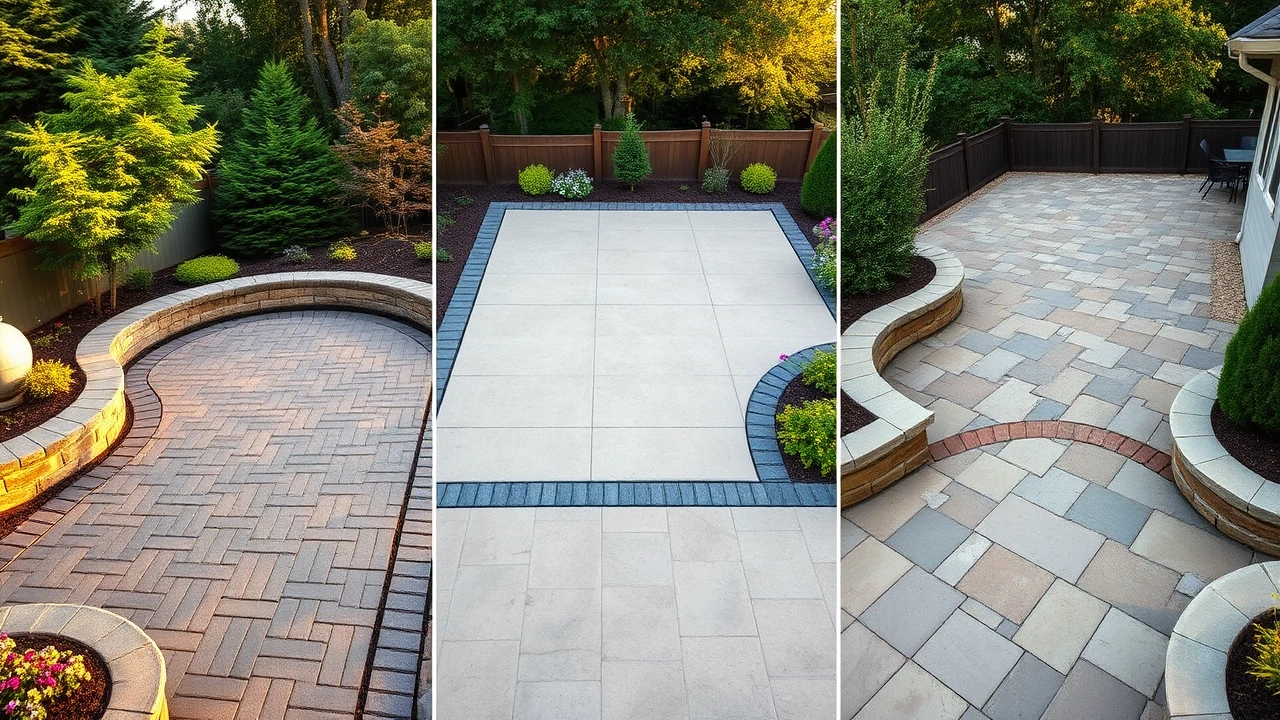
Interlock, poured concrete, or natural stone? It is the single most common decision we walk Hamilton, Burlington and Oakville homeowners through every patio season. This guide compares all three head-to-head on real 2026 Ontario costs, lifespan in our freeze-thaw climate, repair-ability after a frost heave, DIY difficulty and pure curb appeal, so you can pick the surface that fits your yard and your budget before you sign a quote.
Quick verdict
Cheapest up front: poured concrete, almost always. Longest lifespan in Ontario freeze-thaw: interlock pavers, because they flex with the ground instead of cracking. Friendliest to DIY: none of them, honestly, but a small interlock pad is the most forgiving weekend project of the three. Best curb appeal and resale lift: natural stone, with interlock a close second once you move into premium paver lines.
Head-to-head comparison table
| Factor | Interlock pavers | Poured concrete | Natural stone |
|---|---|---|---|
| Cost per sq ft (2026 ON, installed) | $22 to $40 | $14 to $34 | $30 to $60 |
| Lifespan | 30 to 40 years | 15 to 25 years | 50+ years |
| Repair-ability | Excellent (lift, re-level, drop back) | Poor (patches always show) | Very good (re-set individual stones) |
| DIY-friendly | Possible for small pads | Hard, finish is unforgiving | Hard, stones are heavy and uneven |
| Curb appeal | Strong, design flexible | Functional, can look flat | Premium, organic, unique |
| Best for | Driveways, walkways, larger patios | Budget patios, utility pads, garage approaches | Showpiece patios, pool decks, character homes |
Interlock pavers: where they win and where they lose
Interlock is the workhorse of Ontario hardscaping for one reason: it survives our freeze-thaw cycle better than anything else in this price bracket. Joints between pavers let the surface flex, so when frost heaves the base, individual pavers move a few millimetres and settle back. A poured slab in the same conditions cracks.
Pros
- Flexes with frost, no slab-wide cracks.
- Repairable: lift a single paver, re-level the base, drop it back, joint sand, done.
- Massive design range. Soldier courses, contrasting borders, circle kits, permeable variants for drainage code.
- Adds real resale value in Hamilton, Burlington and Oakville comp sets.
Cons
- Joint sand needs a refresh every 3 to 5 years.
- Weeds and ants will exploit poorly compacted joints. Polymeric sand helps but is not bulletproof.
- Bad base prep is the silent killer. Settling shows within 2 winters.
Real-world cost range
2026 Ontario installed cost runs $22 to $40 per sq ft for a residential patio. The low end is a basic Techo-Bloc or Unilock paver on a standard 8 inch granular base. The high end covers premium paver lines (Borealis, Blu 60), contrasting borders, circle kits or sloped sites that need extra base depth. Budget another $4 to $8 per sq ft if you are replacing an old surface and demolition / haul is required.
Best fit
Driveways, primary patios over 200 sq ft, walkways from driveway to back door, and any site with clay soil that frost-heaves predictably. If you plan to be in the house another 5+ years, interlock almost always wins on lifetime cost.
Poured concrete: where it wins and where it loses
Poured concrete is the budget pick. It is fast, the labour pool is wide, and a 400 sq ft slab can be poured, finished and broom-textured in a single day. The trade-off is that it is the least forgiving surface in our climate. Ontario freeze-thaw cycles are brutal on monolithic concrete: hairline cracks turn into structural cracks within 5 to 10 years, and there is no clean way to patch them.
Pros
- Cheapest installed cost per sq ft.
- Smooth, broom-finished, stamped or exposed-aggregate options.
- Fast install, often 1 to 2 days for a residential pad.
- Easy to clean, no weed pressure between joints.
Cons
- Cracks. Always. The question is when, not if, in our freeze-thaw zone.
- Patches are visible. Once it cracks, it stays cracked or gets ripped out.
- Stamped concrete colour fades within 5 to 7 years without re-sealing.
- Slick when wet unless properly broom-finished or sealed with grit additive.
Real-world cost range
Plain broom-finished concrete in 2026 runs $14 to $20 per sq ft installed across Hamilton, Burlington and Oakville. Stamped or coloured concrete pushes that to $22 to $34. Re-seal every 2 to 3 years adds $1.00 to $2.20 per sq ft per cycle. A 4 inch slab on compacted granular with rebar or mesh is the standard residential spec. Skipping the mesh to save $300 is a false economy. The slab will crack early.
Best fit
Utility pads (shed bases, AC condenser pads, garbage corrals), garage approaches that have to take vehicle weight, and small budget patios where the homeowner accepts that visible cracks in year 10 are part of the deal.
Natural stone (flagstone, limestone): where it wins and where it loses
Natural stone is the showpiece tier. Indiana limestone, Wiarton flagstone, and Owen Sound ledgerock are the three most common picks across our region. Each slab is unique, the colour palette is warm and organic, and a properly built stone patio outlives the rest of the yard. The catch is cost and labour: every stone is hand-fit, mortared or dry-laid on a deep base, and you need a crew who can read a stone pile.
Pros
- 50+ year lifespan with no fading or surface degradation.
- Premium look that lifts whole-home appraisal value, especially on character homes.
- Individual stones can be lifted and re-set if frost or roots disturb a section.
- Pairs perfectly with stone retaining walls, fire pits and water features for a coherent yard.
Cons
- Most expensive option by 50 to 100 percent.
- Uneven surfaces (intentional, but tough on patio furniture and stilettos).
- Skilled labour is scarce. A bad stone install looks worse than bad concrete.
- Heavier than interlock, so base prep is even more critical.
Real-world cost range
Installed cost in 2026 across Ontario runs $30 to $60 per sq ft. Dry-laid Wiarton flagstone on a granular base lands at the low end. Mortared Indiana limestone on a concrete base, with cut edges and stone-dust joints, lands at the top. Random irregular flagstone is cheaper than cut rectangular pieces because the labour is faster on the cuts. Yes, really.
Best fit
Showpiece patios under existing mature trees, pool decks where the look matters as much as function, and character homes (Victorian, Craftsman, mid-century brick) where concrete or interlock would look out of place. If the budget is there, stone is the lifetime answer.
Which one is right for your Hamilton/Burlington/Oakville yard?
Three factors decide this faster than any other: your soil, your budget horizon, and the rest of your hardscape plan.
- Heavy clay (Hamilton Mountain, Ancaster, Stoney Creek, north Burlington): default to interlock. Clay heaves 2 to 4 inches per winter in this region, and frost depth runs to 4 ft. A flexible jointed surface will outlast a slab every time.
- Sandier loam (lakefront Burlington, Oakville south of the QEW, Niagara orchard ground): all three options work. Pick on look and budget.
- Tight budget, utility use: poured concrete. Accept the 15 to 25 year lifespan.
- Pool deck or pool surround: check the pool enclosure bylaw first. Burlington and Oakville require non-slip surfaces inside the enclosure. Natural stone (textured) and textured interlock both qualify. Smooth concrete usually does not.
- Mid-life or forever home: spend on interlock or stone. The cost-per-year math beats concrete after about year 12.
- Selling in 1 to 3 years: interlock returns the best ratio of dollar-in to listing-price-up in our local comps. Stone can over-improve a starter home.
Common mistakes we see on quote reviews
- Under-built base. Quotes that spec a 4 inch granular base for interlock or stone. Minimum in this region is 6 to 8 inches of 3/4 clear or HPB, compacted in lifts. Anything less is a failure on year 2.
- No drainage plan. Patios that pitch toward the house, or patios that sit at the bottom of a downspout run with no swale. Always confirm 1 to 2 percent slope away from foundations.
- Skipping mesh or rebar in concrete. Saves $300 and costs you the slab. Walk away from any concrete quote that does not spec reinforcement.
- Mixing premium paver with cheap edge restraint. Plastic edge restraint with 8 inch spikes is the right call. Stapling the edge to a 2x4 frame is not.
- No polymeric sand line item on interlock. If it is not in the quote, ask. Standard joint sand washes out in 2 seasons.
- Stone quoted by stone count instead of square footage. Always demand sq ft pricing. Stone count games hide overruns.
Frequently asked questions
Can I put interlock over an existing concrete slab?
Not directly. The slab has to be removed or you need to build a flexible mortared overlay, which defeats the point of interlock. If the slab is cracked, demo it, re-base it, then lay pavers.
How long does each surface take to install?
Concrete: 1 to 2 days for the pour, plus 7 days cure before furniture. Interlock: 3 to 7 days for a 300 sq ft patio depending on base depth and design. Natural stone: 5 to 10 days for the same area because every piece is hand-fit.
Do I need a permit for a patio in Hamilton or Burlington?
For a grade-level patio without a roof or attached deck, generally no. Pool decks and any patio that ties into a deck structure may. See our landscape permits guide for the full breakdown.
Which is the most slippery in winter?
Smooth poured concrete and polished limestone are the worst. Textured interlock and split-face flagstone grip well even with frost. We will not install smooth surfaces on any path that connects to a primary door.
Can I mix surfaces, like interlock patio with a stone border?
Yes, and it is one of the highest-impact design moves we do. A natural stone perimeter band around an interlock field gives you premium look at a manageable budget. Same trick works for fire-pit aprons.
What about permeable interlock for drainage code?
Permeable pavers are required on some new-build lots in Burlington and Oakville where lot coverage rules apply. They cost about 15 percent more installed and need a different (open-graded) base. Worth it if the bylaw requires it or if you have chronic backyard pooling.
How do I tell a good installer from a bad one?
Ask to see a 5+ year old job. Anyone can build a patio that looks great on install day. The ones that look great after 5 Hamilton winters separate the pros from the weekenders.
Ready to price the real number for your yard? Request a free quote and we will walk the site, run the slope, and come back with three options inside your budget. While you are at it, try our patio cost calculator for a quick estimate, or read the deeper 2026 Ontario patio cost guide.
Leaning toward natural stone? See the full 2026 flagstone patio cost breakdown including dry-laid versus mortar-set in Ontario winters.
Picked a material? See patio ideas and layouts for Ontario backyards.
Considering concrete slabs? See patio stones and slabs, sizes and costs and when they make sense.