
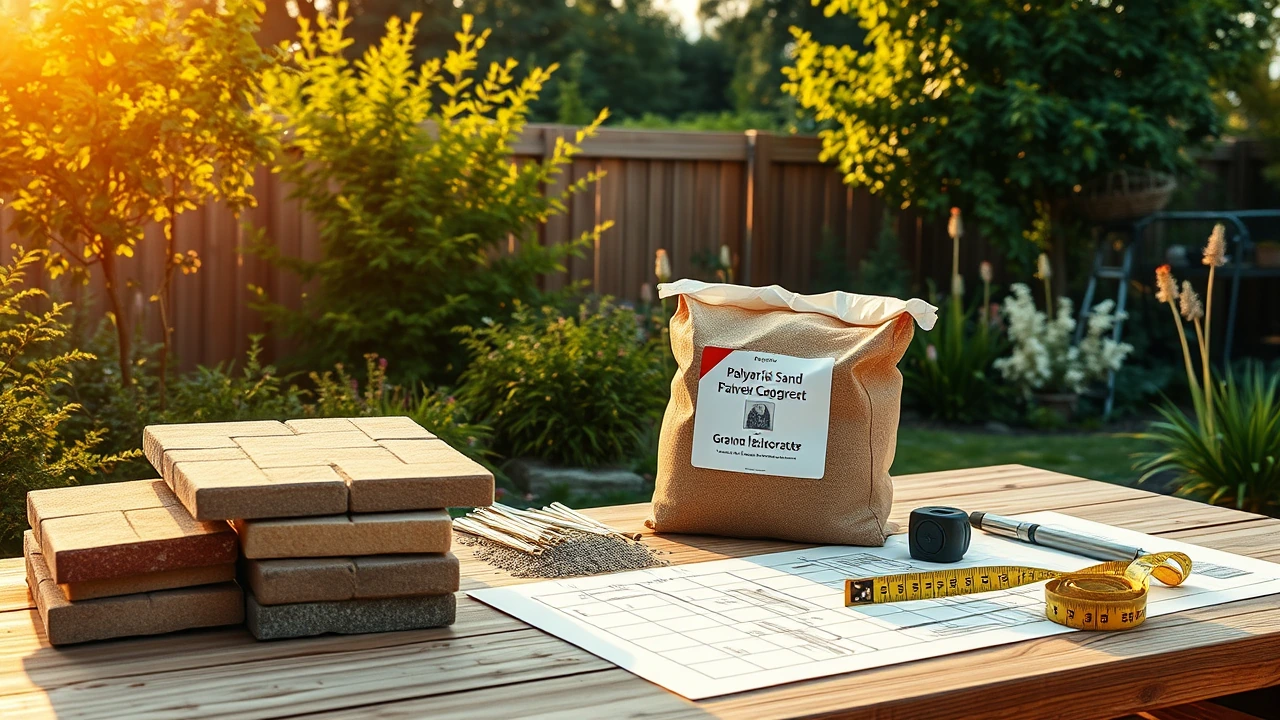
A working glossary of the landscaping terms we use most on quote calls and design conversations. Plain language, with links to the relevant service page where one exists. Bookmark this if any of the vocabulary feels unfamiliar.
How to use this glossary
Most landscape contractors assume homeowners already know terms like "polymeric sand," "geogrid," "Granular A" and "design-build." Those terms have specific meanings and they affect what you are paying for. The glossary below covers the words that come up most in quote conversations, with definitions that try to explain what they actually mean for your project rather than just defining them in industry jargon.
Terms A to Z
- Hardscape
- The non-living, built parts of a landscape: patios, walkways, retaining walls, fences, decks, fire pits, edging. Anything that does not grow.
- Softscape
- The living, growing parts of a landscape: lawns, trees, shrubs, perennials, annuals, ground cover. Counterpart to hardscape.
- Interlocking pavers (see service)
- Individual concrete or stone units installed on a compacted granular base with polymeric sand swept into the joints, so the surface flexes with freeze-thaw movement instead of cracking. The dominant patio and driveway surface in Ontario.
- Granular A
- A blend of crushed stone and stone dust used as a compacted aggregate base layer under paver patios and driveways. Typical residential install is 150 to 200 mm of compacted Granular A under the bedding sand.
- Bedding sand
- A thin layer (20 to 25 mm) of clean, washed concrete sand laid on top of the compacted granular base. Pavers are set into the bedding sand and tamped to grade.
- Polymeric sand
- A jointing material containing fine sand plus polymer binders. Swept into the joints between pavers, then activated with water mist. Sets like mortar in the joints, locking the field of pavers together and resisting weeds and ant tunnels.
- Geotextile
- A woven or non-woven fabric installed between the native subgrade soil and the granular base. Prevents base aggregate from migrating into the soil over decades. Often called a separation fabric.
- Edge restraint
- Spiked aluminum, plastic or concrete edging installed at the perimeter of a paver field. Prevents perimeter pavers from drifting outward over time. Essential; patios without proper edge restraint fail at the edges within a few seasons.
- Efflorescence
- A whitish residue that appears on the surface of new concrete pavers as calcium leaches out during initial curing. Usually disappears with weather exposure over six to twelve months. Persistent cases respond to paver-specific efflorescence cleaners.
- Retaining wall (see service)
- A structure that holds back soil and changes grade on a sloped lot. In residential landscaping, built with engineered segmental block, natural stone, gabion baskets or (less commonly) treated timber.
- Segmental block
- Modular engineered concrete blocks designed to interlock without mortar. The dominant residential retaining wall material in Ontario. Major systems include Versa-Lok, Allan Block, Belgard and Techo-Bloc.
- Geogrid
- A high-tensile fabric installed in horizontal layers behind retaining walls, extending back into the soil to anchor the wall. Required for walls above a certain height. The hidden component that decides whether a wall stands for decades.
- Dry stone wall
- A retaining or freestanding wall built from natural stone without mortar, relying on careful stone selection, tight fit and proper drainage. A traditional craft that produces walls with a much longer lifespan than block.
- Grading (see service)
- Shaping the ground surface so water flows away from buildings and toward where you want it. Lot grading is the most-overlooked landscape issue and the biggest cause of basement water problems.
- French drain
- A trench filled with gravel containing a perforated pipe that collects and redirects subsurface water. Standard solution for wet spots, foundation drainage and behind retaining walls.
- Swale
- A shallow, gently sloped ditch designed to capture and channel surface water away from buildings. Often planted with grass or moisture-tolerant perennials.
- Catch basin
- A grated drain set into the ground that collects surface water and connects to a pipe leading away. Used in low spots and at the base of downspouts.
- Permeable pavers
- Pavers with built-in gaps filled with permeable aggregate, allowing water to filter through to the ground below rather than running off. Useful where municipal stormwater rules require on-site infiltration.
- Design-build (see service)
- A service model where one company handles both the landscape design and the construction. The advantage is one team accountable for the whole project; the trade-off is less designer independence.
- Hardiness zone
- A geographic classification of climate based on average annual minimum temperature. The Hamilton-Halton-Niagara area sits mostly in Zone 6a; lakeshore microclimates can be Zone 6b or warmer. Plants are rated for the zones they can survive in.
- Microclimate
- A small area whose temperature, sun exposure or wind pattern differs from the surrounding region. Lake-effect along Lake Ontario creates a warmer microclimate that extends the planting season for nearby properties.
- Lake-effect
- The climate moderation caused by proximity to a large body of water. In our service area, Lake Ontario warms nearby lots in fall and cools them in spring, extending the growing season and reducing first-frost risk for lakeshore properties.
- ICPI
- Interlocking Concrete Pavement Institute. The North American industry body that sets installation standards for paver patios, driveways and retaining walls. Our crew is trained on ICPI methods.
- Landscape Ontario
- The provincial trade association for the Ontario landscaping industry. Sets standards for member companies on documentation, homeowner protection and ethical business practice.
- WSIB
- Workplace Safety and Insurance Board. Ontario's workplace insurance system covering work-related injuries. Reputable landscaping companies maintain WSIB clearance and can provide a certificate on request.
- Resanding (see service)
- Restoring the polymeric sand in the joints between pavers, typically every five to seven years. The polymeric sand erodes over time; resanding restores joint lock and prevents weed growth.
- Sealing
- Applying a penetrating sealer to a paver surface, primarily for the colour-deepened wet look or to resist staining. Optional for performance; pavers do not need to be sealed to last.
- Perennial (see service)
- A plant that returns year after year from the same root system. The backbone of an Ontario garden because annual replanting is expensive and labour-intensive at scale.
- Annual
- A plant that completes its life cycle in one growing season. Used for seasonal colour, often in containers or as accents in perennial beds.
- Native species
- Plants that occur naturally in a region. Native plants in our area (oak, sugar maple, serviceberry, black-eyed Susan, coneflower) are typically lower-maintenance and better for local pollinators than non-native ornamentals.
- Mulch
- A layer of organic material (typically shredded bark) spread on top of garden beds. Conserves moisture, suppresses weeds, moderates soil temperature, and breaks down over time to feed the soil.
- Soil amendment
- Adding compost, peat, sand or other materials to existing soil to improve its texture, drainage or fertility before planting. The single most useful step before installing any garden bed.
- Low-voltage lighting (see service)
- Outdoor lighting systems running at 12 volts rather than 120, powered through a transformer from a regular outlet. Standard for landscape lighting because it is safer to install, easier to modify, and uses less energy.
- Drip irrigation (see service)
- An irrigation system that delivers water directly to the root zone of individual plants through emitters along a tubing network. Uses far less water than overhead sprinklers; ideal for garden beds.
- Plate compactor
- A handheld powered machine that compacts granular base material in layers. Essential for a properly built paver patio; the base must be compacted in lifts rather than dumped and walked on.
- Skid-steer
- A compact, manoeuvrable construction loader used to move large quantities of soil, base material and pavers around a job site. Standard equipment on most residential builds; smaller variants fit through 90 cm gates.
Have a term you want defined?
We add to this glossary as new questions come up on quote calls. If you have read a quote, a contract or an article and a term left you uncertain, send us a note via the contact form and we will add a definition.