
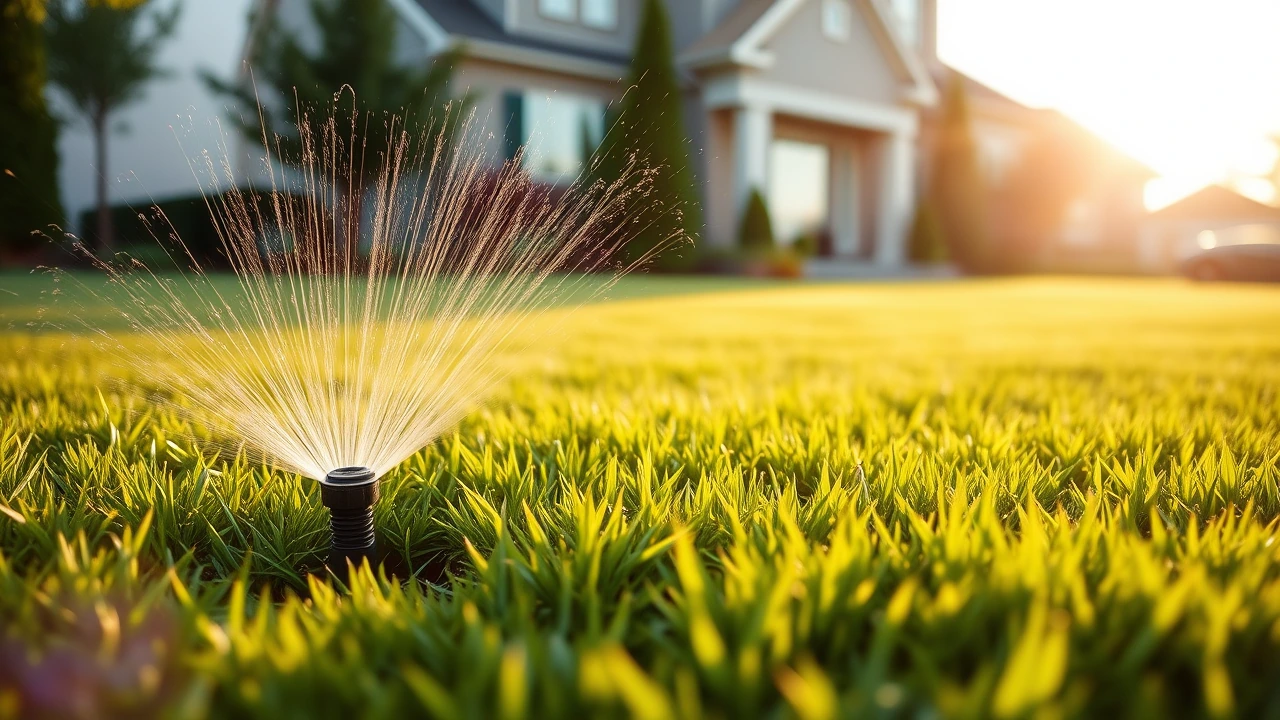
Most Ontario lawns are watered wrong, and most homeowners are paying for it twice: once on the water bill and again in thinner turf, fungal disease and shallow roots that crisp the moment the temperature hits 30 degrees. The science of summer watering in Hamilton, Halton and Niagara is actually simple. One inch of water per week, applied in one or two deep sessions, before the sun is up, on the day your municipal bylaw allows. The execution is where homeowners go sideways. Here is the 2026 schedule the Peace Love Landscaping crew uses on real properties.
Quick TL;DR
Aim for 1 inch of water per week, including rainfall. Apply it in one or two deep soakings, not daily sprinkles. Water between 5 and 9 am only. Check your municipal bylaw before you set a timer, because Hamilton, Halton and Niagara all have odd-even or day-of-week restrictions in summer. A lawn that goes dormant in August is not dying, it is doing exactly what cool-season grass is supposed to do.
How much water and when
| Lawn type | Inches per week | Mins per zone | Best time of day | Bylaw watch |
|---|---|---|---|---|
| Established lawn on clay (Hamilton Mountain, Ancaster, Stoney Creek) | 1 inch, one session | 35 to 45 min | 5 to 9 am | Odd-even by address in Hamilton when in effect |
| Established lawn on sandy or sandy-loam (parts of Oakville, Niagara) | 1 to 1.25 inch, split into two sessions | 20 to 25 min, twice weekly | 5 to 9 am | Halton odd-even by address in effect summer 2026 |
| New sod (first 3 weeks) | 1 inch per day, multiple sessions | 15 min, 2 to 3 times daily | Morning + midday top-up | New sod is usually exempt, confirm with municipality |
| New seed or overseed | 0.25 inch, twice daily | 8 to 10 min, twice daily | Early morning + late afternoon | Usually exempt with permit, confirm locally |
| Beds and shrubs (established) | 1 inch per week at root zone | Drip 45 to 60 min weekly | Early morning | Drip irrigation typically exempt |
| Mature trees | 10 gal per inch of trunk diameter weekly in drought | Slow soak at drip line | Any cool time of day | Trees often exempt |
Clay-soil watering math
Most of Hamilton Mountain, Ancaster, Dundas, Stoney Creek and Grimsby sits on heavy clay. Clay holds water beautifully but absorbs it slowly. If you blast a clay lawn with 30 minutes at high output, most of that water runs off into the gutter before it ever reaches the root zone. The trick is one deep session with a short cycle-and-soak: 15 minutes on, 20 minutes off, 15 minutes on, 20 minutes off, 10 minutes on. The pause lets the surface absorb so the second and third pulses penetrate.
One inch of water on clay drives roots 4 to 6 inches deep, which is what you want. Daily 10-minute waterings keep roots in the top inch, where they cook the moment a heat wave arrives. To measure output, set 4 tuna cans across the zone, run for 15 minutes, average the depth, then do the math.
Sandy-soil watering math
Parts of south Oakville, lakeside Burlington, and the Niagara fruit belt sit on sandier soil. Sand drinks water instantly and holds almost none. The trick here is the opposite: split the weekly inch into two sessions of half an inch each, three or four days apart. One giant soaking just drains past the root zone within hours.
Sandy lawns also need slightly more total water in heat waves, closer to 1.25 inches per week, because evaporation is faster and water-holding capacity is lower. A 3-inch top-dress of compost over two seasons radically improves water retention and pays back the cost in a single dry July.
Deep weekly beats daily sprinkles, every time
This is the rule that fixes more lawns than anything else. Roots chase water. If you water lightly every day, roots stay in the top inch where the moisture lives. When a heat wave hits or you go away for a long weekend, the top inch dries out in hours and the lawn fries. If you water deeply once or twice a week, roots grow 4 to 6 inches deep and the lawn rides out heat waves on stored soil moisture.
This is also better for disease. Constantly wet leaf blades invite fungal problems like dollar spot, leaf spot and brown patch. A deep morning soak with the rest of the day dry is what cool-season grass evolved for.
Best time of day (the 5 to 9 am rule)
Water between 5 and 9 am. Earlier wastes nothing to evaporation, gives the lawn all day to dry off, and avoids the disease risk of evening watering. Midday watering is the worst option: 30 to 40 percent of what you apply evaporates before it reaches the roots, and droplets on leaf blades can scorch in direct sun.
Evening watering is the second worst option. Wet grass overnight is a disease incubator. If your only option is evening because of work or bylaws, water before 7 pm so blades dry before dark.
Watering bans in Hamilton, Halton and Niagara summer 2026
Every municipality in this region has restrictions in effect for summer 2026. The specifics shift annually so always confirm on the official site before you set a controller. As of June 2026:
- Hamilton: Odd-numbered addresses water on odd-numbered calendar dates, even on even, between 5 and 9 am and 7 and 11 pm. Hand-watering with a shutoff nozzle is generally allowed any time. Check the City of Hamilton site for current Level 1 or 2 status.
- Halton (Burlington, Oakville, Milton, Halton Hills): Halton Region operates an outdoor water-use program with odd-even restrictions and time-of-day limits. Confirm at Halton Region.
- Niagara (St. Catharines, Niagara Falls, Welland, Grimsby, Lincoln): Most Niagara municipalities use odd-even by address with morning and evening windows. Drought-year escalations are common. Confirm at Niagara Region.
Fines for non-compliance run from $125 to $5,000 depending on the municipality and infraction. New sod, new seed and drip irrigation are typically exempt with proof or permit.
Smart-controller advantage
A WiFi smart controller (Rachio, Hunter Hydrawise, Rain Bird) pays for itself in one summer. They pull local weather forecasts, skip cycles when rain is incoming, adjust run times for evapotranspiration, and can be programmed for odd-even bylaw compliance automatically. Most utilities in our region offer rebates of $75 to $200 on certified smart controllers.
Pair it with a rain sensor and soil-moisture sensor for the zones that matter and you stop overwatering immediately. We retrofit smart controllers onto existing systems for under $600 installed in most cases. See our irrigation services.
Dormancy is OK (it bounces back)
Kentucky bluegrass and fescue go dormant in extended hot dry weather. The lawn turns straw-coloured, growth stops, and the crown of the plant protects itself underground. This is not death. As soon as a half-inch of rain falls and temperatures moderate, a healthy dormant lawn greens up within 7 to 10 days.
If you cannot or do not want to water through a drought, do not water erratically. Either commit to the full inch per week or let it go dormant cleanly. The worst thing you can do is water lightly enough to break dormancy without enough to sustain growth. That cycle is what kills lawns, not the drought itself.
Brown patch versus drought stress (how to tell)
Drought-stressed lawns are uniformly straw-coloured, often worse in full sun and on south-facing slopes, and footprints stay visible in the grass long after you walk away. They green up after a good rain.
Fungal brown patch shows as circular tan patches 6 inches to 3 feet across, often with a darker grey-green smoke ring at the edge in early morning. Brown patch loves overnight humidity, evening watering and over-fertilized lawns. It does not bounce back from a rain, it spreads. If you are not sure which you are looking at, work through the brown lawn diagnostic guide.
How to apply this on your yard
Pick the rule that matches your soil and stick with it for the whole summer. Random schedules produce random results.
- Clay soil: one 35 to 45 minute morning session per zone, once a week, on your bylaw day.
- Sandy soil: two 20 to 25 minute morning sessions per zone, on consecutive bylaw days.
- New sod: water daily, multiple short sessions, for the first 3 weeks. No exceptions.
- Use the tuna can test to verify your system is putting out what you think it is.
- Install a rain sensor or smart controller. The payback period is one summer.
- Mow at 3 inches minimum. Tall blades shade roots and lock in soil moisture.
Common mistakes we see
- Watering daily for 10 minutes, which produces shallow-rooted lawns that cook in heat waves
- Watering in the evening or overnight, which creates a fungal disease incubator
- Running clay-soil zones at full output without cycle-and-soak, sending most water to the gutter
- Ignoring municipal odd-even bylaws and getting fined, then watering wrong anyway
- Treating dormancy like death and panic-watering, which often makes things worse
- Forgetting beds and shrubs entirely, which die quietly while you obsess over the lawn
- Mowing too short in heat (under 2.5 inches), which exposes roots and accelerates drought stress
Frequently asked questions
How do I measure an inch of water?
Set 4 to 6 straight-sided cans (tuna or cat food cans work) across the zone. Run the system for 15 minutes. Measure the depth in each can and average. Multiply to figure out how long the zone needs to run to deliver 1 inch. Most rotary systems need 35 to 50 minutes per zone.
Is it OK to let my lawn go brown in August?
Yes. Healthy Kentucky bluegrass and fescue can stay dormant for 4 to 6 weeks and recover fully when rain returns. Just do not break dormancy with a single watering and then stop. That cycle kills lawns.
What if I am on a watering ban?
Hand-watering with a shutoff nozzle is usually still allowed. Focus on beds, shrubs, trees and new plantings. Let an established lawn go dormant. It will recover.
Can I water at night to avoid evaporation?
No. Overnight wet grass is the biggest disease risk in Ontario summers. Stick to the 5 to 9 am window.
My lawn is in full sun. Does it need more water?
Slightly. Full-sun zones may need 1.25 inches per week in peak heat versus 1 inch for shaded zones. Adjust run times by zone, not for the whole system.
Do I need to water new sod every day?
Yes, often multiple times a day for the first 2 to 3 weeks. New sod has no root system and dries in hours. Most municipalities exempt new sod from bylaws with proof of install date. See sod vs hydroseed vs seed.
Should I water before or after mowing?
Mow on a dry lawn, then water afterward if it is a watering day. Wet grass clumps, dulls blades, and spreads disease.
What is the cheapest way to cut my water bill?
A rain sensor for $40 to $80 plus correct run times. Most homeowners overwater by 30 to 50 percent. A smart controller upgrade pays back in one summer if your system runs more than 2 zones.
If your lawn is browning unevenly, your irrigation system is older than 10 years, or you want a smart controller retrofit before the next heat wave, the Peace Love Landscaping crew handles it across Hamilton, Burlington, Oakville, Halton and Niagara. Pair this schedule with our brown lawn diagnostic and our sod vs hydroseed vs seed comparison, or browse irrigation services and lawn care and maintenance. Ready to fix it properly? Request a free quote and we will audit your system in one visit.
Watering new sod? See the first-month watering schedule and the signs you are giving it too much or too little.
A zone not coming on? Troubleshoot it step by step with Ontario repair costs for each fault.