
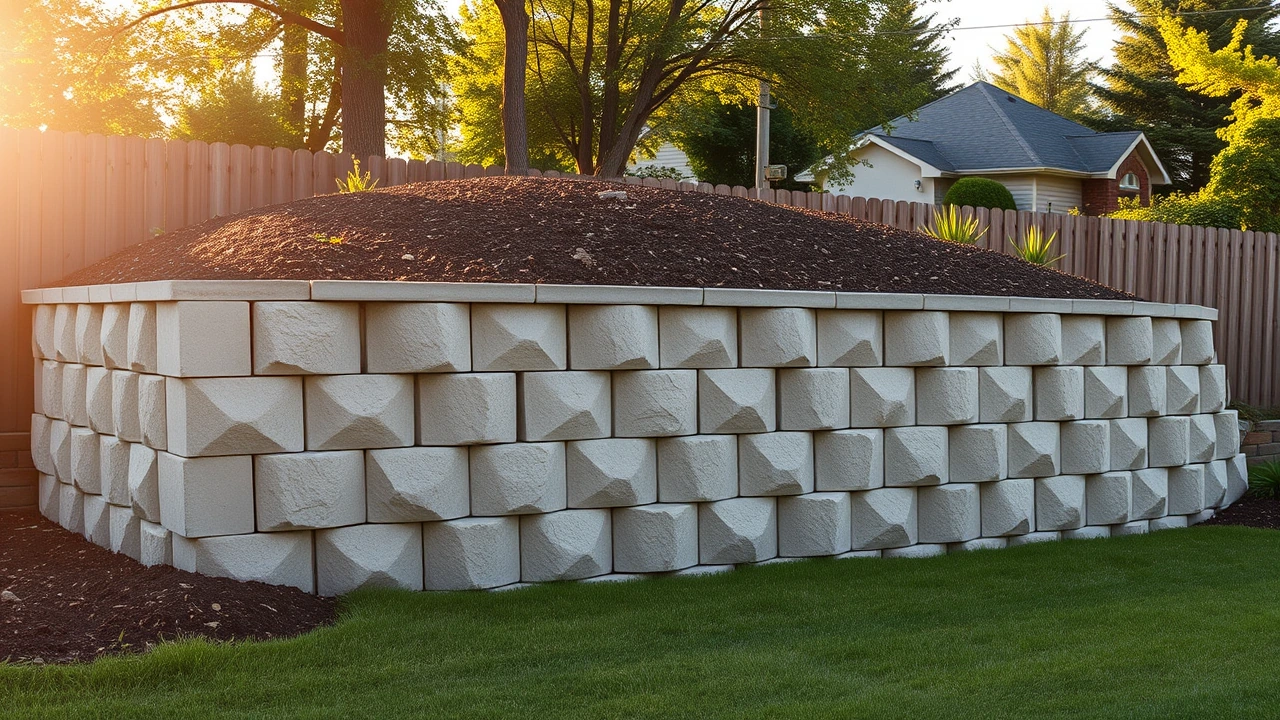
A retaining wall that leans, bulges or cracks is almost never a cosmetic problem. It is a structural warning that water, frost or load is overwhelming what is behind the blocks. In Hamilton, Burlington, Oakville and across Halton and Niagara, we see the same six root causes over and over: no drainage, frost heave on an undersized base, missing geogrid, hydrostatic pressure with no weep system, surcharge load at the top and walls over 4 ft built without an engineer. This guide shows you how to diagnose which one you have, what to fix, and what a proper rebuild costs in 2026.
Quick diagnosis
If your wall is leaning forward at the top, you almost certainly have hydrostatic pressure from no drainage behind the blocks, or missing geogrid on a wall over 3 ft. If the base course has shifted or the wall is tipping at the bottom, it is a frost heave or base failure: not enough gravel below frost line. Cracks that step diagonally through the face usually mean uneven settlement under the base. Bulges in the middle of a tall wall mean the soil behind is winning. Most leaning walls in our region cannot be straightened. They need to be taken apart and rebuilt with proper drainage and base.
Diagnostic table: match your symptom to the cause
| Symptom you see | Likely cause | DIY-fix | Pro-fix cost range |
|---|---|---|---|
| Top of wall leaning outward, soil saturated after rain | No drainage, hydrostatic pressure | Not realistic, water pressure is structural | $180 to $320 per face foot to rebuild with drain |
| Base course shifted, wall tipping at bottom in spring | Frost heave, no gravel base below 4 ft frost depth | No | $200 to $350 per face foot to rebuild base |
| Diagonal stepped cracks through face | Undersized or uneven base, point settlement | No | $2,500 to $7,000 partial rebuild |
| Wall over 3 to 4 ft bulging in middle | No geogrid reinforcement tied back into soil | No | $220 to $380 per face foot, full rebuild with geogrid |
| Wet face, white mineral staining (efflorescence) | Water passing through wall, no weep holes or drain | Add weep holes only on small dry-stack walls | $1,500 to $4,000 retrofit drain |
| Wall under driveway or near parked car cracking | Surcharge overload, wall not designed for traffic | Move load away from wall | $250 to $400 per face foot engineered rebuild |
| Wall over 4 ft with no engineered stamp on file | Built without required engineering, code issue | No | $800 to $2,500 engineer + rebuild cost |
1. Hydrostatic pressure with no drainage behind the wall
This is the number one killer of segmental retaining walls in Ontario. When rain saturates the soil behind your wall and there is no clear gravel chimney and perforated drain pipe, water has nowhere to go. It pushes outward with thousands of pounds of force per linear foot. The wall responds by leaning at the top, bulging in the middle, or popping the top course off.
How to confirm
After a heavy rain, check the back of the wall and the toe. If water is seeping through joints, if you see white efflorescence, or if the soil behind stays soggy for days, drainage has failed or was never installed. Dig a small test pit 12 inches behind the wall: you should hit 3/4 inch clear gravel, not native clay or topsoil. Look for a daylighted 4 inch perforated pipe at the base. No pipe means no drainage.
How to fix
There is no cheap retrofit. The wall must be taken down, a proper drainage envelope built (clear stone, filter fabric, 4 inch perforated pipe daylighted to grade or a catch basin), then rebuilt. Adding weep holes to an existing dry-stack wall under 2 ft can buy time but will not fix a leaning wall.
What it costs
Rebuilding a 30 ft long, 3 ft tall wall with full drainage runs $6,500 to $12,500 in 2026. Per face foot, budget $180 to $320 including demolition, base, blocks, drainage stone, fabric, pipe and backfill.
2. Frost heave from an undersized or shallow base
Ontario frost depth is roughly 4 ft. A retaining wall base that sits on 4 to 6 inches of gravel over native clay will heave every winter. Each spring, the base course shifts a fraction of an inch. After 5 to 10 winters, the wall is visibly tipping or stepping out at the bottom.
How to confirm
Sight along the base course in spring. If it has shifted forward of the second course, frost is the cause. Probe behind the base with a metal rod: a proper base is at least 6 to 12 inches of compacted 3/4 inch clear stone, with the bottom course buried 1 course deep. Most failing walls have 2 to 4 inches of dirty crushed limestone sitting directly on clay.
How to fix
Tear out, excavate 12 inches below grade, install 8 to 12 inches of compacted clear stone, bury the first course, then rebuild. There is no way to retrofit a base under an existing wall.
What it costs
$200 to $350 per face foot for a full rebuild with a proper base, depending on excavation depth and access.
3. No geogrid on a wall over 3 to 4 ft
Any segmental block wall over about 3 ft (some manufacturers say 4 ft) needs geogrid reinforcement layered into the backfill every 1 to 2 courses. Geogrid is a polyester mesh that ties the wall back into the soil mass behind it, turning blocks and soil into one reinforced gravity wall. Without it, tall walls bulge in the middle and lean at the top within 3 to 8 years.
How to confirm
If your wall is over 3 ft and bulging in the middle, geogrid is almost certainly missing or was installed only in the bottom course. Dig 18 inches behind the wall at mid-height: you should hit black mesh extending 3 to 6 ft back. No mesh, no fix.
How to fix
Full rebuild. Geogrid cannot be retrofitted. On walls over 4 ft, an Ontario-licensed engineer must size the grid spacing and embedment length for your soil.
What it costs
$220 to $380 per face foot for a geogrid-reinforced rebuild, plus $800 to $2,500 for engineered drawings on walls over 4 ft.
4. Surcharge overload at the top
A wall designed for grass and shrubs behind it will fail if a driveway, parked car, hot tub, shed or pool deck loads the top. Surcharge load multiplies the force at the base of the wall.
How to confirm
Look at what is within 4 ft of the back of the wall. Vehicle parking, a deck footing, a pool deck or a shed corner all count as surcharge. If the wall is cracking only under that loaded section, surcharge is the cause.
How to fix
Either move the load (relocate the parking pad, shed or hot tub), or rebuild the wall as an engineered surcharge-rated structure with deeper base, more geogrid and a stronger block.
What it costs
$250 to $400 per face foot for an engineered surcharge rebuild. Moving the load may be cheaper if practical.
5. Walls over 4 ft built without an engineer
Across Hamilton, Burlington and Oakville, walls measured from the bottom of the buried course to the top of the wall that exceed 1.0 m (about 3 ft 3 in) typically require a building permit and engineered drawings. Many DIY and unlicensed builds skip this. The wall is then under-designed for the soil and load, and the homeowner has no engineering on file when it fails or when they sell.
How to confirm
Measure total wall height including buried courses. Check your municipal permit history. If the wall is over 1.0 m and there is no permit or engineer stamp, it was not built to code.
How to fix
Hire a Pro. Get an engineer to inspect, stamp a rebuild design, pull a permit, and rebuild to spec. This protects the resale value of the house. See our landscaping permits guide.
What it costs
$800 to $2,500 for the engineer and permit, plus the per-face-foot rebuild cost above.
6. Base settlement and uneven compaction
Stepped diagonal cracking that runs through several block courses is the signature of a settling base. One section of the base subgrade was softer (organic fill, old tree stump, buried debris), or the compaction was uneven.
How to confirm
Sight along the top of the wall. A dip over one section, with diagonal cracks radiating up from that dip, confirms settlement at that point. Probe the soil at the base with a rod, you will hit soft fill or void.
How to fix
Disassemble the affected section, dig out the bad subgrade until you hit undisturbed soil, replace with compacted clear stone in 4 inch lifts, rebuild.
What it costs
$2,500 to $7,000 for a partial rebuild of a 6 to 12 ft section, depending on access.
Repair vs rebuild: how to decide
For segmental block retaining walls, the decision is usually binary. Walls that have moved structurally cannot be pushed back. Use these criteria:
- Rebuild if the wall is leaning more than 1 inch off plumb per foot of height, bulging in the middle, or has shifted at the base.
- Rebuild if the wall is over 3 ft tall and has no geogrid, or over 4 ft with no engineering.
- Rebuild if there is no drainage behind the wall and it is showing any movement at all.
- Partial rebuild may work if only one 6 to 12 ft section is settling and the rest is plumb and dry.
- Repair only (re-level a top course, swap a cracked cap) on walls under 2 ft that are otherwise plumb, drained and stable.
For natural stone walls and armour stone, more of the structure can sometimes be reset because individual stones are heavier and rely on mass. For segmental block, plan on tear-out.
How to prevent it next time
- Always install a 4 inch perforated drain pipe at the base, wrapped in filter fabric, daylighted to grade.
- Build a 12 inch wide gravel chimney of 3/4 inch clear stone directly behind every course.
- Use a compacted clear stone base 8 to 12 inches thick, with the bottom course buried.
- Add geogrid every 1 to 2 courses on any wall over 3 ft.
- Pull a permit and hire an engineer on any wall over 1.0 m total height.
- Keep vehicles, decks, hot tubs and sheds at least 4 ft back from the top of the wall, or design for the surcharge.
- Cap with a slope away from the wall so surface water cannot pond behind it.
Frequently asked questions
Can a leaning retaining wall be pushed back into place?
No. Once a segmental block wall has rotated forward, the joints have shifted and the soil behind has compacted into that lean. Pushing it back creates voids and the wall will lean again within a season. It must be disassembled and rebuilt.
How long should a properly built retaining wall last in Ontario?
40 to 75 years for segmental block, 50 to 100+ years for natural stone and armour stone, assuming drainage, base and geogrid were done right. Walls built without drainage often fail in 5 to 15 years.
Do I need a permit to rebuild a retaining wall in Hamilton or Burlington?
If the wall is over 1.0 m (about 3 ft 3 in) measured from the bottom of the buried course, yes. Under 1.0 m, most municipalities do not require a permit, but check your local zoning bylaw. See our permits guide.
Is geogrid really necessary on a 4 ft wall?
Yes. Without geogrid, the wall acts as a simple gravity wall and the blocks alone do not have enough mass to resist the soil at that height. Every reputable block manufacturer (Techo-Bloc, Unilock, Permacon) requires geogrid above their listed gravity height, usually 3 to 4 ft.
Can I just add weep holes to fix a leaning wall?
Weep holes alone will not stop a wall that is already leaning. They can help slow further damage on a small dry-stack wall under 2 ft, but on any wall showing movement, drainage must be retrofitted by rebuild.
What is the cheapest fix for a cracked retaining wall?
If the crack is cosmetic (single hairline in one block, no movement), no fix is needed. If the wall is moving, the cheapest fix is a partial rebuild of the affected section, $2,500 to $7,000. Caulking cracks on a moving wall is throwing money away.
How much does it cost to rebuild a 30 ft x 3 ft retaining wall in Ontario?
$6,500 to $12,500 in 2026 for a full rebuild with drainage, proper base and geogrid. Higher walls or difficult access push the number up. Use our retaining wall cost calculator for your specific wall.
Is it covered by home insurance?
Almost never. Retaining wall failure from drainage or frost is treated as a maintenance issue, not sudden damage. Only walls damaged by a covered peril like a fallen tree or vehicle impact are typically claimable.
If your wall is leaning, bulging or cracking, get it diagnosed before another winter. Request a free quote and we will come out, measure, identify which of the 6 causes is at play, and give you a written rebuild scope. While you are planning, read our retaining wall cost guide, price your specific wall with the retaining wall cost calculator, see our retaining wall services page, and check whether you need a permit in our Hamilton, Burlington and Oakville permits guide.
In Oakville? Talk to an Oakville retaining walls installation company for local 2026 cost, permit rules and our build process.