
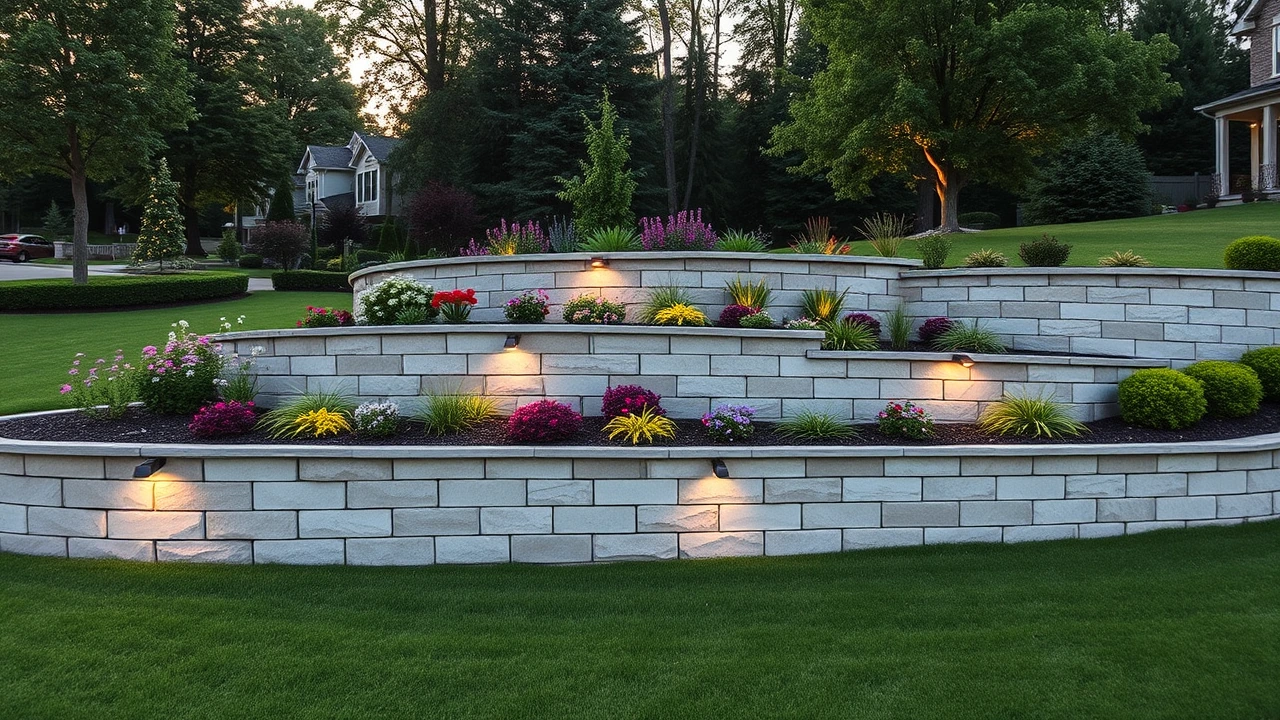
Retaining walls in Oakville fail differently than they do in Hamilton. South-of-Lakeshore lake-effect freeze-thaw runs 70 to 90 cycles a season, hammering the back-of-wall joints. The Town sits on a mix of glacial till, clay and silty fills that hold water badly, and the spring runoff from the Niagara Escarpment slope through north Oakville stacks pressure against any wall that lacks proper drainage. Joshua Creek and Glen Abbey have the grade changes and the design budgets that push walls toward natural stone or premium segmental product. Old Oakville layers a heritage conservation district over the whole south-of-Lakeshore zone. Bronte and Kerr Village have water tables close enough to the surface that the wall base sometimes sits within the active groundwater zone. Conservation Halton regulates anything near 16 Mile Creek, Bronte Creek or Sixteen Mile Creek tributaries. A DIY wall on Oakville soil will lean, bulge or fail outright by year five if the drainage, geogrid and base detail is not engineered correctly.
Want a real budget number for your specific project? Use our 2026 Ontario calculators (Hamilton, Halton, Niagara data baked in):
- Landscaping cost guide (Ontario)
- Backyard renovation cost calculator
- Retaining wall cost calculator (Canada)
- Deck cost calculator
- Fence cost calculator
Or request a free quote for a line-item estimate on your property.
Quick verdict for Oakville homeowners
For a properly built, code-compliant retaining wall in Oakville in 2026, budget $95 to $175 per face square foot turnkey for standard segmental block walls under 4 ft tall, with premium natural stone and engineered walls above 4 ft running $200 to $325. Oakville runs higher than Hamilton because the paver and stone spec, drainage detail and design fees all step up. Any wall over 1.2 m (about 4 ft) exposed face height in Ontario requires a stamped engineering review and a Town building permit, no exceptions. A typical 30 to 60 linear ft Oakville wall takes 6 to 14 working days. Always get a written scope showing base depth, geogrid spacing, drainage stone, weeping tile and batter angle before signing.
2026 Oakville retaining wall cost
Prices below are turnkey installed costs for Oakville in 2026, measured per face square foot (wall height multiplied by length). They include excavation, geotextile, 12 inch granular base, drainage stone, weeping tile, geogrid where required, block or stone supply, capping and site cleanup. They do not include engineering stamp fees on walls over 4 ft, lighting circuits, or stair and railing systems.
| Tier | System and product | Cost per face sq ft | Lifespan | Best fit |
|---|---|---|---|---|
| Basic | Permacon Lafitt or Techo-Bloc Mini-Creta segmental block, under 3 ft | $55 to $95 | 30 to 50 years | Garden bed walls, side-yard grade transitions in Kerr Village |
| Mid-grade | Unilock Roman Pisa, Techo-Bloc Borealis large-face segmental, 3 to 4 ft | $95 to $175 | 50 to 75 years | Most West Oak Trails and River Oaks terraced backyards |
| Premium | Unilock Estate Wall, Techo-Bloc Quarrystone, engineered geogrid systems 4 to 6 ft | $175 to $275 | 75 to 100 years | Glen Abbey terraced patios, Joshua Creek slope retention, pool surrounds |
| Luxury | Natural Wiarton or Owen Sound limestone, Permacon Lamina XL face block, engineered walls 6 ft and up | $225 to $325 | 100+ years | Joshua Creek estate frontages, Bronte ravine-lot walls, heritage Old Oakville installs |
To sanity check the numbers on your own wall, run them through our Ontario retaining wall cost guide for a full line-item breakdown.
Common Oakville retaining wall projects we build
Estate frontage and slope retention in Joshua Creek
Joshua Creek lots step down 1 m to 4 m from the road to the front door on a lot of the streets through Postmaster, Munns and Grand Boulevard, and the front retaining wall has to be both structural and a centrepiece. We build these as engineered segmental walls in Unilock Estate Wall or Techo-Bloc Quarrystone, often 4 to 6 ft exposed face, with a 12 inch granular base, geogrid reinforcement laid every 2 courses tying back into the slope, full drainage stone behind the face, a perforated weeping tile at the wall toe piped to a side-yard discharge, and a stamped engineering review filed with the Town. The capping is wide-format flagstone or a contrasting concrete cap that reads as a landscape feature instead of a structural wall. Walls in this category last 75 to 100 years when the base, geogrid and drainage detail are done right.
Terraced backyards in Glen Abbey, West Oak Trails and River Oaks
Glen Abbey, West Oak Trails and River Oaks have the family-yard belt where the rear lot drops 600 mm to 1.5 m from the back door to the rear fence. A single flat patio is impossible. We design these as terraced systems: an upper entertaining patio at door level, a 600 mm to 1.2 m segmental block retaining wall stepping down, and a lower fire-pit or pool patio at the second elevation. Each tier gets a 12 inch granular base, geogrid reinforcement on the bottom two courses, drainage stone and weeping tile behind the face piped to a side-yard discharge, and a 1:12 batter angle (about 5 degrees back from vertical) that gives the wall its structural lean against the retained soil. The same crew handles the interlock patio work above and below the wall in a single mobilisation.
Heritage and tight-lot walls in Old Oakville and Bronte
Old Oakville south of Lakeshore and Bronte through Kerr Village have heritage frontages, mature canopies and tight side yards where the wall has to feel inevitable, not engineered. We build these as 600 mm to 1.2 m natural stone or heritage-pattern segmental walls in muted limestone or sandstone tones, with hand-laid Wiarton or Owen Sound dimensional stone on the premium projects and Unilock Roman Pisa on mid-grade jobs. Drainage matters more here than almost anywhere else in Oakville because of the high water table near Bronte Creek. We over-excavate, lay non-woven geotextile, run a perforated weeping tile at the wall toe piped to a captured discharge, and back-fill the drainage zone with 3/4 clear stone wrapped in geotextile so the fines from the native silt cannot migrate into the drainage layer. Heritage permit paperwork is part of the scope on Old Oakville designated properties.
Ravine-edge and Conservation Halton walls north of Dundas
North Oakville above Dundas and the ravine-edge streets near the Niagara Escarpment have grade changes of 2 m to 5 m and Conservation Halton oversight on anything inside the regulated area. Walls here run 4 ft to 8 ft exposed face, always engineered, always permitted. We build them as stamped segmental block or natural stone systems with full geogrid reinforcement tying back 1.5 to 2 times the wall height into the retained slope, a 12 to 18 inch granular base, drainage stone wrapped in geotextile behind the face, a perforated weeping tile at the toe piped to a controlled discharge, and a 1:12 batter angle. Conservation Halton approval is required before excavation, and we file it on your behalf along with the Town building permit.
Why DIY walls fail in Oakville (and what we do differently)
The four failure modes we see again and again on torn-out Oakville DIY walls repeat every season. First, base failure: the wall set on 2 to 3 inches of screening or directly on the native clay subgrade. Within three winters the base loses bearing, the first course tilts, and the wall starts to lean. A real Oakville wall base is 12 inches of compacted granular A on non-woven geotextile, level to a string line within 3 mm across the run. Second, missing geogrid: any wall over 600 mm exposed face needs geogrid layers tying back into the retained soil at 1 to 1.5 times the wall height. Stack-bond walls without geogrid bulge and rotate forward under the weight of the wet retained slope.
Third, no drainage: this is the single most common failure mode in Oakville. A wall with no weeping tile, no drainage stone behind the face, and no controlled discharge will fail by year five. Spring runoff stacks hydrostatic pressure behind the wall, freezes, expands and pushes the face out. We back every Oakville wall with 12 inches of 3/4 clear drainage stone wrapped in non-woven geotextile, a perforated weeping tile at the wall toe piped to a side-yard or storm discharge, and a positive surface pitch above the wall so runoff sheds away from the retained zone. Fourth, no batter and no engineering review on tall walls. Any wall over 1.2 m exposed face height in Ontario requires a stamped engineering review and a Town building permit. We file both as part of the build.
The Oakville retaining wall install timeline
- Free on-site visit. We measure the grade change, probe the soil, check drainage from the foundation and the slope above, photograph existing grades, and talk through the wall function. You leave with a realistic Oakville 2026 cost band and a clear sense of whether the wall needs an engineering stamp.
- Design, engineering and written quote. We send a fixed scope with block or stone spec, base depth, geogrid layout, drainage detail, batter angle, capping and timeline. For walls over 1.2 m exposed face, we engage a stamped Ontario engineer and file the design with the Town.
- Permit, bylaw and Conservation Halton check. Walls over 1.2 m, walls inside a Conservation Halton regulated area, walls inside a heritage conservation district, and walls within the protected root zone of a regulated tree all need paperwork. We file it before mobilising.
- Demo and excavation. We strip vegetation, break out failing walls or timbers, excavate the wall trench 12 to 24 inches deep depending on height and frost considerations, and haul away the spoils. Frost depth in Ontario is 4 ft, so wall bases below frost line are required on engineered installs.
- Base, drainage and first course. Non-woven geotextile on the subgrade, 12 inches of compacted granular A in 3 inch lifts, level to a string line. Perforated weeping tile at the toe piped to discharge. Wrap the drainage zone in geotextile. Set and level the first course to within 3 mm across the run.
- Block courses, geogrid, drainage stone and capping. Stack courses with the design batter, lay geogrid at the engineered spacing, back-fill the drainage zone with 3/4 clear in 6 inch lifts, compact each lift, and cap the wall with the agreed flagstone or concrete cap glued with construction adhesive. Walk the site with you and confirm post-build grades and drainage.
Permits and bylaws in Oakville
The Town of Oakville requires a building permit and a stamped engineering review for any retaining wall over 1.2 m (about 4 ft) exposed face height. This is the Ontario default threshold and Oakville enforces it strictly. Walls under 1.2 m at exposed face still need to meet lot-grading rules and cannot push surface runoff onto a neighbouring property. The Town mature-tree bylaw applies to any excavation within the protected root zone of a regulated tree, and walls inside an Old Oakville Heritage Conservation District need a heritage permit for any visible exterior change.
For Oakville walls near 16 Mile Creek, Bronte Creek, Sixteen Mile Creek tributaries or any Conservation Halton regulated watercourse or hazard land, Conservation Halton review can add 4 to 10 weeks to the timeline depending on wall height and proximity to the watercourse. We handle the engineering stamp, building permit, Conservation Halton approval, tree-bylaw paperwork and final inspection coordination as part of the build, so you are not chasing Town and Conservation Halton forms while the crew waits.
Frequently asked questions
What kind of warranty do you offer on an Oakville retaining wall?
Our standard Peace Love Landscaping warranty is 2 to 3 years on workmanship across the full wall assembly (base, geogrid, drainage stone, weeping tile, block layout, capping), on top of the manufacturer warranty on the block. Unilock, Techo-Bloc and Permacon all carry 25-year to lifetime transferable warranties against structural defects. For engineered walls over 1.2 m, the engineering stamp covers the structural design. Full terms are in the signed contract.
When does my Oakville wall need an engineering stamp?
Any wall over 1.2 m (about 4 ft) exposed face height in Ontario requires a stamped engineering review and a Town of Oakville building permit. We engage a licensed Ontario engineer on those projects, file the design and permit before excavation, and book the required inspections. Walls under 1.2 m still need proper base, geogrid and drainage even though they do not need a permit.
Segmental block, poured concrete, or natural stone?
Segmental block is the default for most Oakville residential walls because it is engineered, modular, frost-tolerant and cost-effective. Poured concrete walls cost more, need form work and have less design flexibility, but make sense on certain structural walls. Natural Wiarton or Owen Sound limestone is the premium option for Joshua Creek and Old Oakville heritage projects, hand-laid by a stone mason and priced accordingly. Our poured vs segmental vs natural stone comparison walks through the trade-offs.
How do you handle drainage behind the wall?
Three layers. A 12 inch zone of 3/4 clear drainage stone wrapped in non-woven geotextile behind the wall face. A perforated weeping tile at the wall toe piped to a controlled discharge (side yard, storm, or drywell, never onto a neighbour). And a positive surface pitch on the retained soil above the wall so runoff sheds away from the wall instead of soaking down behind it. On Bronte and Aldershot-edge sites with high water tables, we sometimes add a second weeping tile mid-height.
Can you build a retaining wall in winter in Oakville?
No. Our Oakville wall install season is May through October. We do not place block on frozen base or set drainage in frozen ground. Most clients book in late winter for a May to August build slot, especially for engineered walls that need permit lead time.
How tall a wall do you build?
We build walls from 600 mm garden-bed transitions up to 8 ft engineered segmental walls. Anything over 1.2 m gets a stamped engineering review and a Town permit. We do not build unengineered walls over 1.2 m, no matter the budget pressure.
What about Conservation Halton oversight?
Conservation Halton regulates any work inside their mapped regulated area, which includes 16 Mile Creek, Bronte Creek, Sixteen Mile Creek tributaries and a buffer zone around each. Walls inside the regulated area need Conservation Halton approval before any excavation. We pull the regulated-area mapping early in the design phase, file the approval on your behalf, and build the timeline around the 4 to 10 week review.
Can you tie the wall into a new patio or driveway?
Yes, and on most sloped Oakville lots it is the right call. Combining the wall, patio and driveway into one mobilisation saves setup costs and gives a single warranty across the assembly.
People also ask about retaining walls in Oakville
The questions below cover the search phrases Oakville homeowners actually type when researching this work. Click any question for our direct answer.
Who is the best retaining wall company in Oakville?
"Best" depends on your project. For most Oakville residential builds (one-tier to two-tier segmental walls between 600 mm and 1.2 m), look for a fully insured, WSIB-covered contractor working to Landscape Ontario standards, with a written engineered drawing for any wall over 1 metre, photos of completed Oakville-area walls and a transparent line-item quote. Peace Love Landscaping has been building retaining walls across Oakville, Glen Abbey, Bronte, Old Oakville and Joshua Creek since 2008. Request a free quote and we will book a site visit, usually within 2 business days.
Who offers retaining walls installation in Oakville?
We do. Our crew handles the entire build in one mobilisation: excavation, geotextile separation, weeping tile and clear stone drainage, segmental block laying, geogrid embedment on any wall over 1 metre, capstones, and final grading. We have built walls across every Oakville neighbourhood from College Park to Joshua Creek north. See the full process on our Oakville retaining wall installation page.
Who is a good retaining wall contractor in Oakville?
A good Oakville retaining wall contractor will: confirm whether your wall needs an engineered drawing (everything over 1.2 m or anything supporting a surcharge in Oakville does), pull a Town of Oakville building permit when required, schedule a Conservation Halton review if the wall sits within 30 m of Sixteen Mile, Fourteen Mile or Bronte Creek, and show you photos of completed walls in your specific neighbourhood. We tick all four boxes on every Oakville project.
What does retaining wall installation cost in Oakville in 2026?
For a properly engineered segmental block retaining wall in Oakville in 2026, budget $300 to $550 per linear metre for walls under 1 m, $500 to $900 per linear metre for walls 1 m to 2 m, and $800 to $1,400+ per linear metre for engineered walls over 2 m or premium natural-stone builds. Heritage Old Oakville and Joshua Creek estate work runs at the top of the range. Run your numbers through our retaining wall cost calculator and read the full Ontario retaining wall cost guide.
Where can I find a retaining walls company near me in Oakville?
Peace Love Landscaping covers all of Oakville (Glen Abbey, Bronte, Old Oakville, Joshua Creek, West Oak Trails, River Oaks, College Park, Iroquois Ridge, Clearview) plus Burlington, Milton, Halton Hills and Hamilton. We come to your property for the consultation. Book a free site visit.
Do I need a permit for a retaining wall in Oakville?
The Town of Oakville requires a building permit for any retaining wall over 1.0 m (3 ft 3 in) in exposed height. Walls supporting a load (driveway, pool deck, vehicle traffic) or stacked walls within 1.2 m of each other require an engineered drawing regardless of height. Walls within 30 m of a regulated watercourse (Sixteen Mile, Fourteen Mile, Bronte Creek) also require Conservation Halton review. We handle the permit path and engineering coordination as part of the build.
How long does a retaining wall installation take in Oakville?
A typical one-tier segmental wall (6 to 12 metres long, 600 mm to 1 m high) takes 3 to 6 working days on site, weather permitting. A two-tier or engineered wall over 1.2 m runs 7 to 14 days. Add 2 to 6 weeks up-front if a Town of Oakville building permit or Conservation Halton review is required.
What is the best block for an Oakville retaining wall?
For most Oakville residential walls we spec Permacon, Techo-Bloc or Unilock segmental block in the 150 mm to 200 mm range, with matching capstones. Premium Oakville builds (Joshua Creek, Glen Abbey estate) often go with large-format Techo-Bloc Aberdeen or Unilock Brussels Dimensional, paired with limestone or sandstone caps for a heritage-appropriate finish in Old Oakville.
Ready to talk about your Oakville retaining wall? Request a free quote and we will book a site visit, usually within 2 business days. While you are scoping the project, the Oakville landscaping hub shows the rest of what we build across town, the retaining walls and hardscaping service page covers materials and engineering, and the Ontario retaining wall cost guide lets you sanity-check any quote you receive. Still weighing system options? Our poured vs segmental vs natural stone comparison walks through the trade-offs, and if your current wall is already moving, the failing wall diagnostic tells you whether to repair or rebuild.