
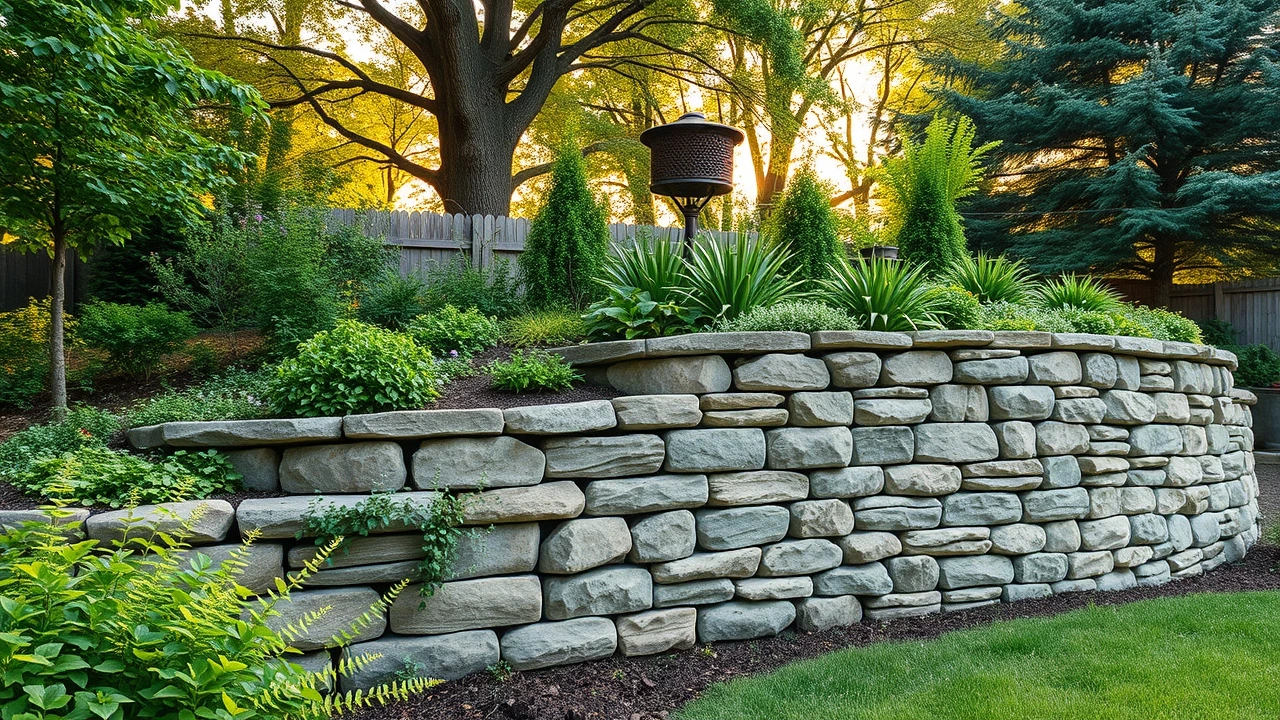
Retaining walls are the most variable-priced project in residential landscaping. A 20 m wall could be $6,000 or $24,000, depending on the height, the material, the drainage strategy and whether engineering is required.
Want a real budget number for your specific project? Use our 2026 Ontario calculators (Hamilton, Halton, Niagara data baked in):
- Landscaping cost guide (Ontario)
- Backyard renovation cost calculator
- Retaining wall cost calculator (Canada)
- Deck cost calculator
- Fence cost calculator
Or request a free quote for a line-item estimate on your property.
What goes into a retaining wall
A retaining wall is mostly what you do not see. Below the visible face: a compacted granular footing (the foundation of the wall), the buried first course (often 100 to 200 mm below grade), the drainage stone behind the wall (a free-draining gravel zone), the drainage pipe at the base (a perforated pipe that takes hydrostatic pressure off the wall), and the geogrid (a tension fabric tied back into the soil for walls above a certain height). Above grade is just the face material.
Cost by wall height
| Wall height | Engineered Block | Natural Stone | Notes |
|---|---|---|---|
| Under 0.6 m (24") | $300-$500 per linear m | $500-$800 per linear m | Usually no engineering required |
| 0.6 to 1.2 m (24"-48") | $400-$700 per linear m | $700-$1,100 per linear m | Some jurisdictions require engineering above 0.9 m |
| 1.2 to 2.0 m (48"-80") | $700-$1,200 per linear m | $1,000-$1,800 per linear m | Engineering required; geogrid reinforcement |
| Above 2.0 m | Custom-engineered | Custom-engineered | Substantially higher cost; structural engineering |
Material comparison
Engineered segmental block (Versa-Lok, Allan Block, Belgard, Techo-Bloc) is the workhorse. Modular, fast to build, designed to interlock with proper drainage. Lasts 30 to 50 years. Looks clean but obviously manufactured.
Natural stone (limestone, Wiarton flagstone, Algonquin, granite) is more expensive but has a timeless look. Dry-laid stone walls have a different aesthetic vocabulary than block walls and pair well with heritage homes. Lifespan is functionally unlimited if built properly.
Gabion walls (wire baskets filled with stone) have a contemporary, industrial look. Cost is mid-range ($400 to $800 per linear m). Lifespan depends on the wire grade.
Timber walls (treated landscape ties) cost about half of block ($200 to $400 per linear m) but only last 12 to 20 years before the treated wood degrades. We rarely install these for permanent applications.
Where retaining wall costs spike
Three places. Engineering fees (typically $1,500 to $4,000 for walls above the local height threshold). Site access (a wall behind the house with no rear access can double labour cost from $2,500 to $5,000 on a typical job). Drainage complexity (walls in clay-heavy or wet sites need more drainage detail; that is good design, not over-engineering).
Permits and rules
Most Ontario municipalities require a building permit for walls above 0.9 to 1.0 m. Walls near property lines, walls affecting drainage to public streets, and walls in conservation-adjacent properties may need additional approvals. Hamilton, Burlington, Oakville and the rest of our service area each have slightly different thresholds. We check the local rules before quoting.
Frequently asked questions
How long does a retaining wall last in Ontario?
Properly built engineered block walls: 30 to 50 years. Natural stone walls: functionally unlimited (centuries-old stone walls still stand). Timber walls: 12 to 20 years. The drainage design behind the wall matters more than the face material for longevity.
Do I need a permit for a retaining wall?
In most Ontario municipalities, walls above 0.9 to 1.0 m require a building permit and engineered drawings. Walls below that threshold usually do not. Conservation areas, heritage districts and lots near property lines may have additional rules.
Can I build a retaining wall myself?
A small wall under 0.6 m on a stable lot is a realistic DIY project. Above that, the drainage detail and the consequences of failure (a failed wall can damage foundations, retaining structures and neighbouring properties) tip the math heavily toward hiring a pro.
Why do some retaining walls fail?
Almost always one of three reasons. Insufficient base. Inadequate drainage behind the wall (hydrostatic pressure pushes the wall outward). Wrong wall type for the height (a wall designed for under 1 m used at 1.5 m). The visible face is rarely what fails first.
What is the cheapest retaining wall option?
Treated timber, at roughly half the cost of block. The trade-off is a 12 to 20 year lifespan vs 30 to 50 for block. Over a 30 year horizon, block is cheaper. Timber makes sense only when budget is tight today and you accept the future rebuild.
- Retaining walls & hardscaping (service)
- Ancaster escarpment walls
- Burlington Tyandaga escarpment walls
Sources and further reading
- Interlocking Concrete Pavement Institute (ICPI) for paver industry standards, base-prep specifications and installer certification.
- Landscape Ontario for Ontario industry standards, member directories and consumer resources.
- Belgard, Techo-Bloc, Unilock and Permacon for paver product specifications and warranty information.
- Peace Love Landscaping installer experience across hundreds of projects in Hamilton-Wentworth, Halton and Niagara, 2008-2026.
Wall already leaning or cracking? Read our diagnostic walk-through: match symptoms to root causes with DIY-fix steps and realistic pro-repair cost ranges.
In Oakville? Visit our retaining wall installation Oakville page for local 2026 cost, permit rules and our build process.