
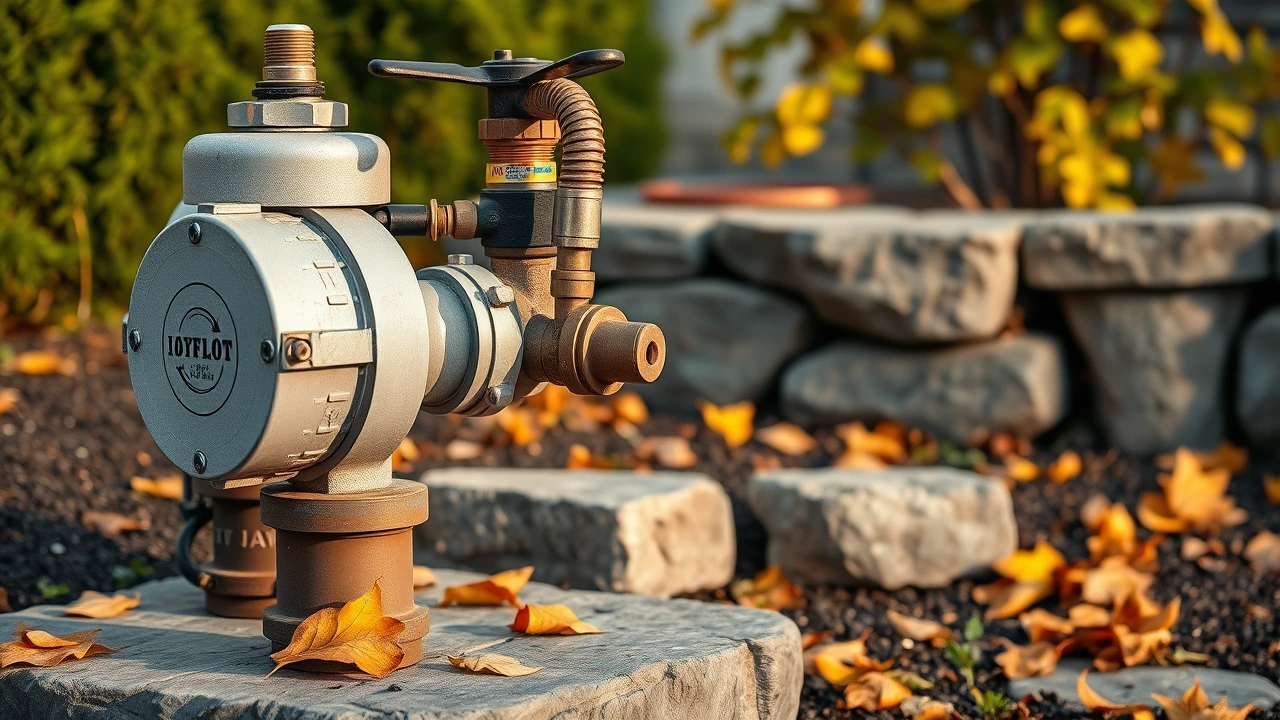
Winterizing an irrigation system in Ontario is not optional. Once water freezes inside PVC, poly, brass valves or a backflow preventer, it expands and splits whatever is holding it. A single cracked manifold can cost more than ten years of professional blowouts. This guide walks through when to winterize in southern Ontario, the blowout method we use on Hamilton, Burlington and Oakville systems, the safe PSI by pipe size, when a drain method is acceptable, and where the DIY route quietly goes wrong.
Quick TL;DR
Book your blowout before the first hard frost, usually late October in the GTA and Niagara. Use a rotary-screw compressor sized to 50 CFM or more, never a small home-shop tank. Hold pressure under the safe PSI for your pipe material (50 PSI for PVC, 80 PSI for poly) and run zones one at a time from the highest head down to the lowest until the heads spit dry air. A pro typically charges $75 to $150 for a residential system, and a single freeze burst can cost $600 to $2,500 to repair.
Blowout PSI by pipe size
| Pipe size | Material | Safe PSI | CFM compressor needed | Notes |
|---|---|---|---|---|
| 1/2 in | PVC | 50 PSI max | 30 to 50 CFM | Most residential lateral runs. Never exceed 50 PSI on PVC. |
| 3/4 in | PVC | 50 PSI max | 40 to 60 CFM | Common zone size for 4 to 6 spray heads. |
| 1 in | PVC | 50 PSI max | 50 to 80 CFM | Mainline or rotor zones. Larger CFM, not higher PSI. |
| 1/2 in | Poly | 80 PSI max | 30 to 50 CFM | Poly tolerates higher pressure but still vents better at low PSI. |
| 3/4 in | Poly | 80 PSI max | 40 to 60 CFM | Standard in many Hamilton retrofits. |
| 1 in | Poly | 80 PSI max | 50 to 80 CFM | Larger lateral or feeder lines. |
| Drip | Poly micro | 25 PSI max | 10 to 20 CFM | Low pressure only. Emitters blow out at higher PSI. |
Volume (CFM) moves the water. Pressure (PSI) does not. Crank PSI to compensate for a small compressor and you crack fittings instead of drying pipes.
When to winterize in Ontario
In Hamilton, Burlington, Oakville, Halton and Niagara, the first hard frost usually lands in the last week of October. We aim to have every residential system blown out between October 15 and November 10. Waiting until late November is a gamble. A single overnight dip to minus 4 C with water sitting in a backflow preventer is enough to split the brass body. The backflow sits above grade, so it freezes first, hours before buried pipes do.
If you are running a smart controller with a weather feed, set it to OFF for the season the same day you book the blowout. Do not just rely on the rain sensor. Lake-effect systems in Niagara and the Hamilton mountain can run cold air down well before the calendar says winter, so book early rather than chasing the first frost warning. For the broader fall sequence, see our November winterization checklist and the how to prepare your yard for winter guide.
Why a freeze burst is catastrophic
Water expands roughly 9 percent when it freezes. Inside a sealed pipe or valve, that expansion has nowhere to go, so it splits the weakest point. On most Ontario residential systems, the weak point is the backflow preventer (a $250 to $600 brass assembly) or a zone valve manifold (another $150 to $400 to replace). Cracked PVC underground is even worse, because finding the split means digging up the lateral, and the repair is rarely under $800. We have seen systems where the homeowner skipped one season and the spring startup found three separate splits totalling over $2,000.
Insurance does not cover irrigation freeze damage in almost any Ontario policy we have seen, because it is treated as deferred maintenance. The math on hiring a pro for $100 versus rolling the dice on a $1,500 repair is not close.
Blowout method step by step
The blowout method is what every Ontario pro uses. It pushes compressed air through the system to evacuate water from every zone, head, valve and lateral. Here is the exact sequence:
- Shut the irrigation main. Close the indoor shutoff that feeds the backflow. This isolates the system from house pressure.
- Drain the backflow. Open both test cocks on the backflow preventer to relieve trapped water. Leave them open through the winter.
- Attach the compressor. Connect to the blowout port downstream of the backflow, never upstream. Use a quick-connect rated for the line size.
- Set the regulator. Cap PSI at 50 for PVC, 80 for poly. Set this on the regulator before opening any zone valve.
- Open one zone at the controller. Manually activate the highest-elevation zone first. Higher zones drain best with gravity working with you.
- Run until heads spit dry air. Watch each head pop, mist, then go dry. Stop the zone within 60 seconds of dry air, not longer. Sustained dry air against a closed head melts seals.
- Repeat zone by zone, high to low. Cycle each zone twice with a 2 to 3 minute rest between passes to let residual water re-pool and blow out cleanly.
- Drain the controller and bag the backflow. Power off, drain any wall-mounted timer, and wrap the backflow in an insulated cover.
Drain method (when it works)
The drain method relies on gravity instead of compressed air. It only works if the system was designed for it: every lateral pipe must be sloped to a manual drain valve at the lowest point of each zone, with no traps or rises. In our experience, fewer than 1 in 10 residential systems in southern Ontario are built this way. Most installers in the 2000s and 2010s did not bother because blowouts are faster and more reliable.
If you do have a true drain-to-low-point system, the process is: shut the main, open every manual drain valve and every zone valve, leave them open until spring. Even then, the backflow and any above-grade riser must still be drained manually or blown out separately. If you are not certain your system is drain-method compatible, assume it is not and blow it out.
DIY risk: where home jobs go wrong
The most common DIY mistake is using a small home-shop pancake compressor. A typical 6-gallon, 2.6 CFM unit cannot move enough air volume to evacuate the lateral, so the homeowner cranks the regulator up to 100 PSI trying to compensate. That high-pressure, low-volume combination is the exact recipe for cracked PVC fittings, blown solenoids and split backflow bodies. The compressor builds pressure, dumps it, and the heads barely mist before the tank empties. Meanwhile, the surge spikes hammer every joint.
Other recurring DIY failures: connecting the compressor upstream of the backflow (which back-pressures the device and ruins it), forgetting to open the test cocks, running a single zone for ten minutes straight (overheating the rotor gears), and skipping the drip zones entirely. Each of these shows up in our spring service calls.
Why pros bring a 50+ CFM rotary compressor
A professional irrigation tech rolls up with a tow-behind rotary-screw compressor rated at 50 to 185 CFM. That volume is what lets us hold a steady 40 to 50 PSI on the regulator while still pushing enough air to evacuate a 100 foot lateral in under 2 minutes. The pressure stays low (safe for PVC), the volume stays high (effective at clearing water), and the system never sees a spike. A home tank cannot do this. Renting one for a day costs more than hiring the pro, before you factor in the learning curve and the risk of doing it wrong.
Pro cost in Ontario
For a typical 4 to 8 zone residential system in Hamilton, Burlington, Oakville or St. Catharines, blowout pricing in 2026 runs $75 to $150. Larger systems (10 to 16 zones, drip plus spray, multiple controllers) run $150 to $275. Most pros offer a spring startup bundle that includes the fall blowout for $200 to $325 total, which is usually the best value. See our irrigation system cost guide for full pricing context and our irrigation services page for what we include.
How to apply this on your yard
Decide which path fits your situation:
- Hire a pro: Default choice for most homeowners. Cheaper than one repair, faster than renting a compressor, no risk of damaging a $500 backflow.
- DIY with the right gear: Only viable if you have access to a 50+ CFM rotary compressor, understand zone sequencing, and have done it before. Borrowing a 6-gallon pancake from the garage does not count.
- Drain method: Only if your installer confirmed the system is sloped to manual drain valves at every low point. Verify in writing or assume no.
Whichever path, book or schedule it before mid-October. Late bookings get pushed into the first frost window, which is the highest-risk week of the year.
Common mistakes we see
- Using a small pancake compressor and cranking PSI to 100+ to compensate for low CFM.
- Connecting the compressor upstream of the backflow instead of downstream.
- Running one zone for 8 to 10 minutes straight, melting rotor gears.
- Forgetting drip zones entirely, leaving emitters full of water.
- Leaving the controller powered on with the rain sensor as the only safeguard.
- Skipping the backflow test cocks, so trapped water freezes inside the brass body.
- Booking the blowout after the first hard frost has already hit.
Frequently asked questions
When is the latest I can winterize in Ontario?
Aim for October 15 to November 10 in the GTA, Halton and Niagara. Past mid-November you are gambling against the forecast, and a single overnight frost is enough to crack a backflow.
Can I use my home air compressor?
Only if it can deliver 30+ CFM at a regulated 40 to 50 PSI continuously. Most home units are 2 to 6 CFM tank units. They cannot do this job safely. Renting a tow-behind for a day usually costs more than hiring a pro.
What PSI should I use on PVC pipe?
50 PSI maximum, never higher. PVC fittings crack at sustained high pressure. The fix for slow drying is more CFM, not more PSI.
Do I need to drain my backflow separately?
Yes. Open both test cocks after shutting the main and leave them open through winter. Even with a clean blowout, residual water in the brass body can freeze and split it.
What if I have drip irrigation?
Drip needs lower pressure, around 25 PSI max. Emitters and 1/4 in tubing blow out at higher PSI. Run drip zones last, briefly, at the lowest regulator setting.
How much does a freeze repair cost?
A cracked backflow runs $250 to $600 in parts plus labour. A split underground lateral can hit $800 to $2,500 once digging and repair are included. Either is far more than the $75 to $150 blowout.
Does insurance cover frozen irrigation damage?
In nearly every Ontario homeowner policy we have seen, no. It is classified as deferred maintenance, not sudden damage.
Should I bundle spring startup with the fall blowout?
Yes if your pro offers it. Bundles usually run $200 to $325 for both visits and lock in your spring slot before the May rush.
Ready to get your system blown out before the first frost? Request a free quote from the Peace Love Landscaping crew, or read the related guides: irrigation services, irrigation system cost, how to prepare your yard for winter and the November winterization checklist.