
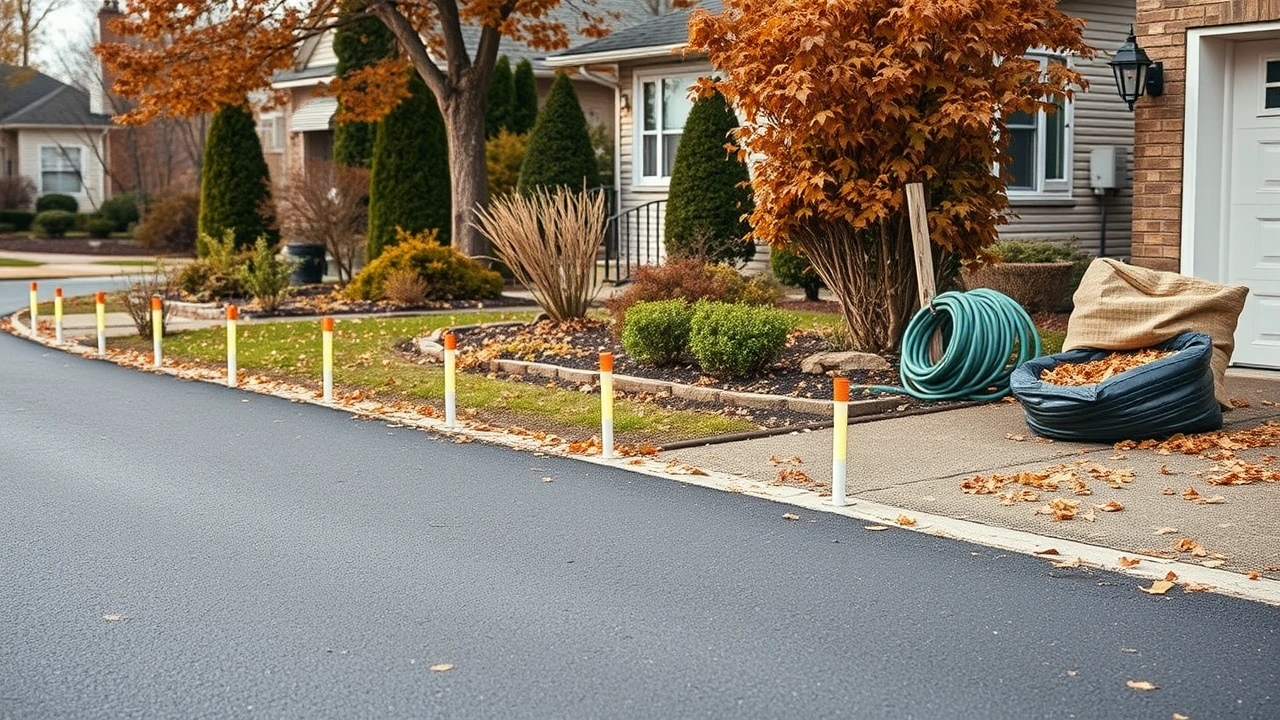
November is the month that decides what your yard looks like in April. Skip the last mow at the right height, leave hoses pressurized, forget to mark perennial beds, and you will spend May fixing damage that took 20 minutes to prevent. This is the same November winterization sequence we run on Hamilton, Burlington and Oakville properties every fall, in the order we actually do it, with the timing windows, time estimates and the calls about which jobs are worth paying a pro for.
Quick TL;DR
Do irrigation blowout and pool closing by the first week of November. Final mow at 2.5 to 3 inches (not scalped) and full leaf cleanup by mid November. Drain and disconnect every hose, mark perennial beds and driveway edges with stakes, and burlap-wrap first-winter evergreens by month-end. Book snow removal before the first storm hits, not after.
The plan
| Task | Window | Why | Time required | DIY vs pro |
|---|---|---|---|---|
| Irrigation blowout | Last week Oct to first week Nov | Prevents cracked manifolds and broken heads | 30 to 60 min | Pro (needs compressor) |
| Pool closing | By first week Nov | Avoids freeze damage to lines + pump | 2 to 4 hr | Pro for in-ground |
| Last mow at 2.5 to 3 in | Early to mid Nov | Right height resists snow mold and crown damage | 45 to 90 min | DIY |
| Leaf cleanup + bag | Mid Nov | Smothered lawn equals dead lawn by April | 2 to 4 hr | DIY or pro |
| Drain + disconnect hoses | Before first hard frost | Stops burst spigots and split hoses | 15 min | DIY |
| Mark perennial beds | Mid to late Nov | Tells plows where not to push snow | 20 to 40 min | DIY |
| Burlap-wrap first-winter evergreens | Late Nov | Prevents winter burn + salt damage | 30 to 60 min per shrub | DIY |
| Driveway snow stakes | Before first snowfall | Plows see edges + sod stays intact | 15 to 30 min | DIY |
Pair this with the longer-form how to prepare your yard for winter guide and the wider fall landscaping checklist for October prep.
Last mow: 2.5 to 3 inches, never scalped
The single most common November mistake is scalping the lawn down to 1.5 inches because someone heard short grass survives winter better. The opposite is true. Grass cut under 2 inches has less photosynthetic surface to store carbohydrates for spring green-up, and exposed crowns are more vulnerable to crown hydration injury during freeze-thaw. Cut over 3.5 inches and matted long blades trap moisture against the crown, which invites pink and gray snow mold.
The right final mow height for Ontario is 2.5 to 3 inches. Bag it (do not mulch it) on the final pass so you also remove the last of the leaf litter and short clippings that would otherwise mat. Sharpen the blade before the final cut so you get a clean shear, not a torn tip. If your lawn already looks rough heading into November, we cover the common causes in why is my lawn brown.
Leaf cleanup and final yard sweep
Leaves left thick on the lawn smother turf within 2 to 3 weeks of being wet. By April that section is dead and you are looking at sod repair. Get every leaf off the lawn, beds and patio by mid November. A thin layer of shredded leaves mulched into the lawn with a mulching mower is fine, but anything thicker than 1/4 inch needs to come off.
Bag leaves for municipal pickup or compost them. Skip blowing leaves into beds as instant mulch, they mat down and turn anaerobic. If you want to recycle them, shred first with a mower or leaf vac, then layer thin into the compost bin. Clean off patios, decks and walkways too, wet leaves stain pavers and rot deck boards over winter.
Drain and disconnect every hose
This is the cheapest, fastest job on the list and the one most often skipped. A hose left connected to an outdoor spigot through a hard freeze can crack the spigot, the pipe inside the wall, or both. We have replaced enough split copper to know it is a real number.
Sequence: shut off the indoor valve that feeds the outdoor spigot (most Hamilton-area homes have one), open the outdoor spigot to drain any standing water, then disconnect every hose. Drain the hoses fully (walk them out, raise one end), coil and store in a shed or garage. Frost-free spigots still need the hose disconnected, the hose itself keeps water in the line.
Mark perennial beds and driveway edges with snow stakes
Snow stakes are the difference between an intact yard in April and a sod replacement quote. Drive 4 ft fiberglass or wood stakes (reflective stakes work best) into the ground at:
- Both sides of the driveway, every 8 to 10 ft, set 6 to 12 inches in from the actual edge. Plows aim for the stake line.
- Corners of perennial and shrub beds that meet the lawn or driveway, so plow operators do not push snow piles onto perennials.
- Edges of new sod or fall seed from any source of street salt spray.
- Around dormant ornamentals that disappear under snow (hostas, daylilies, ornamental grasses cut short).
If you have booked a plow service, ask them what stake colour or height they expect. Some operators want orange reflective only.
Burlap-wrap first-winter evergreens
First-winter evergreens (any cedar, boxwood, yew or juniper planted that calendar year) lose moisture through their needles all winter but cannot replace it once the soil freezes. The result is winter burn: brown, dried-out tips by March. Burlap wrapping does two things: it cuts wind speed across the foliage, reducing desiccation, and it blocks salt spray from streets and driveways.
Set 3 wood stakes around each shrub, then wrap burlap around the outside of the stakes (not directly against the foliage). Tie with twine. Leave the top open so snow can settle on top of the shrub naturally, which actually adds insulation. Wrap by late November before the first wind chill stretch. Remove in early April after the worst of the salt-spray season ends.
Irrigation blowout: the one job worth a pro
Irrigation blowout uses a 10-plus CFM air compressor to push every drop of water out of the system before it freezes. The shop-vac and pancake compressor most homeowners own cannot move enough air to blow a residential zone clean. The result of a failed blowout is cracked manifolds, split poly lines and broken heads, which is a $400 to $1,500 spring repair instead of a $90 fall service.
Book your blowout for late October to first week of November, before overnight temps stay under -5 C. If you need it done this year, our irrigation services include blowout for Hamilton, Burlington and Oakville. Pool closing falls in the same window for the same reasons, in-ground systems should be pro-closed.
Snow removal booking and seasonal pavers
Book snow removal in October or early November, not after the first storm. Hamilton, Burlington and Oakville operators fill seasonal contracts by mid November and turn away walk-ups once snow falls. Our two companion guides cover the timing and the math: when to book snow removal and snow removal cost in Ontario. If you want a quote from our crew, our snow removal service covers driveways, walkways and salting.
One more timing note: do not seal pavers in November. Sealer needs 24-plus hours of dry weather above 10 C and clean dry stone. November weather in Ontario almost never delivers that. Plan paver sealing for late spring or early fall instead.
How to apply this on your yard
Run the sequence in this order across the first 3 weekends of November:
- Weekend 1 (first week of Nov): book irrigation blowout, pool closing if applicable, and snow removal. Final leaf sweep on lawn and patios.
- Weekend 2 (mid Nov): last mow at 2.5 to 3 inches, bagged. Drain and disconnect hoses. Pull annuals and add to compost.
- Weekend 3 (late Nov): mark perennial beds and driveway with snow stakes. Burlap-wrap first-winter evergreens. Replace burnt bulbs in landscape lighting. Move patio furniture and clay pots into the shed.
If snow shows up early, prioritize hose disconnect, mowing and stake placement. Wrapping and lighting can wait a week.
Common mistakes we see
- Scalping the final mow under 2 inches, then losing the lawn to snow mold by March.
- Leaving leaves on the lawn into December and finding bare dead patches in April.
- Skipping irrigation blowout to save $90, then paying $800 to fix split lines.
- Wrapping evergreens directly with burlap touching the foliage. Use stakes, leave an air gap.
- Forgetting to mark new sod or perennial beds, then watching the plow tear them up.
- Sealing pavers in cool, damp November weather. Sealer never cures, finish goes hazy.
- Booking snow removal after the first storm, when every operator is already full.
Frequently asked questions
What height should I cut my lawn for the last mow?
2.5 to 3 inches. Scalping shorter exposes crowns to winter damage, leaving it longer mats and invites snow mold.
When is the cutoff for irrigation blowout in Ontario?
Before overnight temperatures consistently drop under -5 C. In Hamilton, Burlington and Oakville that is the first week of November in most years. Earlier is fine, later is risky.
Do I really need to disconnect my hose if I have a frost-free spigot?
Yes. The hose itself holds water against the back of the spigot, which can freeze and crack the assembly. Disconnect regardless of spigot type.
Should I burlap-wrap every shrub in my yard?
No. Wrap first-winter evergreens, anything within 5 ft of a salted road or driveway, and any boxwood, cedar or yew you have lost branches on before. Mature, established shrubs can be left.
When should I book snow removal?
October or early November. Our when to book snow removal guide covers the timing window in detail. Operators fill seasonal contracts before the first storm.
Can I seal my pavers in November?
No. Sealer needs dry stone and 24-plus hours above 10 C to cure. Plan paver sealing for May or early September instead.
What about my deck boards over winter?
Sweep them clean, leave them dry. Do not cover with tarps, trapped moisture rots boards faster than open exposure. Move patio furniture and planters off the deck.
Is one fall fertilizer application worth it?
Yes, a late-season slow-release fertilizer applied in October before the final mow gives roots a head start the following spring. Skip it if you missed the October window, do not apply in November.
If you want the November list done for you (last mow, leaf cleanup, irrigation blowout, snow stakes, burlap wrap, snow contract), our crew handles full fall winterization across Hamilton, Burlington, Oakville and Halton. Bundle it with a seasonal snow removal contract for a single point of contact through April. Request a free quote and we will walk the property, build the November task list, and lock in your snow contract before the first storm.