
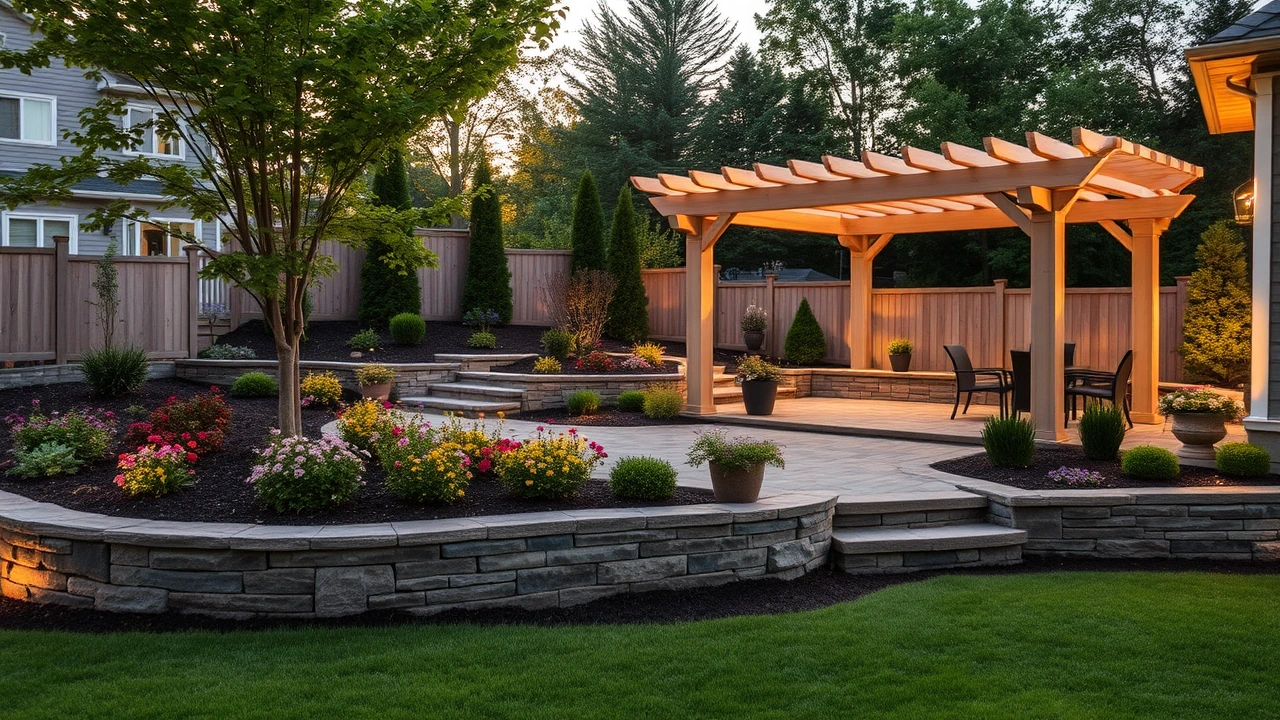
Hamilton is a tough town to design a landscape for, and most homeowners do not realise it until the first plant dies or the first patio shifts. The escarpment slices the city into Mountain and Lower with completely different microclimates, frost timing and soil. Westdale and Kirkendall have mature canopy that throws deep shade onto half the yard while the rest bakes in afternoon sun. Stoney Creek and Winona sit closer to lake-influenced clay that stays wet through May. Ancaster lots run large with long sight lines that punish a thin planting plan. Dundas valleys carry their own cold air pockets that wipe out borderline-hardy species the rest of the city can grow. A real Hamilton landscape design works backward from those constraints, not from a Pinterest board. It starts with grades, sun, soil and how the family actually uses the yard.
Quick verdict for Hamilton homeowners
For a real landscape design package in Hamilton in 2026, budget $1,500 to $4,500 for a single-area refresh plan, $4,500 to $9,000 for a mid-yard concept with planting and hardscape, $9,000 to $18,000 for a full-yard CAD master plan with 3D renderings, and $18,000 to $35,000+ for an estate master plan covering an Ancaster or escarpment-edge property. Hamilton sits on the Zone 6b and Zone 7a border depending on elevation and proximity to the lake, which changes the planting palette street by street. Any design that ignores grade, drainage or the escarpment microclimate will fail on build day. Always get a written scope showing deliverables, revision rounds, planting list, and whether the design fee credits toward the build.
2026 Hamilton landscape design cost
Prices below are 2026 design-only fees for Hamilton, including site visit, measure-up, base plan, concept rounds and final deliverables. Build cost is separate. Most clients credit 50 to 100 percent of the design fee toward the build when the same firm carries the project from plan into install.
| Tier | Scope and deliverables | Design fee | Timeline | Best fit |
|---|---|---|---|---|
| Refresh plan | Single-area concept: front beds, one patio zone or a pool surround. 2D plan, planting list, one revision. | $1,500 to $4,500 | 2 to 4 weeks | Westdale front-yard refresh, Mountain bed redesign, small Dundas courtyard |
| Mid-yard plan | Half the property: rear yard or front-and-side. 2D plan, planting palette, hardscape layout, 2 revisions, basic lighting concept. | $4,500 to $9,000 | 4 to 7 weeks | Most Hamilton family yards, Stoney Creek terracing concepts |
| Full-yard CAD master plan | Whole property: grading, drainage, hardscape, planting, lighting, irrigation zones. CAD plan, 3D renderings, phasing schedule, 3 revisions. | $9,000 to $18,000 | 6 to 10 weeks | Ancaster family estates, premium Mountain rebuilds, pool-yard coordination |
| Estate master plan | Large lots with multiple zones, ravine or escarpment edges. CAD plan, full 3D walkthrough, lighting plan, irrigation plan, conservation review coordination, unlimited revisions in scope. | $18,000 to $35,000+ | 10 to 16 weeks | Ancaster estate lots, escarpment-edge Mountain brow, Dundas valley ravine properties |
For a deeper line-item breakdown of where the budget actually goes between design fees, hardscape and planting, read our full Ontario landscape design cost guide. If you are still mapping the spaces and zones before booking, the backyard layout planning guide walks through the framework we use on every Hamilton site visit.
Common Hamilton design projects we build
Mountain rear-yard rebuilds and bed redesigns
Most of the Hamilton Mountain, from Gourley and Eastmount through Gilkson, Rolston and the Rymal corridor, is 1960s through 1980s subdivision stock on heavy clay. The original landscape was a strip of foundation cedars, a single maple, and a lawn. Forty years later the cedars are leggy, the maple has lifted the front walk, and the back is a mud pit by April. We redesign these yards around the way a Mountain family actually lives in 2026: a real entertaining patio off the kitchen, a screening layer of compact native shrubs along the rear fence, a small ornamental tree like serviceberry or eastern redbud to replace the dying foundation cedars, and a perennial border of switchgrass, little bluestem, coneflower and rudbeckia that runs through October. The deliverable is a 2D CAD plan, a planting list keyed to local nurseries, and a phased build budget.
Westdale and Kirkendall character-home front-yard plans
Westdale and Kirkendall around McMaster are heritage neighbourhoods where the design has to respect a 1920s or 1930s house, a mature canopy and a tight front yard. The temptation here is a busy plan with too many species fighting for attention. We design these the opposite way: a clean front walk in coursed stone or premium paver, two structural shrubs flanking the porch, a low boxwood or inkberry hedge defining the bed line, and a restrained perennial palette in three or four species that repeats along the length of the bed. Shade tolerance matters because the canopy is thick. Native and Zone 6b classics work best: foamflower, wild geranium, sedge, and oakleaf hydrangea where the sun lands. The plan includes a low-voltage lighting concept for the path and the front facade, because a Westdale house at night carries half its curb appeal in the lighting.
Ancaster full-yard CAD master plans
Ancaster from Meadowlands through Mohawk and out toward Wilson Street has the lot sizes that demand a real master plan instead of a piecemeal approach. We design these as full-yard CAD packages with 3D renderings of the key views: the kitchen window looking out, the back door arrival, and the entertaining patio looking back at the house. The plan covers grading and drainage first, hardscape layout second, planting third, and lighting and irrigation as overlay layers. Phasing is the difference-maker on an Ancaster project. Most clients cannot or do not want to build the entire $150K to $400K yard in one season. We write the plan so phase 1 lands the patio, fire feature and structural planting in year one, phase 2 adds the pool surround or pergola in year two, and phase 3 fills in the perennial and bulb layer in year three. Every phase stands on its own and reads as finished.
Stoney Creek and Dundas sloped-lot terracing concepts
Old Stoney Creek and the streets climbing toward the escarpment, plus the Dundas valley side streets running off Governors Road, share a single design problem: grade. A back door 1 m to 4 m above the rear fence cannot host a single flat lawn or patio. We design these as terraced systems on paper before a shovel touches the ground: an upper entertaining tier at door level, a 600 to 900 mm segmental block retaining wall with weeping tile, a mid-level garden tier with a fire pit or pergola, and a lower naturalised tier of native grasses, sumac, serviceberry and dogwood blending into whatever sits beyond the fence. The plan shows grading sections, geogrid layers, drainage discharge and a planting palette that will actually survive on each tier. For homeowners weighing the wall component on its own, our Ontario retaining wall cost guide covers the structural piece, and the leaning wall diagnostic explains what fails when these are designed without an engineer in the loop.
Why DIY design plans fail in Hamilton (and what we do differently)
The four design failures we see again and again on Hamilton DIY plans are the same every year. First, no grade work: a beautiful planting plan drawn over a yard that drains the wrong way. The plants drown by their second spring because nobody mapped where water actually goes during a Hamilton March thaw. Second, wrong hardiness zone: a Pinterest planting list copied from a Zone 8 California or Pacific Northwest yard, full of species that cannot survive a Hamilton Mountain winter where ground frost reaches 4 ft and wind chill at the escarpment edge runs colder than the city average. Third, scale problems: shrubs and trees specified at nursery size instead of mature size, so the plan that looks balanced on day one is a wall of overgrown viburnum by year five.
Fourth, no phasing: a $180,000 design that the family cannot build, so it sits in a drawer for three years until the kitchen reno eats the budget and the yard never happens. We design differently on every Hamilton site. We start with a real measure-up and grade survey, not a Google Earth screenshot. We build the planting palette around Zone 6b and 7a hardiness with native anchors like eastern redbud, serviceberry, switchgrass, little bluestem, oakleaf hydrangea and Joe Pye weed. We draw plants at 5-year and 10-year mature size in CAD so the spacing works long-term. And we write the plan in three or four phases with standalone budgets, so the family can build at their own pace and the yard reads as finished at every step. For homeowners filling in the planting layer themselves, our Ontario perennials guide covers the species we lean on most.
The Hamilton design process timeline
- Free on-site consultation. We walk the property, measure key dimensions, photograph existing grades, sun and shade patterns, soil and drainage clues. You leave with a realistic Hamilton 2026 cost band for both the design and the build.
- Design agreement and measure-up. We sign a fixed-fee design agreement, return for a full measure-up with laser and tape, and lock in scope, revision count and deliverable list.
- Concept design and 2D plan. We draft a 2D conceptual plan showing hardscape footprint, planting bed lines, key sight lines and proposed grading. We present it on screen, walk through the logic and capture revisions.
- CAD master plan and 3D renderings. For mid-yard and full-yard tiers we move to CAD master plan with planting list, materials schedule and 3D renderings of the key views. Lighting and irrigation layers come in at this stage.
- Permit and conservation review. If the design touches lot grading, sits near the escarpment, a regulated creek or Conservation Hamilton lands, we coordinate the review and adjust the plan to clear it before the build quote is final.
- Phased build budget and handoff. We deliver a phased build budget tied to the master plan, with priced phases and a recommended sequence. The design fee credit applies when we carry the build, and the planting list and hardscape spec go straight into the construction quote.
Permits and bylaws in Hamilton
The City of Hamilton does not require a permit for most planting plans or above-grade landscape design work that does not change the building envelope. The triggers that pull permits and reviews into the design process: any design that changes lot grading enough to require lot-grading re-certification, any work inside a pool enclosure (which falls under the pool fence bylaw with a 1.5 m non-climbable enclosure measured from the highest ground within 1.0 m of the fence, no gap that passes a 4-inch sphere and self-closing, self-latching gates), and any design that re-routes surface water across a property line. Even when no permit is required, the City of Hamilton drainage and lot-grading rules still apply, and a design that pushes runoff onto a neighbour can be the subject of a complaint.
For Hamilton properties near the escarpment, the Mountain brow, regulated creeks or Conservation Hamilton lands, the conservation review can add 4 to 8 weeks to the design timeline. We build that into the plan up front so the homeowner is not surprised. The full picture of what permits, what does not and what triggers a review across Hamilton, Burlington and Oakville sits in our permits guide.
Frequently asked questions
Do I get 2D plans or 3D renderings with a Hamilton design?
Both, depending on the tier. The refresh plan and mid-yard tiers deliver 2D CAD plans with planting lists. Full-yard CAD master plans and estate master plans include 3D renderings of three to five key views (kitchen window, back door arrival, entertaining patio, pool surround) so you can see what the yard will actually look like before any digging starts.
Does the design fee credit toward the build?
Yes, in most cases. When Peace Love Landscaping carries the project from design into install, we credit 50 to 100 percent of the design fee against the build invoice depending on tier. The design fee covers our time on the plan whether or not you build with us, but the credit is meaningful when we carry it through.
What hardiness zone is Hamilton, and which plants actually work?
Hamilton straddles Zone 6b and Zone 7a depending on elevation and proximity to Lake Ontario. The Mountain is colder, the Lower City and lake-influenced east end are warmer. Reliable native and adapted anchors we use across the city: eastern redbud, serviceberry, oakleaf hydrangea, switchgrass, little bluestem, Joe Pye weed, foamflower, wild geranium and northern sea oats. We avoid borderline Zone 7b and 8 species that look great in catalogues but die in a real Hamilton winter.
How long does a Hamilton landscape design take?
2 to 4 weeks for a refresh plan, 4 to 7 weeks for a mid-yard plan, 6 to 10 weeks for a full-yard CAD master plan, and 10 to 16 weeks for an estate plan. If Conservation Hamilton review is in scope, add 4 to 8 weeks for their process.
Do you handle phasing so I can build over multiple years?
Yes. Phasing is the most useful single feature of a real master plan in Hamilton. We write every full-yard and estate plan in three or four phases, each with its own standalone budget, build timeline and finished look. You can build phase 1 this year, phase 2 in two years, and phase 3 when the budget lands without the yard ever looking half-done.
Will you include native species in the planting plan?
Yes, by default. Our standard Hamilton planting palette leans 50 to 70 percent native species (eastern redbud, serviceberry, switchgrass, little bluestem, Joe Pye weed, native asters, milkweed) for pollinator value, drought tolerance and low maintenance. We round it out with proven adapted ornamentals where the design calls for them.
Can the design include a low-voltage lighting plan?
Yes. Full-yard and estate plans include a low-voltage lighting layer covering path lighting, downlighting from trees, facade wash and feature uplighting. We spec the transformer size, wire runs and fixture schedule so the lighting installer can quote directly off the plan.
What if my Hamilton yard backs onto the escarpment or a creek?
Then conservation review is part of the design process. We coordinate with Conservation Hamilton, adjust the planting palette to native and non-invasive species, set the build footprint outside the regulated area where required, and write the plan so the review clears without revisions. Build that timeline into your expectations: 4 to 8 weeks added on top of the standard design schedule.
Ready to talk about your Hamilton landscape design? Request a free consultation and we will book a site visit, usually within 2 business days. While you are scoping, the Hamilton landscaping hub shows the rest of what we build across town, the landscape design service page covers deliverables and process, and the Ontario landscape design cost guide walks through where the budget actually goes. For homeowners working on the planting layer themselves, the Ontario perennials guide and the backyard layout planning guide are the two we send most often before a first call.
Where we work across the City of Hamilton
Hamilton amalgamated in 2001, so the city limits reach a long way past the lower city. We take on landscape design and build right across it, and the ground changes more than most homeowners expect between one community and the next.
- Ancaster: escarpment-side lots with heavier clay and long approach driveways.
- Dundas: valley properties with mature tree canopy and tight rear access.
- Stoney Creek: benchland above the escarpment with a lake-moderated microclimate.
- Waterdown: newer subdivisions on former farmland, often shallow topsoil over till.
- Flamborough: larger rural properties where well and septic locations dictate layout.
- Glanbrook: flat former farmland with heavy clay and slow natural drainage.
If you are in any of those communities, you are inside our core service area and the pricing on this page applies to your property.
Planting the beds? See garden bed design ideas and spacing for Hamilton gardens.
Big tree in the way? See tree removal in Hamilton and what the City allows.