
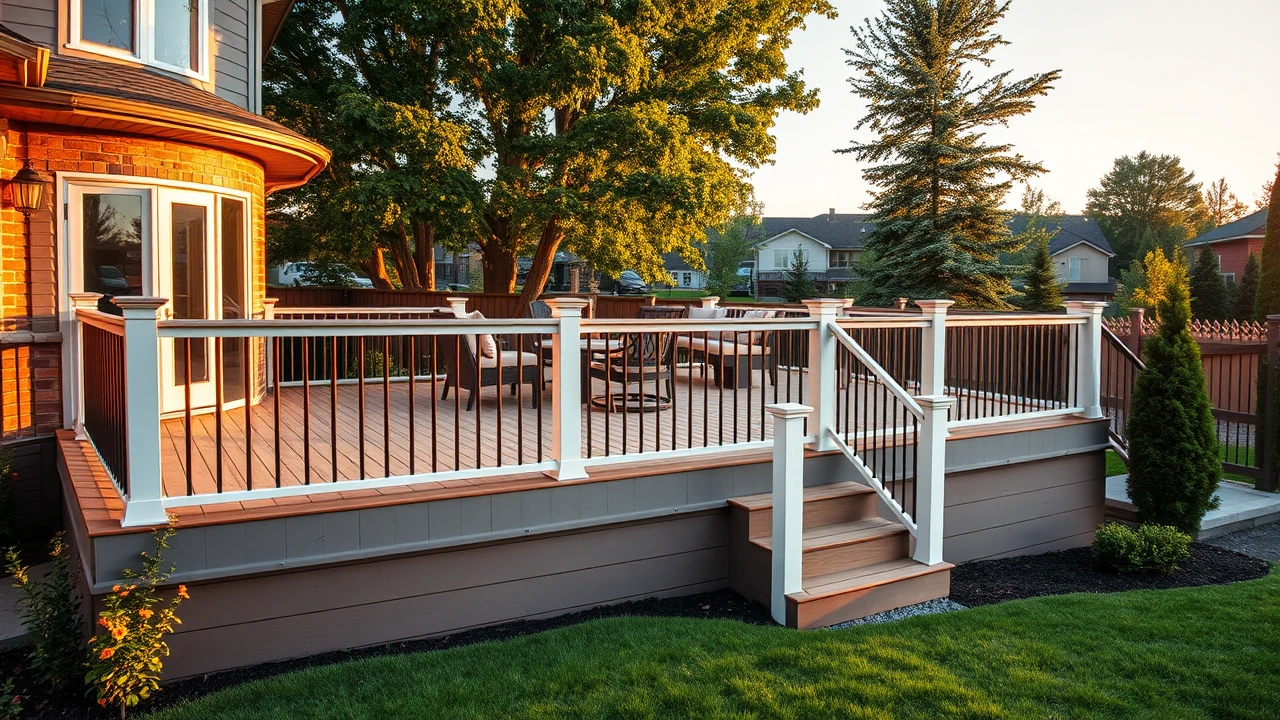
Burlington decks live or die on what is happening below the deck boards. The Aldershot clay belt north of Plains Road has a high water table and a frost cycle that will lift a poorly footed deck out of plane inside three winters. Tyandaga and the escarpment-edge lots have grade drops of 1 m to 3 m off the back door, which puts most of these decks above the 600 mm threshold where the Ontario Building Code starts demanding permits, drawings and inspections. Roseland and the central core have older homes where ledger attachment to the existing rim joist needs careful Z-flashing or the wall behind the deck rots quietly for a decade. Millcroft and Alton Village are newer build communities with engineered floor systems that complicate ledger work, and Orchard north of Dundas Street sits on heavier clay that pushes the footing decision toward helical piles over sonotubes. A Burlington deck built without thinking through footing depth, ledger detail and guard-rail code will fail a final inspection or worse, fail in service ten years in.
Quick verdict for Burlington homeowners
For a properly built, OBC-compliant deck in Burlington in 2026, expect $45 to $90 per square foot turnkey for pressure-treated framing and PT decking, $75 to $130 for PT framing with composite decking (Trex, TimberTech, Fiberon), and $130 to $200 for premium composite or cedar over engineered framing with helical piles. A typical 250 to 400 sq ft Burlington rear deck runs 2 to 4 weeks on site once the permit is in hand. Any deck above 600 mm (24 inches) off finished grade is a permitted structure under the Ontario Building Code and needs drawings, footings to 4 ft frost depth, and inspection sign-offs. Always get a written scope showing footing type and depth, ledger detail, joist spacing and railing spec before signing.
2026 Burlington deck cost
Prices below are turnkey installed costs for Burlington in 2026, including permit drawings and fees, helical pile or sonotube footings to 4 ft frost depth, pressure-treated framing, decking and railing as specified, code-compliant guards and stairs, and final inspection. They do not include screened-room enclosures, hot tubs, electrical, gas or pergola roofs.
| Tier | Materials and framing | Cost per sq ft | Lifespan | Best fit |
|---|---|---|---|---|
| Basic | PT framing, PT 5/4 decking, PT railing, sonotube footings | $45 to $70 | 15 to 20 years | Low ground-level decks, side-yard utility decks, basic Orchard rear decks |
| Mid-grade | PT framing 16 in spacing, composite decking (Trex Enhance, TimberTech Edge), aluminum picket railing | $70 to $110 | 25 to 30 years | Most Burlington family rear decks, Roseland and Millcroft mid-size builds |
| Premium | PT framing 12 in spacing, premium composite (Trex Transcend, TimberTech AZEK, Fiberon Concordia), glass or cable railing, helical piles | $110 to $160 | 30 to 40 years | Tyandaga elevated decks, Alton Village builds, walkout-basement decks |
| Luxury | Western red cedar or premium AZEK with hidden fasteners, glass railing, helical piles, integrated lighting and bench seating | $150 to $220 | 40+ years | Estate Tyandaga ravine lots, Aldershot lakefront-adjacent, two-storey decks |
To sanity check the numbers on your own square footage, run them through our deck cost calculator and read the full Ontario deck cost guide for the line-item breakdown. Still choosing decking material? Our pressure treated vs cedar vs composite comparison walks through the trade-offs.
Common Burlington deck projects we build
Walkout-basement and elevated rear decks in Tyandaga
Tyandaga and the escarpment-edge streets running up toward the Niagara Escarpment have grade drops of 1 m to 4 m between the back door and the rear yard. Most of these decks sit 1.5 m to 3 m off finished grade, well above the 600 mm OBC threshold and squarely into permitted-structure territory with full drawings, footings to 4 ft frost depth, 36 inch guards with 4 inch maximum baluster gaps, and an inspection sequence. We typically spec helical pile footings on these elevated builds because the auger bypasses the clay-heave issue and gets verifiable bearing capacity. The frame goes to 12 inch joist spacing for composite, the ledger is through-bolted with Z-flashing, and the railing is aluminum picket or glass for the view.
Pool-deck and ground-level decks in Roseland and Millcroft
Roseland and the Millcroft golf community are family yards where the deck is integrated with the pool, hot tub or a low patio. Most of these decks come in at or just below the 600 mm threshold to stay out of the permit path. We use sonotube footings to 4 ft frost depth, joist spacing at 16 inches for PT or 12 inches for composite, and we sequence the deck around the pool fence so the City of Burlington pool enclosure bylaw is satisfied. The surface gets a slight pitch away from the pool basin. Our deck vs patio comparison helps decide what to build where.
Lakefront-adjacent low decks in Aldershot
Aldershot, especially the streets between Plains Road and the lake from LaSalle Park toward Maple Avenue, has the highest water table in Burlington and a sharper frost cycle than the upper city. A low deck on standard sonotubes here often heaves over 5 to 10 winters as the saturated clay freezes. We strongly prefer helical piles on Aldershot lakefront-adjacent jobs: the pile goes below the frost zone to verified torque, with a documented bearing capacity. The deck itself is typically a 250 to 400 sq ft mid-grade composite over PT framing. Ravine-edge or lake-influenced lots may also need Conservation Halton review.
Newer-build rear decks in Alton Village and Orchard
Alton Village north of Dundas and the Orchard community on the east side are 2000s-era subdivisions with uniform grading and lot sizes. The standard rear deck here is 200 to 400 sq ft, attached to an engineered floor system on the house. Engineered I-joist rim attachment changes the ledger detail: we cannot lag-bolt into TJI flanges, so we through-bolt with backing blocks or transition to a freestanding deck on its own posts. We specify PT framing at 16 inch spacing for PT decking or 12 inch for composite, sonotube footings to 4 ft frost depth, and aluminum picket railing. A typical 300 sq ft mid-grade composite deck in Alton or Orchard runs $25,000 to $38,000 turnkey.
Why DIY decks fail in Burlington (and what we do differently)
The five failure modes we see again and again on Burlington DIY and handyman-built decks are predictable. First, footings too shallow: sonotubes poured 2 to 3 ft deep instead of below the 4 ft Ontario frost line. The footings heave every winter, the deck tilts, the railing racks out of square within 5 years, and the joints around the ledger open up. Second, ledger attachment without flashing: a PT ledger lag-bolted to the house rim with no Z-flashing above it. Water runs down the siding behind the ledger, the rim joist rots, and the homeowner finds out when the deck pulls away from the wall during a barbecue.
Third, joist spacing too wide: 24 inch spacing under composite decking that requires 16 inch maximum, which voids the Trex, TimberTech or Fiberon warranty and produces sag between joists. Fourth, guard rails out of code: residential guards below 36 inches, balusters more than 4 inches apart, or no graspable handrail on stairs over 3 risers. Fifth, untreated hardware in PT lumber: galvanic corrosion eats fasteners not rated for ACQ. We do it differently: helical piles or sonotubes to 4 ft frost depth, through-bolted ledgers with Z-flashing, joist spacing matched to decking spec, code-compliant guards and stairs, and hot-dip galvanised or stainless fasteners rated for ACQ.
The Burlington deck build timeline
- Free on-site visit. We measure the space, probe footing locations, check the house wall and rim joist condition for ledger attachment, verify grade drop and identify whether the deck triggers the 600 mm permit threshold. You leave with a realistic Burlington 2026 cost band.
- Design, drawings and written quote. We send a fixed scope with footing type and depth, framing spec, decking and railing brand and finish, stair detail, square footage and timeline. For permitted decks we prepare the drawings (plan, elevation, framing layout, footing schedule) the City of Burlington needs for permit submission.
- Permit submission. Decks above 600 mm finished grade need a City of Burlington building permit. We submit the drawings, pay fees and track the review. Standard permit timeline is 2 to 4 weeks once submitted.
- Footings. Helical piles or sonotube footings to 4 ft frost depth, inspected as required. Helical piles go in inside a day on most sites and produce a documented torque-to-capacity reading.
- Framing, ledger and deck boards. Through-bolted ledger with Z-flashing, PT joists at 12 in or 16 in spacing depending on decking spec, blocking at midspan, deck boards installed with hidden fasteners or top-screwed per material. Stairs framed with code-compliant rise and run.
- Railing, final inspection and walk-through. Code-compliant guards at 36 in minimum residential, 4 in maximum baluster gap, graspable handrail on stairs. Final inspection on permitted decks. Site walk-through with the homeowner before invoicing.
Permits and bylaws in Burlington
The Ontario Building Code triggers a building permit on any deck where the walking surface is above 600 mm (24 inches) from finished grade. The City of Burlington enforces this strictly. A permitted deck needs stamped drawings showing plan, elevation, framing layout and footing schedule, and goes through a footing inspection, a framing inspection and a final inspection. Standard permit timeline is 2 to 4 weeks. Guard rails on residential decks must be minimum 36 inches high with a 4 inch maximum baluster gap, and stairs over 3 risers need a graspable handrail.
Decks at or below 600 mm finished grade do not need a permit, but the construction detail still matters and the zoning bylaw setbacks still apply: most Burlington residential zones require minimum 4 ft setbacks from the side and rear lot lines for any deck structure. For decks near the escarpment or any regulated watercourse off Mount Nemo or the Niagara Escarpment, Conservation Halton review can add 4 to 8 weeks to the timeline. We handle the permit drawings, submission, inspections and any required Conservation Halton review as part of the build. Pool-deck builds also need to satisfy the City of Burlington pool enclosure bylaw, which measures fence height from any hardscape (deck included) within 1.2 m of the water.
Frequently asked questions
What kind of warranty do you offer on a Burlington deck?
Our standard Peace Love Landscaping warranty is 2 years on workmanship across the assembly (footings, framing, ledger, decking installation, railing), on top of the manufacturer warranty on the decking and railing materials. Trex, TimberTech and Fiberon all carry 25 to 50 year limited residential warranties against structural failure and fade-and-stain. Helical pile suppliers warrant the pile installation and torque-to-capacity reading. Full terms are in the signed contract.
Do I need a permit for my Burlington deck?
If the walking surface of the deck is more than 600 mm (24 inches) above finished grade at any point, yes, you need a City of Burlington building permit and an inspection sequence. If the deck stays at or below 600 mm, no permit is required, but zoning bylaw setbacks and pool enclosure rules still apply. We confirm the permit path on the site visit and handle drawings, submission and inspections as part of the build for permitted decks.
Helical piles or sonotubes for my Burlington deck?
Both can work to OBC depth (below 4 ft frost line). Sonotubes are cheaper on flat, accessible sites with workable soil. Helical piles are the better call on Aldershot lakefront-adjacent clay with high water table, on Tyandaga escarpment-edge slopes where excavation is awkward, on ravine-edge lots, and on any deck above 1 m off grade where verified bearing capacity matters. Helical piles also install in a day with no concrete cure, so the framing crew is on site faster.
How long does a Burlington deck build take?
For an unpermitted ground-level deck under 600 mm: 5 to 10 working days once materials land. For a permitted deck above 600 mm: 2 to 4 weeks for permit issuance, then 2 to 4 weeks on site for footings, framing, decking, railing and inspections. Most clients book in late winter for a May to August build slot, with the permit running in parallel with material lead times.
Composite, PT or cedar decking in Burlington?
Pressure-treated is the cheapest upfront but needs annual staining and has a 15 to 20 year lifespan. Composite (Trex, TimberTech, Fiberon) is the most common Burlington choice in 2026: $5 to $9 per square foot for the board, no annual stain, 25 to 50 year warranty, and warm underfoot in summer without splinters. Western red cedar is the premium natural look, $8 to $12 per square foot for the board, beautiful but needs sealing every 2 to 3 years to hold colour. Our decking material comparison walks through the trade-offs in detail. If your deck is already showing signs of trouble, the warping splintering squeaky deck diagnostic tells you whether to repair or rebuild.
What joist spacing do you use?
For pressure-treated 5/4 decking we use 16 in centre-to-centre joist spacing, which is OBC code for the span and decking thickness. For composite decking (Trex, TimberTech, Fiberon) we drop to 12 in centre-to-centre because the manufacturer warranty requires it and the material will sag between joists otherwise. For diagonal composite installs we go to 10 in centres. The joist spacing is in the written quote and the building permit drawings.
How do you flash the ledger so the house wall does not rot?
Z-flashing is non-negotiable. The PT ledger is through-bolted (not lag-bolted) to the house rim with structural bolts, then a metal Z-flashing is tucked behind the house siding above the ledger and folded down over the top of the ledger so water running down the wall is shed away from the joint. Without the flashing, water sits at the top of the ledger, the rim joist rots from behind, and the deck pulls away in 10 to 15 years. On engineered I-joist floor systems in newer Alton and Orchard builds we add backing blocks behind the rim before through-bolting.
Can I add a hot tub, pergola or screened room later?
Yes, if the deck is designed for it from the start. A hot tub adds 4,000 to 6,000 lbs of point load and needs footings and framing sized for that on day one. A screened room is a permitted structure in Burlington. We ask about future plans on the site visit and design once for the long term.
Ready to talk about your Burlington deck? Request a free quote and we will book a site visit, usually within 2 business days. While you are scoping the project, the Burlington landscaping hub shows the rest of what we build in town, the deck building service page covers framing specs and material options in detail, and the Ontario deck cost guide plus deck cost calculator let you sanity-check any quote you receive. Still choosing materials? Our pressure treated vs cedar vs composite comparison and the deck vs patio decision guide are both worth a read before you sign.