
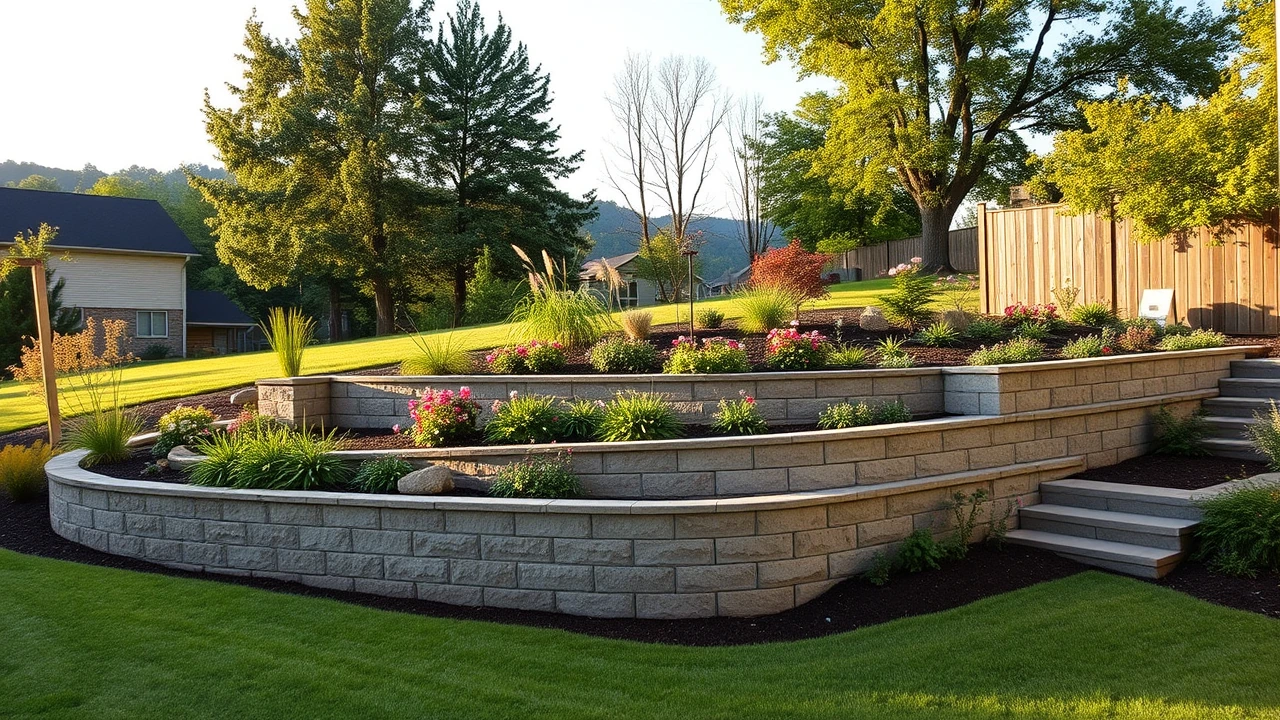
Stoney Creek is the toughest neighbourhood in the GTA west for retaining walls, and the reason is geography. The slope from Highway 8 up to the escarpment climbs roughly 100 m over a few kilometres, the soils through Old Stoney Creek and Lower Stoney Creek are heavy clay over shale, and the freeze-thaw cycle along the escarpment edge runs 80 to 100 events a season. Walls on Stoney Creek lots almost always work in tiers because a single tall wall is structurally and visually wrong on the grade. The wall has to handle saturated clay pushing from behind, frost lift from below, and de-icing salt from the driveway slopes that wash down half the streets in Winona and Fruitland. A DIY block wall stacked dry on Stoney Creek clay leans inside three winters. Doing it right means proper base, geogrid, drainage and the right block for the exposure.
Quick verdict for Stoney Creek homeowners
A properly engineered, code-compliant segmental retaining wall in Stoney Creek costs $55 to $130 per face foot turnkey in 2026 on most residential projects, with tall reinforced or terraced builds running $140 to $220 per face foot. A typical 30 to 60 face foot Stoney Creek garden wall takes 4 to 9 working days on site, weather permitting. Anything over 1.2 m measured from finished grade requires an Ontario Building Code engineered drawing and a City of Hamilton permit. Walls along the Mountain Brow, near Battlefield Creek, or close to Devil’s Punchbowl can also trigger Conservation Hamilton review. Always get a written scope showing block, geogrid layout, drainage stone, weeping tile and capstone before signing.
2026 Stoney Creek retaining wall cost
Prices below are turnkey installed costs for Stoney Creek in 2026, including site survey, excavation, geotextile, compacted 3/4 clear stone base, segmental block supply, geogrid embedment, drainage stone behind the wall, perforated weeping tile, capstones and site cleanup. They exclude engineered drawings on walls over 1.2 m and Conservation Hamilton review fees where required.
| Tier | Block brand and system | Cost per face foot | Lifespan | Best fit |
|---|---|---|---|---|
| Basic | Permacon Magnumstone Small or Techo-Bloc Mini-Creta, gravity wall under 900 mm | $55 to $90 | 30 to 50 years | Garden borders, low Winona front-yard tiers, Fruitland walkway edges |
| Mid-grade | Unilock Pisa2, Techo-Bloc Mini-Creta with geogrid, walls 900 mm to 1.2 m | $80 to $130 | 50 to 75 years | Most Old Stoney Creek backyard tiers, Lower Stoney Creek driveway edges |
| Premium | Unilock SienaStone, Techo-Bloc Borealis, large-format block with engineered geogrid, walls 1.2 m to 2.4 m | $120 to $180 | 75+ years | Mountain Brow slope retention, Battlefield-area terraced builds, Albion Falls properties |
| Luxury | Techo-Bloc Aberdeen, Permacon Magnumstone Standard, salt-tolerant large-format block, structural terraced systems | $160 to $220 | 75+ years | Estate Winona escarpment lots, multi-tier entertaining yards, complex Mountain Brow retaining |
To sanity check the numbers on your own face footage and wall height, run them through our retaining wall cost calculator and read the full retaining wall cost guide for the line-item breakdown.
Common Stoney Creek retaining wall projects we build
Terraced backyard walls in Old Stoney Creek
Old Stoney Creek, the streets climbing from Highway 8 toward King Street East and Lake Avenue, has lots that fall or climb 1.5 m to 3 m from the back door to the rear fence. A single tall wall on these grades is structurally aggressive and visually awful. We build these as two-tier or three-tier systems: a lower 600 to 900 mm segmental block wall holding the upper patio terrace, a flat planted bench of 1.5 to 2.5 m, then a second 600 to 900 mm wall stepping up to a garden or fire-pit landing. Each tier gets a 6 inch compacted 3/4 clear base, full geogrid embedment back into the slope every other course, drainage stone and a perforated weeping tile piped to a side-yard discharge. The tiered approach also keeps each wall under the 1.2 m engineered-drawing threshold, which is faster and cheaper than a single tall reinforced wall.
Driveway and front-yard retaining in Lower Stoney Creek
Lower Stoney Creek, from Centennial Parkway through Green Road to Fifty Road, has hundreds of post-war bungalows where the driveway cuts across a side slope and the original concrete retaining curb has failed. These are 30 to 80 face foot walls running along the driveway edge. The exposure is brutal because winter de-icing salt washes down the driveway every freeze-thaw cycle. We spec a salt-tolerant Techo-Bloc or Permacon block, set the base below the 4 ft frost line, use full-height drainage stone with a weeping tile out the low end, and finish with a heavy capstone that takes the snow-plow brush without chipping.
Escarpment-edge walls along the Mountain Brow and Albion Falls
The streets running along the Mountain Brow from Felker’s Falls through to Albion Falls have some of the most dramatic lots in Hamilton, and some of the most complicated retaining requirements. Grade changes of 3 m to 6 m, regulated ravine setbacks, and Conservation Hamilton review on anything near the escarpment edge or the regulated watercourse running into Battlefield Creek. We design these as engineered terraced systems with large-format Unilock SienaStone or Techo-Bloc Borealis block, full geogrid grids running 60 to 80 percent of the wall height back into the slope, drainage layers between tiers, and an Ontario Building Code engineered drawing stamped by a licensed structural engineer for any wall section over 1.2 m. Premium block here is the right call because the design budget on a Mountain Brow lot will already carry it, and the visual scale of the wall has to match the house.
Garden and walkway walls in Winona and Fruitland
Winona and Fruitland, between Highway 8 and the QEW from Winona Road through to Fifty Road, have larger lots with gentler grades but real soils issues: heavy clay subsoil, pockets of fill from old orchard conversions, and saturated spring water tables. The walls here are usually shorter, 400 to 900 mm garden and walkway edge walls in mid-grade Permacon or Techo-Bloc Mini-Creta. Base prep still has to clear the active frost zone with 6 inches of compacted 3/4 clear over geotextile. For Winona homeowners pairing the wall with a patio, the same crew handles the interlocking patio in a single mobilisation.
Why DIY retaining walls fail on Stoney Creek clay (and what we do differently)
The four failure modes we see again and again on torn-out Stoney Creek DIY walls repeat every season. First, base failure: blocks stacked on 3 inches of bagged paver base or directly on the clay, with no geotextile separation. The clay pumps fines up into the base through freeze-thaw, the base loses bearing, and the wall settles unevenly. The first sign is a step in the cap line. Second, no drainage: no weeping tile, no drainage stone behind the wall, just blocks stacked against backfill clay. Hydrostatic pressure from saturated clay in spring blows the wall outward by year three, and the wall develops the classic Stoney Creek lean toward the lawn.
Third, no geogrid: gravity-only walls built taller than 900 mm in mid-grade block. Without geogrid embedment back into the retained soil, anything over a metre fails in shear within a decade. Fourth, wrong batter and no engineered drawing on tall walls: a wall built bolt-vertical instead of with a 1 inch per course batter, and any wall over 1.2 m built without the OBC engineered drawing. We do it differently: 6 inches of compacted 3/4 clear base below frost, geotextile against the clay, full-height drainage stone, perforated weeping tile to discharge, geogrid every other course over 900 mm, and 1 inch per course batter on every wall.
The Stoney Creek retaining wall install timeline
- Free on-site visit. We measure the grade, probe the soils, check the drainage path from the wall to a legal discharge, photograph existing conditions, and talk through the use of the upper and lower spaces. You leave with a realistic Stoney Creek 2026 cost band.
- Design, drawings and written quote. We send a fixed scope with block spec, base depth, geogrid layout, drainage detail, weeping tile route, capstone product, face footage and timeline. Walls over 1.2 m include the engineered drawing line item.
- Permit and Conservation Hamilton check. Walls over 1.2 m need a City of Hamilton permit and an engineered drawing. Walls near Devil’s Punchbowl, Battlefield Creek or the escarpment edge often need Conservation Hamilton review.
- Excavation and base. We strip sod and excavate to below frost at 4 ft for the base trench, set non-woven geotextile against the cut, and place 6 inches of compacted 3/4 clear stone in 2-inch lifts.
- Block, drainage and geogrid. First course is set level and pinned to the base. We lay block in running pattern with 1 inch per course batter, place drainage stone behind the wall full height, run perforated weeping tile at the base piped to discharge, and embed geogrid every other course on walls above 900 mm.
- Capstones, backfill and cleanup. We adhere capstones with construction adhesive rated for outdoor use, backfill the top course with topsoil, restore grades above and below, and walk the site with you before final cleanup.
Permits and bylaws in Stoney Creek
The City of Hamilton requires a building permit and a stamped OBC engineered drawing for any retaining wall over 1.2 m measured from finished grade at the base to the top of the wall. Walls under 1.2 m generally do not need a permit, but still have to respect lot-grading certification and the City drainage bylaw. The 1.2 m threshold is the most important number in retaining wall planning in Stoney Creek, because most of the slope between Highway 8 and the brow tempts homeowners into a tall single wall when a tiered system would be both cheaper and code-friendly.
Stoney Creek also sits inside Conservation Hamilton’s jurisdiction along the escarpment, the Devil’s Punchbowl regulated area, and along Battlefield Creek to the lake. Any wall inside the regulated allowance, typically 30 m from a watercourse or escarpment edge, needs a Conservation Hamilton permit. Review can add 4 to 8 weeks. Our landscaping permits guide for Hamilton, Burlington and Oakville covers the steps. We handle the permits and inspections as part of the build.
Frequently asked questions
What kind of warranty do you offer on a Stoney Creek retaining wall?
Our standard Peace Love Landscaping warranty is 2 years on workmanship across the assembly (base, geogrid, drainage stone, weeping tile, block layout, capstone adhesion), on top of the manufacturer warranty on the block itself (Unilock, Techo-Bloc and Permacon carry 25-year to lifetime transferable warranties against structural defects in the block). Engineered walls also carry the structural engineer’s sign-off on the drawing.
When do I need an engineered drawing for a Stoney Creek wall?
Ontario Building Code triggers an engineered drawing at any wall over 1.2 m measured from finished grade at the base to the top of the wall. On Stoney Creek slopes, we often design tiered systems that keep each individual wall under 1.2 m, which is faster and cheaper than a single tall wall. Walls over 1.2 m get a stamped drawing from a licensed structural engineer as a line item on the quote.
Why is geogrid important on Stoney Creek lots?
Geogrid is a high-strength polymer mesh laid between block courses and extending back into the retained soil. It locks a portion of the soil into the wall structure, so the wall acts as a reinforced mass rather than a stacked gravity facade. On Stoney Creek’s sloped clay lots, where the retained soil is heavy and saturated for parts of the year, geogrid is the difference between a wall that holds for 75 years and a wall that leans by year ten. Required on anything over 900 mm in most block systems.
How do you handle drainage behind the wall?
Three layers. Non-woven geotextile against the cut clay subsoil so fines cannot migrate into the drainage stone. Full-height 3/4 clear drainage stone behind the wall, the full thickness of the block. And a 4 inch perforated weeping tile at the base, wrapped in sock, piped to a side-yard or street discharge so captured spring runoff leaves the wall instead of stacking behind it. This is the single biggest factor in long-term wall life on Stoney Creek clay.
What block holds up best against driveway de-icing salt?
Salt-tolerant segmental block from Techo-Bloc, Permacon and Unilock is rated for chloride and freeze-thaw exposure. We spec these for any wall within splash distance of a driveway or sidewalk that gets salted. Standard concrete garden block will spall and pit within a decade under repeated salt exposure, which is why so many Lower Stoney Creek driveway walls from the 2000s are crumbling at the cap line.
Can you build a retaining wall in winter in Stoney Creek?
No. Our Stoney Creek wall install season is roughly April through November. We do not set block on frozen base or backfill against frozen clay, because the spring thaw will move the assembly and crack the bond between block and base. Most clients book in late winter for a May to August build slot, and Conservation Hamilton review can push a project from spring into summer.
My wall is already leaning. Do I need a full rebuild?
Usually yes, although it depends on the cause and the height. A wall leaning because of base failure or missing drainage cannot be straightened, the bond between courses and the load path is already compromised. A wall leaning because of a single failed section sometimes allows a partial rebuild. Our leaning, bulging or cracking wall diagnostic walks through the failure modes and what each one means for repair vs rebuild.
Can you tie the wall into a new patio or driveway?
Yes, and on sloped Stoney Creek lots it is almost always the right call. Combining the wall with a patio or driveway into one mobilisation saves two or three days of setup costs, gives a single warranty across the whole assembly, and lets us tie the drainage from the wall, patio and downspouts into one coordinated discharge. The same crew handles all three.
Ready to talk about your Stoney Creek retaining wall? Request a free quote and we will book a site visit, usually within 2 business days. While you are scoping, the Stoney Creek landscaping hub shows the rest of what we build along the slope, the retaining walls and hardscaping service page covers block systems and engineering, and the retaining wall cost guide plus cost calculator let you sanity-check any quote you receive. If your current wall is already moving, the leaning, bulging or cracking wall diagnostic tells you whether to repair or rebuild, and the Stoney Creek interlocking patio page covers the surface work that usually pairs with a new wall.