
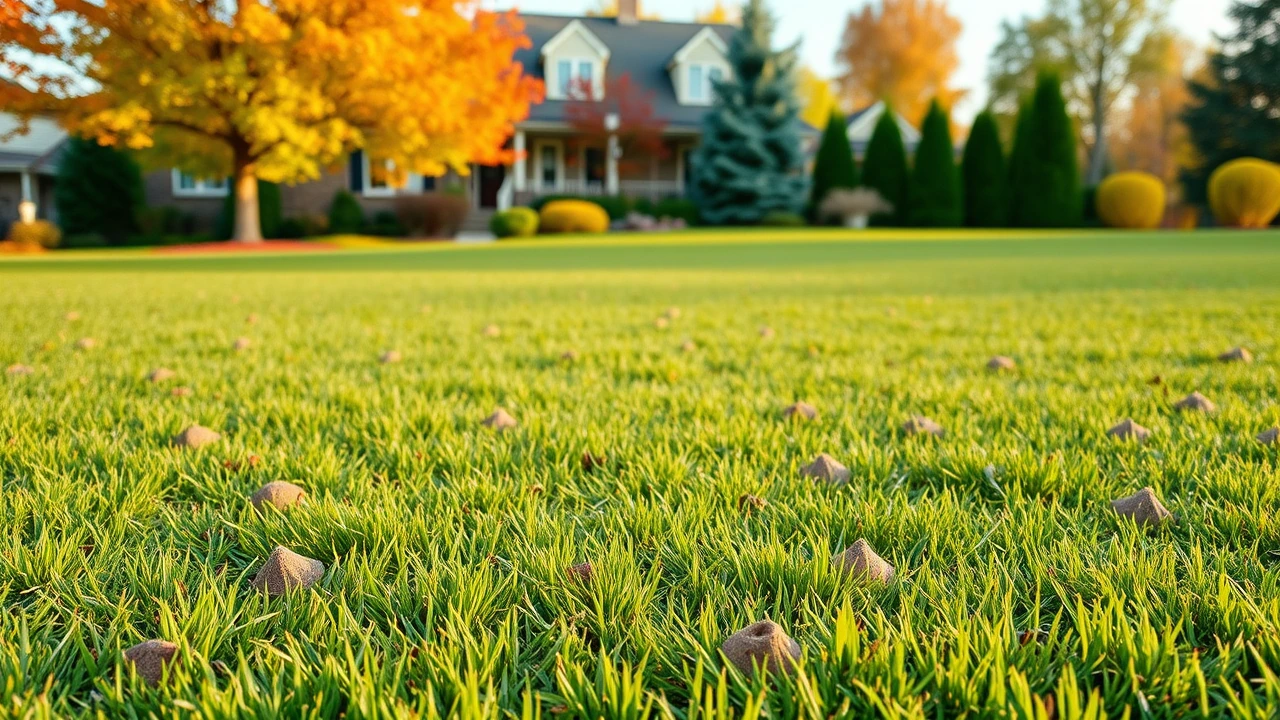
Aeration and overseeding are the single highest-leverage thing you can do to a tired Ontario lawn. Done right, in the right week, you go from thin and patchy in August to dense and green by mid October, and the lawn comes out of winter ahead of every untreated neighbour. Done wrong, in April when everyone else is doing it, you waste seed, money and weekends. Below is the 2026 calendar and method we use across Hamilton, Burlington, Oakville and Niagara.
Quick TL;DR
The best window to aerate and overseed an Ontario lawn is late August to mid September, when soil temperatures sit at 13-18C. Use a core aerator, not a spike, and pull plugs 5-10 cm deep on 7-10 cm spacing. Overseed at 4-8 lb per 1000 sq ft with a Kentucky bluegrass and fine fescue blend. Water lightly twice a day for 14 days until germination, then taper. Frost-seed in late February or early March as a cheaper alternative.
The schedule
| Task | Best window | Soil temp | Rate per 1000 sq ft | Notes |
|---|---|---|---|---|
| Frost seed (alternative) | Late Feb to early March | Below freezing at surface | 2-4 lb seed | Cheap, works on thin lawns. No aeration. Lower germination than fall. |
| Spring overseed (if must) | Late April to mid May | 10-13C | 4-6 lb seed | Competes with weeds and pre-emergent. Lower success rate. Avoid if possible. |
| Summer prep | Mid August | 18-22C | Mow at 3.5 inches | Cut existing lawn short before fall aeration, water deeply. |
| Core aerate + overseed (BEST) | Late Aug to mid Sept | 13-18C | 4-8 lb seed | Highest germination, lowest weed pressure, pairs with fall fertilizer. |
| Starter fertilizer | Same day as seed | 13-18C | 0.75 lb N (18-24-12) | Phosphorus drives root development on new seedlings. |
| Late seed (last call) | Late September | 10-13C | 5-8 lb seed | Risky, frost can kill seedlings before they tiller. Hamilton cutoff Oct 1. |
| Dormant seed | Early to mid November | Below 5C | 4-6 lb seed | Seed sits, germinates next April. Works but unpredictable. |
Why fall beats spring (every time)
Three reasons. First, soil temperature. Cool-season seed (KBG, fescue, ryegrass) germinates best when soil sits at 13-18C. Hamilton soil hits that range in mid May and again from late August through late September. Spring window is short and gets cut off by summer heat. Fall window is long, stable, and trends warmer at the seed and cooler in the air, which is exactly what germination wants.
Second, weed competition. Crabgrass, broadleaf weeds and annual grasses germinate in spring alongside your seed and out-compete it for light and water. In fall, those weeds are dying back. Your new seed has the field to itself.
Third, root development time. Seed planted in September has 6 to 8 weeks of root-growing weather before frost, plus a full spring of cool growth before summer stress. Spring seedlings get maybe 6 weeks of root before they hit July heat with shallow roots and die. We have replaced more failed spring overseeds in clients yards than we can count.
Core aeration vs spike aeration
Core aeration pulls actual plugs of soil and thatch out of the lawn, leaving open channels 5-10 cm deep. The plugs lie on top and break down within 2 weeks. Air, water, fertilizer and seed all reach the root zone. This is what you want.
Spike aeration just punches holes. It does not remove soil. On compacted clay (which most of Hamilton sits on), spike aerators actually make compaction worse by pressing soil sideways into the surrounding root zone. The shoe-spike aerators sold at big-box stores are essentially decorative. Skip them.
Rent a powered core aerator for $80-$120 per day at Home Depot or a local rental shop. Make two passes at 90 degrees to each other so the hole pattern is on a roughly 7-10 cm grid. Or hire a local crew. We do this as part of lawn care maintenance across the GTA-Hamilton corridor.
Picking the right seed
For Ontario lawns, a blend of Kentucky bluegrass (KBG), turf-type tall fescue and fine fescue (creeping red, chewings, hard fescue) is the standard. KBG gives colour and self-repair through rhizomes. Tall fescue adds drought tolerance and deep roots. Fine fescue handles shade. Skip the cheap "contractor mix" that is mostly annual ryegrass, which dies in winter.
Read the seed tag. Look for at least 90% germination, less than 0.5% weed seed, and a named cultivar list. Premium blends run $40-$80 per 10 lb bag. For sun and partial sun lawns, a 50% KBG and 50% turf-type tall fescue blend works across most Hamilton properties. For full shade, go 70% fine fescue. For wear areas around play structures, lean tall fescue.
Overseed rates and soil prep
Rate depends on what you are doing. For a healthy lawn you are just thickening up, 2-4 lb per 1000 sq ft is plenty. For a thin or patchy lawn that needs real renovation, 4-6 lb per 1000 sq ft. For bare spots after a full slice or scalp, 6-8 lb per 1000 sq ft.
Prep matters as much as the seed. Mow the existing lawn to 2.5 inches the day before. Rake out heavy thatch (more than 1/2 inch) or de-thatch with a power rake. Core aerate. Spread seed with a rotary spreader at half rate in two perpendicular passes for even coverage. Apply starter fertilizer same day. Topdress thin spots with 1/4 inch of compost or screened topsoil to improve seed-to-soil contact. If you are doing a full re-grade or thinking about sod instead, read sod vs hydroseed vs seed and sod cost in Ontario first.
Watering and mowing new seed
This is where most DIY overseeds fail. Seed needs constant moisture at the surface for the first 14-21 days. That means light watering 2 to 3 times per day for 5-10 minutes each, not one long soak. Keep the top 1/4 inch of soil consistently damp. Once you see germination (5-10 days for ryegrass, 10-14 for fescue, 14-21 for KBG), back off to once a day. After 4 weeks, transition to deep, infrequent watering. See our watering schedule guide for the long-term rhythm.
Do not mow until new seed is at least 3 inches tall, and when you do, only take off the top inch with a sharp blade. Mow at 3 inches or higher for the rest of the year. Tall grass shades out weeds and develops deeper roots. Avoid all herbicide for at least 8 weeks after overseed, since pre-emergent will kill new seed too.
Frost seeding in late winter
If you missed the fall window, frost seeding is the budget backup. In late February or early March, when overnight temperatures still freeze but daytime sun thaws the surface, broadcast seed directly onto bare or thin areas. The freeze-thaw cycle pulls seed into the soil, and it germinates as soon as soil temperatures climb in April. Works well for fescue and ryegrass, less reliable for KBG. Rate is 2-4 lb per 1000 sq ft. No aeration needed.
It is cheaper than fall overseeding but the germination rate is lower (maybe 50-70%) and you cannot apply starter fertilizer with herbicide premixed. We use frost seeding as a fix for clients who missed September, not as a primary method.
How to apply this on your yard
Plan around lot size and how thin the lawn really is. Most Hamilton-area properties fall into these buckets:
- Small urban lot (under 1500 sq ft of lawn): rent a small core aerator for 4 hours ($40-$60), one 5 lb bag of premium seed ($30-$50). Total DIY: under $150. One Saturday.
- Typical Hamilton or Burlington lot (1500-4000 sq ft): half-day aerator rental, 10-15 lb of seed, starter fertilizer. DIY total: $200-$350. Hired: $500-$900.
- Larger Ancaster, Waterdown or Halton lot (4000-10,000 sq ft): full-day rental or hire it out. 20-40 lb of seed. DIY total: $400-$700. Hired: $900-$1700.
- Estate or commercial (10,000+ sq ft): always hire. Truck-mounted slit seeders make a real difference at this scale.
If your lawn is more than 30% weeds or bare, overseeding alone will not save it. You are in sod installation territory. Same if drainage is the real problem, in which case start with why water pools in your backyard.
Common mistakes we see
- Aerating and overseeding in April or May, then watching it cook in July.
- Using spike aerators or shoe-spike attachments on compacted clay, making compaction worse.
- Buying cheap contractor-mix seed (mostly annual ryegrass) that dies the first winter.
- Skipping starter fertilizer with phosphorus, leaving new seedlings without root fuel.
- Watering once a day instead of 2-3 times a day during germination, drying out the seed.
- Applying pre-emergent crabgrass control within 8 weeks of overseed, killing both.
- Mowing too short or too soon and ripping out new seedlings before they tiller.
Frequently asked questions
When is the best time to aerate and overseed in Ontario?
Late August to mid September, when soil temperatures sit at 13-18C. This is the highest-germination, lowest-weed-pressure window in the entire year for cool-season grass.
Can I aerate in spring instead?
You can, but expect lower success. Spring overseeds compete with weeds, get cut short by summer heat, and have shallow roots heading into July. Fall outperforms spring on every measure.
How often should I aerate?
Every year on clay soils (most of Hamilton, Burlington, Oakville). Every 2-3 years on sandy or well-drained soils. High-traffic lawns benefit from annual aeration regardless.
Do I have to overseed when I aerate?
No, but you should. The open holes are perfect seed-to-soil contact you will not get otherwise. Doing both at once doubles the value of one Saturday.
How long until I see results?
Germination in 10-21 days depending on species. Visible fill-in by week 4-6. A renovated lawn looks like a finished lawn by next May.
Should I leave the soil plugs on the lawn?
Yes. They break down within 2 weeks and return organic matter and microbes to the surface. Raking them off defeats half the benefit.
Can I aerate a wet lawn?
Slightly moist soil is ideal. Soaking wet soil smears and seals the holes. Bone-dry soil is too hard to penetrate. Water 2 days before aerating if there has been no rain.
What about new sod, can I aerate it?
Wait at least a full year after install. New sod needs that time to knit roots into the base soil. After year one, aeration is encouraged.
If you want the fall window handled for you, we book aeration and overseed routes across Hamilton, Burlington, Oakville and Niagara from mid August through late September every year, paired with the fall fertilizer apps in our maintenance program. Slots fill by mid July. Request a free quote and we will get you on the schedule.
Booking it out instead? See what aeration and overseeding cost in Ontario alongside the rest of the 2026 lawn care pricing.