
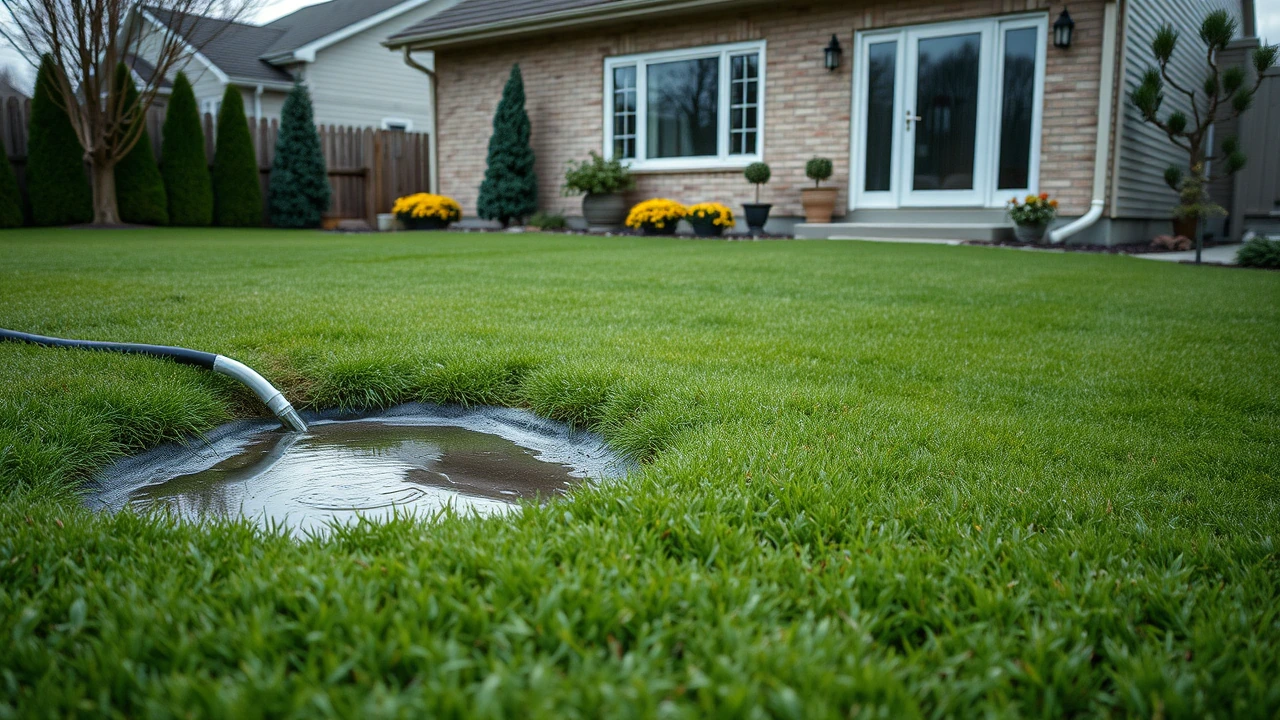
Standing water in a Hamilton, Burlington or Oakville backyard is almost never one problem. It is usually grade, soil and roof water stacking up at the same low spot. The good news: most pooling has a clear cause once you walk the yard with a level and a hose. This guide gives you the same 8-point diagnostic our crew runs before quoting any French drain, swale or regrade across Halton and Niagara in 2026.
Quick diagnosis
If water pools within 2 m of the foundation, grade is the prime suspect and you fix it before anything else. If it pools in the middle of the lawn 24 hours after rain, you are looking at clay subsoil plus compaction, and the answer is a French drain or dry well. If it only pools under a downspout, a 3 m extension solves it for under $60. If the whole yard sheets toward one corner, you need a swale or catch basin tied to the storm system.
Diagnostic table: match your symptom to the cause
| Symptom | Likely cause | DIY fix | Pro fix cost |
|---|---|---|---|
| Puddle within 2 m of foundation | Negative grade toward house | Topsoil regrade, 6 in drop over 10 ft | $1,200 to $4,500 |
| Water still standing 24 h after rain | Clay subsoil + compaction | Core aerate, topdress with sand | $2,800 to $6,500 French drain |
| Puddle directly under downspout | Roof water dumping at grade | 3 m flex extension, $40 | $350 to $900 buried pipe to daylight |
| Wet spot 3 to 6 m from house wall | Sump pump discharge too close | Extend discharge line | $450 to $1,200 buried run |
| Whole lawn squishy, builder yard | Subgrade compaction from construction | Aeration + topdress, slow | $3,500 to $9,000 regrade + drain tile |
| Water trapped behind new patio | Hardscape blocking flow path | None, design issue | $1,800 to $5,000 channel drain retrofit |
| One persistent bowl mid-lawn | Low spot from settled fill | Cut sod, fill, re-sod | $600 to $1,800 |
| Water arrives from neighbour yard | Upstream grading dump | None legally on their side | $2,200 to $7,500 interceptor swale |
1. Negative grade toward the house
This is the most common and most dangerous cause of basement leaks in Hamilton stone-foundation homes and Burlington 1970s splits. Code wants 6 inches of fall in the first 10 feet away from the wall. Most yards we inspect have 0 to 2 inches, and a few actually slope back.
How to confirm
Set a 4 ft level on the soil at the foundation with a 2x4 extension. Anything less than 2 in of drop end to end is borderline. If the bubble reads level or tips back toward the wall, you have negative grade. Cross-check by spraying a hose at the wall for 5 minutes and watching where water travels.
How to fix
Strip sod 6 ft out from the foundation, import clean triaxle topsoil (not black garden mix, it slumps), build a 6 in crown at the wall feathered to existing grade, then re-sod. Keep soil 6 in below siding and 8 in below brick weep holes.
What it costs
For a typical 40 ft run of foundation: $1,200 to $2,500 for hand regrade, $2,800 to $4,500 if we machine-strip and reset window wells. Add $400 to $900 for sod replacement.
2. Clay subsoil that will not drain
Most of Halton, Stoney Creek and west Hamilton sits on Queenston shale clay. Percolation rates of 0.1 to 0.5 in per hour are normal. After a 25 mm storm, that clay is saturated for 24 to 48 hours, and water has nowhere to go but up through your turf.
How to confirm
Dig a 12 in deep, 6 in wide test hole, fill with water, let it drain, refill, time it. If less than 1 in drops per hour, you have a drainage-class clay problem. Squeeze a moist handful: if it ribbons more than 2 in without breaking, it is heavy clay.
How to fix
You do not fix clay, you bypass it. A 4 in perforated pipe in a gravel-wrapped trench, sleeved in non-woven geotextile, tied to a dry well or daylight outlet, gives water a faster path than the clay matrix. For small areas, a 4 ft x 4 ft x 3 ft deep dry well filled with 50 mm clear stone handles 600 to 900 L per event.
What it costs
French drain 50 ft run: $2,800 to $6,500 installed depending on hand-dig vs machine and outlet distance. Dry well: $1,400 to $2,800. Add $400 to $1,100 for a pop-up emitter at the daylight end.
3. Downspouts discharging straight to the lawn
A 1,500 sq ft roof in a 25 mm Ontario summer storm sheds 2,300 L of water in under an hour. Splash blocks at the base dump that volume into a 1 sq m patch. That patch becomes a swamp by hour two.
How to confirm
Watch a downspout during real rain or simulate with a hose into the gutter. If the puddle is centred under the spout and dries fastest from the edges in, the downspout is the cause.
How to fix
Cheapest: a 3 m corrugated flex extension to a planting bed or lawn area that actually drains. Better: a 4 in solid PVC buried run sloped 1 percent to a pop-up emitter 6 m from the house, or tied to a dry well. Never tie to a weeping tile or storm lateral without a permit.
What it costs
Flex extension: $40 to $80 DIY. Buried solid pipe to pop-up: $350 to $900 per downspout depending on run length and whether we trench through hardscape.
4. Sump pump discharge dumping too close
Most builder sump discharge lines exit the wall and end 1 m later, sometimes feeding right back to the foundation footing they just pumped from. We see this on almost every Oakville 1990s-2000s subdivision.
How to confirm
Find the discharge stub, run a wet/dry cycle from inside, watch where the water goes. If it reaches the wet bed in under 90 seconds, the discharge is in a recirculation loop.
How to fix
Bury 4 in solid PVC 6 in below frost-affected lawn (8 to 12 in is plenty in Ontario since the pump runs in non-freezing weather only), discharge to a pop-up at least 5 m from the foundation, ideally toward the front swale or back-of-lot easement. Add a 1 way valve at the wall if the line slopes back.
What it costs
$450 to $1,200 for a buried 6 to 10 m run with pop-up. Add $200 if we have to cut and patch a paver walkway to cross it.
5. Subgrade compaction from construction
New-build Ontario yards in Binbrook, Waterdown and north Oakville are often 4 to 6 in of trucked topsoil dumped over a clay subgrade that was driven on by excavators for months. The topsoil drains. The compacted clay underneath does not. Result: a perched water table sitting on the interface.
How to confirm
Dig a 10 in test hole. If you hit a hard grey, blue or rust-mottled clay layer with topsoil sitting wet on top, you have a compaction perched table. Push a soil probe: under 4 in of resistance is loose, over 12 in resistance per push is severely compacted.
How to fix
Two-stage. Short term: core aerate 2 to 3 passes per year, topdress with 1/4 in coarse sand, overseed. Long term: install a French drain network at the topsoil-clay interface, or strip and re-prep with a 4 in granular A drainage layer before re-topsoiling.
What it costs
Aeration program: $250 to $500 per visit. Full regrade with drain tile network: $3,500 to $9,000 for a typical 30 ft by 40 ft backyard.
6. Hardscape blocking the natural flow path
A new patio, raised garden wall or wide walkway can act like a dam across the yard. Water that used to sheet off to a swale now pools behind the hardscape. We retrofit this 20 times a season.
How to confirm
Wet line at rain: if water stops cleanly along the back of a patio or wall and pools there, the hardscape is the dam. Check whether the patio was built without a channel drain or any low point cut through it.
How to fix
Retrofit a 4 in channel drain (NDS or ACO) across the low edge, tie to a 4 in solid pipe to daylight or dry well. If a retaining wall is the dam, drill 2 in weep holes every 4 ft at the base and add a gravel chimney behind. Worst case: lift and reset a 1 m section of patio with a slope to the channel.
What it costs
Channel drain retrofit: $1,800 to $3,500 for a 12 ft run with outlet. Wall weeps: $400 to $900. Patio lift and reset: $1,500 to $3,000.
7. Persistent low-spot bowls and neighbour grading
Settled fill over old tree roots, a buried stump or an old septic field will keep sinking for years and form a permanent puddle. Separately, an upstream neighbour whose grading dumps onto your lot is a frustrating but common Halton issue, especially on infill rebuilds.
How to confirm
Low spot: probe with a steel bar, you will often hit decaying wood 12 to 18 in down. Neighbour issue: watch a storm, trace the water across the property line, photograph the entry point.
How to fix
Low spot: cut sod, excavate the decaying material, backfill in 6 in lifts with compacted topsoil, crown 1 in, re-sod. Neighbour issue: build an interceptor swale 30 cm deep, 1 m wide, 1 percent slope along the property line, tied to a daylight outlet at the front or rear easement. Document and notify, but the cheapest path is usually defending your own lot.
What it costs
Low spot repair: $600 to $1,800. Interceptor swale 60 ft: $2,200 to $7,500 depending on outlet and finish (grass swale vs river-rock dry creek).
When to DIY vs call a pro
DIY is realistic if the problem is one downspout, one obvious low spot under 1 sq m, or core aeration. Call a pro when:
- Water is touching the foundation or entering a basement
- You need to trench more than 20 ft or cross hardscape
- You are tying into a storm system or municipal connection (permit required in Hamilton, Burlington and Oakville)
- The yard has a perched water table on builder-compacted clay
- Multiple causes are stacking (grade + downspout + clay), since the fix has to be sequenced
How to prevent it next time
- Hold 6 in of fall in the first 10 ft from every foundation wall, always
- Extend every downspout at least 1.8 m from the house, hard pipe if buried
- Discharge sump pumps a minimum 5 m from the foundation
- Build patios and walls with a designed slope or channel drain, never level across the flow path
- Core aerate clay lawns every spring to keep infiltration alive
- Photograph your yard during a heavy rain once a year, save it, compare year to year
- Keep gutters cleaned twice a year so the system actually moves water
Frequently asked questions
How long should water take to drain after rain?
On a well-graded loam yard, surface water should be gone within 4 hours of rain stopping. On clay, 8 to 24 hours is normal. Anything past 24 hours points to compaction, perched water or no outlet.
Do I need a permit for a French drain in Ontario?
Not for a drain that stays on your property and discharges to a daylight point or dry well. You do need municipal approval to tie into a storm sewer, weeping tile or any city infrastructure. Hamilton, Burlington and Oakville all enforce this.
Will a dry well work in clay soil?
Yes, but smaller than spec sheets suggest. A 1 m cubed dry well in heavy clay handles roughly 500 to 800 L per event, not the 1,500 L brochures claim. Size up by 50 percent or pair with an overflow swale.
Can I tie my downspout into the weeping tile?
No. It overloads the foundation drain and most municipalities prohibit it. Surface-route or run a separate buried line to daylight.
How deep should drain pipe sit in Ontario?
Below typical traffic load, 12 to 18 in is plenty for surface runoff and sump discharge. Frost is not a concern because these lines only run during wet, non-frozen weather. Foundation perimeter drains sit at footing depth, separate system.
French drain vs swale, which is better?
Swale if you have the space and slope and want a $1,500 fix, French drain if you need a hidden solution under lawn or hardscape and budget allows $3K plus. Swales need 1 percent fall minimum.
Will core aeration alone fix my soggy lawn?
Only if the cause is mild compaction in topsoil. If you have a perched water table on a builder-compacted subgrade, aeration helps marginally and you still need a drain system.
Who is responsible if my neighbour grades water onto my yard?
In Ontario the upstream owner cannot materially worsen drainage onto your lot, but enforcement is slow and expensive. Document with photos and video, talk first, then escalate to your municipality. Meanwhile build an interceptor swale to defend your own property.
Drainage problems compound. A wet lawn this year is a foundation crack in five and a $40K basement reno in ten. If you are seeing standing water, soggy turf or water near the foundation across Hamilton, Burlington, Oakville, Halton or Niagara, request a free quote and our crew will walk the yard, diagnose the stack of causes and price the fix in writing. Related reading: our services, how to plan a backyard layout, why is my lawn brown, patchy or dying and landscaping permits in Hamilton, Burlington and Oakville.
Ready to price the fix? See 2026 drainage and grading costs for every common solution, from buried downspouts to full lot regrading.
Want the fix to look good too? See dry creek bed and rock garden ideas that carry water.