
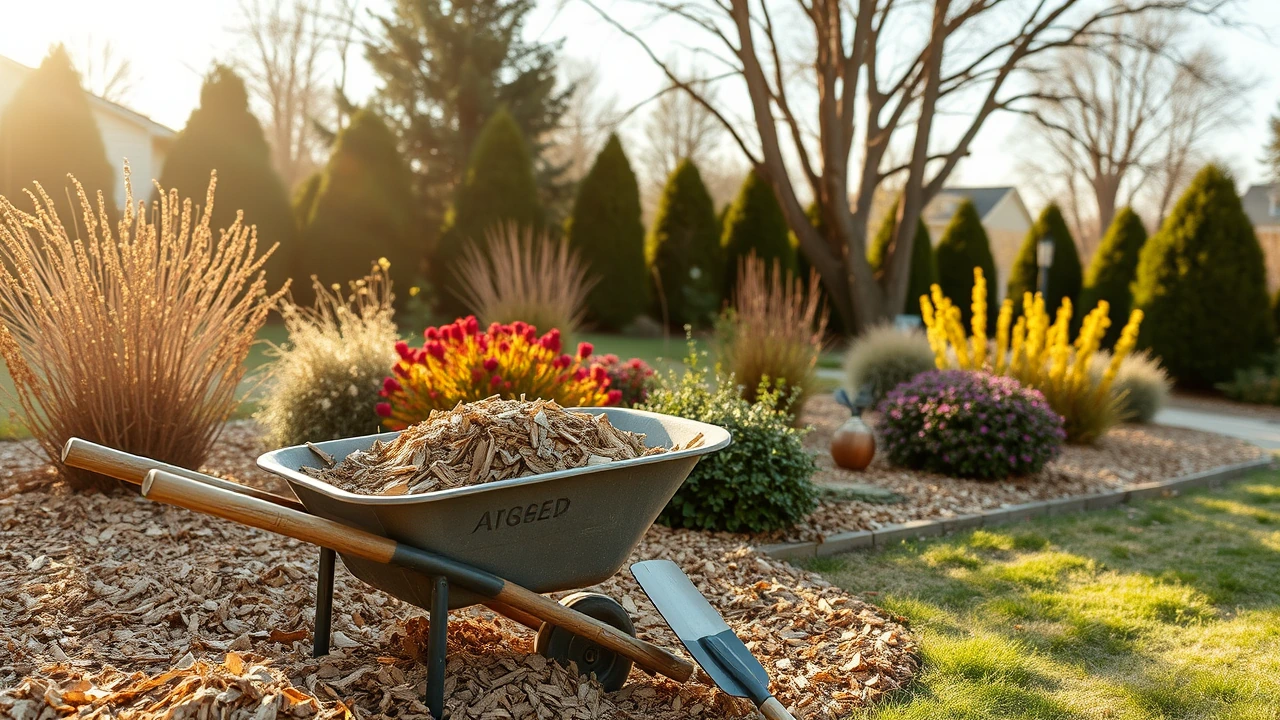
Mulch timing in Ontario is one of those small calls that quietly decides whether your beds look sharp in July or weedy and washed out. Go too early in spring and you trap cold soil. Go too late and crabgrass beats you to the bed. Skip the fall top-up and your perennials lose their winter blanket. This guide walks through the two real mulching windows we work in across Hamilton, Halton and Niagara, plus the depth math, the mistakes we keep fixing, and how to spot when your beds are actually ready.
Quick TL;DR
The two real mulching windows in Ontario are early May (after the last hard frost, before weeds germinate) and late October to mid November (after the first hard frost, to insulate roots). Skip mid-summer top-ups unless beds are visibly bare. Apply 2 to 3 inches of fresh mulch, never 4-plus, and keep it pulled back from trunks. Most Hamilton-area beds need roughly 1 cubic yard per 100 sq ft for a 3 inch layer.
The plan
| Window | Why now | Bed type | Depth | Cubic yards per 100 sq ft |
|---|---|---|---|---|
| Early May (after last frost) | Beats weed germination, locks in spring moisture | Perennial + foundation beds | 2 to 3 in fresh, or top-up to 3 in | 0.6 to 1.0 yd |
| Mid May to early June | Annual beds after planting | Veg + annual flower beds | 1.5 to 2 in (lighter) | 0.5 to 0.6 yd |
| Late June top-up | Only if depth dropped under 1 in | High-wash slopes, exposed beds | Bring back to 2 in | 0.3 to 0.5 yd |
| Late October to mid November | Insulates roots through freeze-thaw | Perennials, new shrubs, roses | 3 in over root zone | 0.9 to 1.0 yd |
| First-year shrub beds | Both spring and fall in year one | Newly planted hedges + trees | 3 in, donut shape | 1.0 yd |
Numbers assume a flat bed at the listed depth. Heavy slopes wash, so plan an extra 15 to 20 percent. Our mulch and topsoil calculator does the cubic yard math automatically once you measure your bed length and width.
Spring window: early May, after the last hard frost
The spring mulching window in southern Ontario opens once overnight temps stop dipping below freezing and the soil is workable, not soupy. In Hamilton, Burlington and Oakville that is typically the first or second week of May. The goal is to get a fresh 2 to 3 inch layer down before crabgrass, chickweed and bindweed germinate. Soil temperatures around 12 to 15 C are the trigger for most cool-season weed seeds, so mulching just ahead of that buys you a quiet summer.
If you mulch too early, while soil is still cold and wet, you slow soil warm-up and delay perennials breaking dormancy. If you wait until late May or June, weeds are already up and you are mulching over them, which only buys a few weeks before they push through. The fix is simple: watch the forecast for a stretch of 10 C-plus nights, edge the beds, pull any visible weed flush, then mulch.
This is also the right time to refresh tired-looking mulch from last year. If the existing layer has faded to grey and compacted to under an inch, top up to 3 inches. If it is still 2-plus inches and holding colour, just turn it over with a rake and skip the new bags. See our spring yard cleanup guide for the full April to May sequence.
Fall window: late October to mid November, after first frost
The fall mulching window is shorter and more often skipped. Once you have had a hard frost (overnight lows under -2 C for a few nights in a row), perennials are entering dormancy and the soil is cooling fast. A 3 inch fall mulch layer over the root zone of perennials, roses and first-year shrubs does two things: it stabilizes soil temperature through the freeze-thaw cycles that heave roots out of the ground, and it slows winter desiccation on evergreens.
In our Hamilton and Halton territory the sweet spot is usually the last week of October through the second week of November. Mulch before the ground freezes solid but after the soil has chilled, otherwise you trap warmth and pests have a cozy winter. First-winter perennials and any shrub planted that calendar year get priority. Pair this with the rest of the steps in our fall landscaping checklist.
Why mid-summer mulching is usually wrong
July and August mulch jobs are the ones we get called in to redo the following spring. Mid-summer mulching feels productive (the beds look great for a week) but it is doing very little real work. Weed seeds have already germinated or gone dormant for the season, the soil is at peak warmth so insulation does not help, and fresh mulch on top of dry soil can actually shed irrigation water before it reaches roots.
The one exception is a top-up on high-wash beds or exposed slopes where the layer has dropped under 1 inch. In that case, add just enough to bring depth back to 2 inches. Do not pile a fresh 3 inch layer on top of a partial existing layer, you will end up at 5-plus inches, which suffocates roots and turns hydrophobic.
Cedar vs hardwood vs dyed: which mulch and when
Material matters as much as timing. We break it down in detail in our bulk vs bagged mulch comparison, but here is the short version for timing decisions:
- Natural cedar: best for foundation beds and anywhere you want a tidy, slow-decaying surface. Holds colour 18-plus months, mild insect-deterrent smell. Pricier per yard but you mulch less often.
- Hardwood (pine/spruce blend): our default for large back-of-house beds and behind hedges. Breaks down faster, feeds the soil, needs annual top-up.
- Dyed black or brown: looks crisp on day one, fades to grey by August. Fine for curb-appeal beds, skip it for veg gardens and around food crops.
- Triple-shred bark: best for slopes, it knits together and resists wash.
Whatever you pick, time it to the windows above. Even the best cedar applied in July is just expensive decoration.
Edge up before you mulch, not after
Crisp bed edges are 80 percent of why a fresh mulch job looks like it cost real money. Re-cut every bed edge with a half-moon edger or sharp spade before the mulch goes down, not after. You want a clean vertical wall about 3 to 4 inches deep between lawn and bed, with the bed side scooped slightly lower so mulch sits below the grass crown. This stops grass from creeping in, gives mowers a clean line, and keeps mulch from spilling onto the lawn. Edging after mulching just buries the new edge under chips.
Depth math: 2 to 3 inches, never 4-plus
Depth is where most DIY mulch jobs go wrong. Under 1.5 inches and weeds push through. Over 3 inches and you start suffocating shallow roots, creating hydrophobic crust, and inviting fungal issues at plant crowns. The target is a fresh 2 to 3 inch layer measured from soil surface to mulch top.
For volume: 1 cubic yard covers roughly 100 sq ft at 3 inches deep, 130 sq ft at 2.5 inches, or 160 sq ft at 2 inches. A typical Hamilton or Burlington front bed of 150 to 200 sq ft needs 1.5 to 2 yards of fresh mulch for a full refresh, or about half that for a top-up. Run your exact beds through the mulch calculator to skip the math.
Volcano mulching: do not pile mulch against trunks
Volcano mulching is the cone of mulch piled up against a tree trunk that you see on every commercial property. It is wrong on every tree we have ever seen it on. Mulch in direct contact with bark holds moisture against the trunk, encouraging rot, girdling roots, and rodent damage over winter. The fix is a flat donut: 3 inch deep ring of mulch out to the drip line, with a 3 to 4 inch bare gap around the actual trunk. Same rule for shrubs, keep mulch pulled back from the crown.
Weed barrier fabric: usually a waste of money
Landscape fabric under mulch sounds smart and almost never works the way homeowners hope. Within a season or two, mulch decays into a thin soil layer on top of the fabric, weed seeds germinate in that layer, and now you have weeds that are impossible to pull because their roots grow through the fabric. We tear out more failed weed barrier than we install. The exception is under stone or gravel, where fabric does help separate aggregate from soil. Under organic mulch, skip it.
How to apply this on your yard
Quick decision tree for the average Hamilton, Burlington or Oakville property:
- Spring refresh in early May: edge first, weed flush, top up to 3 inches. Cedar on the front beds, hardwood on side and back. Order bulk if you need more than 4 yards, bagged otherwise.
- Fall insulation in early November: only on perennial beds, rose beds and any shrub planted that year. 3 inches over the root zone, pulled back from crowns.
- First-year shrubs and trees: mulch both spring and fall in year one. Donut shape, never volcano.
- Mid-summer: only top up beds that have dropped under 1 inch of cover. Otherwise leave it alone.
If your beds are a mess of perennials growing into each other, mulch is treating a symptom. Book a garden bed rebuild first, then a clean mulch job lands properly.
Common mistakes we see
- Mulching in late April while soil is still cold and wet. Trapped cold delays everything.
- Skipping the fall window entirely and losing first-year perennials to frost heave.
- Piling fresh mulch on top of last year is layer, ending up at 5-plus inches.
- Volcano mulching around trees. Slow rot, sometimes fatal over 5 years.
- Installing landscape fabric under organic mulch. Creates the exact problem it was meant to prevent.
- Using dyed black mulch around vegetable beds. Skip the dye on anything you eat from.
- Mulching over visible weeds instead of pulling first. They will be back in 3 weeks.
Frequently asked questions
When is the earliest I can mulch in Hamilton?
Wait until the last hard frost has passed, typically the first week of May in Hamilton, Burlington and Oakville. Mulching in mid-April while soil is still under 8 C delays soil warm-up and slows perennial emergence by 1 to 2 weeks.
How often do I need to replace mulch in Ontario?
A full refresh every 2 to 3 years for cedar, every 1 to 2 years for hardwood. Most years just need a light top-up to bring depth back to 2 to 3 inches.
Is fall mulching really necessary?
For mature beds, no. For first-year perennials, roses, and any shrub planted that calendar year, yes. Fall mulch prevents frost heave, which is the leading cause of first-winter losses we see.
How much mulch do I need?
Roughly 1 cubic yard per 100 sq ft of bed at 3 inches deep. A typical 150 sq ft front bed needs about 1.5 yards for a full refresh. Use our mulch calculator for exact numbers.
Cedar or hardwood mulch for Ontario gardens?
Cedar for front and foundation beds where appearance matters and you want to mulch less often. Hardwood for back-of-house beds and slopes where you want faster soil feeding. Full breakdown in our mulch comparison guide.
Should I put landscape fabric under mulch?
No, not under organic mulch. Within 1 to 2 seasons, decayed mulch on top of fabric becomes a weed seedbed and the weeds are then impossible to pull cleanly. Fabric belongs under stone, not chips.
Can I mulch right up to my tree trunk?
Never. Keep a 3 to 4 inch bare gap around the trunk. Mulch against bark holds moisture, encourages rot, and invites rodents over winter.
What about mulching new sod or grass seed?
Do not mulch lawn areas with bark or chip mulch. New sod and seed need straw or a light peat moss cover, never wood mulch. See our sod installation service for the right approach.
If your beds need more than just a refresh (think structure, soil, plant layout), we plan and rebuild beds across Hamilton, Burlington and Oakville through our garden building and tree and shrub services. Request a free quote and we will walk the property, recommend the right timing window, and quote bulk material with delivery included.
Edges blurring into the lawn? See garden edging ideas and costs for Ontario beds.
Starting a new bed? See garden bed design ideas, spacing and bloom timing for Ontario gardens.