
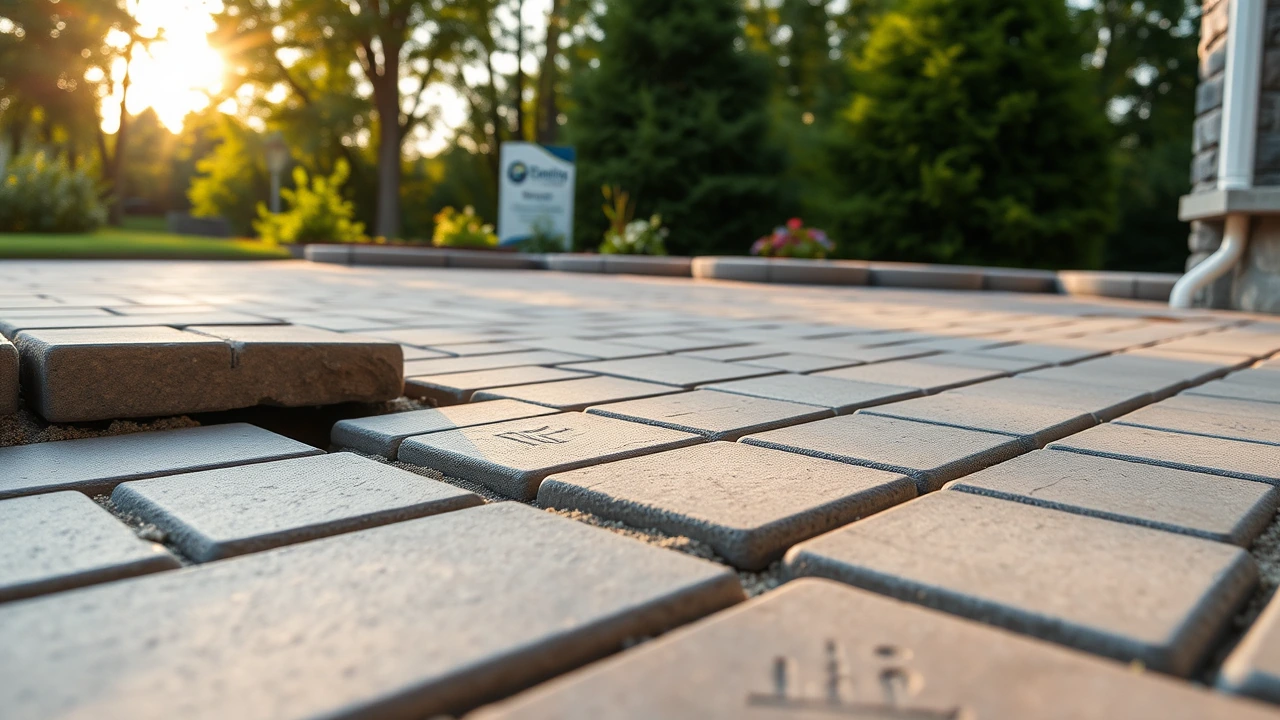
A sinking interlock patio is almost never the pavers fault. The pavers are just the visible symptom of a base, drainage or edge problem hiding underneath. In this guide the Peace Love Landscaping crew walks you through the six causes we actually see on Hamilton, Burlington and Oakville call-outs, how to confirm which one you have in 10 minutes, what the DIY fix looks like, and what a pro repair runs in 2026. By the end you should know whether to grab a rubber mallet or pick up the phone.
Quick diagnosis
If only one or two pavers near the edge dropped, you almost certainly have a failed edge restraint or a localized washout. If the whole patio tilted toward the house or formed a bowl in the middle, the base was under-built or under-compacted. If the dips appeared the spring after a wet fall, suspect frost heave and a clay subsoil. If water now pools and the patio used to drain fine, a downspout or grading change is washing the bedding sand out. Match your symptom to the table below to narrow it down.
Diagnostic table: match your symptom to the cause
| Symptom you see | Likely cause | DIY fix | Pro fix cost |
|---|---|---|---|
| Whole patio dipped or bowled in middle | Under-built base (too thin or wrong material) | Not realistic | $3,500 to $9,000 (lift and re-base) |
| Patio heaves every spring, settles by summer | Frost heave on clay subsoil | Limited | $2,500 to $7,500 |
| Pavers near downspout or low corner dropped | Base washout from poor drainage | $200 to $600 | $900 to $2,800 |
| Edge pavers tilting, rotating or spreading apart | Failed or missing edge restraint | $150 to $500 | $700 to $2,200 |
| Water pools, no slope away from house | Insufficient or reversed slope | Not realistic | $3,000 to $8,500 |
| Small uniform settling 1 to 2 years after install | Normal initial settling | $100 to $400 | $500 to $1,500 |
Cause 1: Under-built or under-compacted base
This is the number-one reason we get called to lift a patio. Ontario frost depth requires a minimum 6 inches of compacted 3/4 inch clear or Granular A under a residential patio, and 8 to 10 inches if the subsoil is clay. Many DIY and budget installs run 3 to 4 inches of crushed stone with one pass of a plate compactor and call it done. Two winters later the whole field bowls.
How to confirm
Lift a paver near the deepest dip. If you see less than 6 inches of compacted aggregate before you hit dirt, or if the aggregate is dusty stone-dust instead of angular clear stone, the base is the problem. A screwdriver should not push easily into the base material.
How to fix
There is no shortcut here. The pavers come up, the old base comes out, new Granular A goes in at 6 to 10 inches in 2 inch lifts, each lift compacted with a 5,000 lb-class plate, then 1 inch of bedding sand screeded flat. Pavers reset, polymeric sand swept, plate compacted with a protective mat.
What it costs
Pro lift-and-rebuild runs $18 to $32 per sq ft in 2026, so a typical 200 sq ft patio lands at $3,600 to $6,400. Full DIY is possible but the rental and material bill alone is usually $1,200 to $2,000 plus a weekend.
Cause 2: Frost heave on clay subsoil
Much of Hamilton, Stoney Creek and the lower Niagara escarpment sits on heavy clay. Clay holds water, water freezes, the patio lifts in February and drops back unevenly in April. If your patio looks fine in July and ugly in May every single year, this is your problem.
How to confirm
Take photos in February and again in late May. If the same areas rise and fall seasonally, that is frost heave, not settling. Confirm by digging a test hole at the patio edge: sticky grey or red clay within 12 inches of grade is the smoking gun.
How to fix
You cannot defeat frost on clay with sand. You need to either over-excavate (replace 12 to 18 inches of clay with Granular A so meltwater drains down, not sideways) or add a 4 inch perforated drain tile around the perimeter wrapped in filter fabric. Both push the frost line below the patio.
What it costs
Over-excavate and re-base runs $4,500 to $9,000 for a 200 sq ft patio. Adding perimeter drainage to an existing patio (without full re-base) is $2,500 to $4,500.
Cause 3: Base washout from poor drainage
This one shows up as a sharp localized dip, usually within 4 feet of a downspout, a sloped lawn that drains toward the patio, or a missing or clogged drain. Water finds the joints, washes the bedding sand sideways, and the pavers above drop into the void.
How to confirm
Wait for a heavy rain. Watch where water sheets onto the patio. Lift a paver in the dip: if the bedding sand is hollowed out into a channel, washout is confirmed. Polymeric sand joints that are gone or crumbled also point here.
How to fix
First fix the water source. Extend the downspout 6 feet past the patio, regrade the lawn, or install a French drain. Then lift the sunken pavers, top up bedding sand, reset, and re-sand the joints with quality polymeric sand.
What it costs
DIY downspout extension and 5 to 10 paver reset: $200 to $600. Pro fix including a small French drain: $900 to $2,800.
Cause 4: Failed or missing edge restraint
Pavers rely on a continuous edge to lock the field together. If the installer skipped plastic edge restraint and 10 inch spikes, or if the spikes worked loose, the outer row spreads outward and the next row in tilts and drops.
How to confirm
Look along the patio edge from one end. Edge pavers that are rotated, leaning out, or have visible gaps to the next row mean the restraint is gone. Probe with a screwdriver: if it slides between the edge paver and any restraint material, there is no restraint left.
How to fix
Pull the loose edge pavers, install proper PaverEdge or Snap-Edge plastic restraint with 10 inch galvanized spikes every 12 inches, reset pavers, re-sand joints. On curves use the bendable version.
What it costs
DIY material is $80 to $200 for restraint and spikes plus a half day. Pro edge restraint redo runs $700 to $2,200 depending on linear footage and how many pavers need resetting.
Cause 5: Insufficient or reversed slope
Every patio needs a fall of at least 1/8 inch per foot (1 percent) away from the house. If yours was built flat, or worse, sloped toward the foundation, water sits on the patio, freezes, lifts pavers, and washes joints. You will also see efflorescence stains and possible basement seepage.
How to confirm
Lay a 4 ft level on the patio with one end against the house. If the bubble is centered or tilted toward the house, you have a slope problem. Water that pools after rain instead of running off confirms it.
How to fix
You cannot tilt a patio without lifting it. The fix is full re-base with a corrected screed grade. On large patios, sometimes you can lift only the inner half and feather a new slope to the existing edge. A drainage channel cut into the patio is a band-aid, not a fix.
What it costs
Pro slope correction on a 200 sq ft patio: $3,000 to $8,500. This is rarely a DIY job because re-grading the base while keeping the perimeter elevation is finicky.
Cause 6: Normal initial settling
Even a properly built patio will settle 1/4 to 1/2 inch in the first 12 to 18 months as the aggregate fully consolidates. This shows up as uniform, minor dipping with no pooling and no edge spread. It is cosmetic, not structural.
How to confirm
The patio is under 2 years old, dips are small (under 1/2 inch), there is no water pooling, edges are tight, and the pavers do not rock when you step on them.
How to fix
Lift the dipped pavers, add bedding sand, reset, re-sand joints with polymeric sand. A reputable installer should cover this under a 1 or 2 year workmanship warranty.
What it costs
DIY: $100 to $400 in sand and a Saturday. Pro touch-up: $500 to $1,500. If your installer is still in business and you are inside warranty, push for a free fix and watch how they respond. See red flags in landscaping contracts for what a real warranty looks like.
When to call a pro vs DIY
The honest split is structural vs cosmetic. If the cause is base, slope or frost heave, you are lifting and re-doing the patio and that is a pro job unless you own a plate compactor and have done it before. If the cause is edge restraint, surface washout or normal settling, a confident DIYer with a rubber mallet, a level, a bag of polymeric sand and a wet Saturday can handle it.
- Call a pro if: more than 10 pavers are involved, the dip is over 1 inch, water pools, or the patio is over 200 sq ft
- Call a pro if: you see efflorescence at the foundation, basement seepage, or cracking in the house wall above the patio
- DIY is fine if: 1 to 6 pavers, edge or surface only, no drainage issue, patio is under 5 years old
- Get 2 to 3 quotes either way. Lift-and-rebuild prices vary 40 percent across Ontario installers
How to prevent it next time
- Spec a minimum 6 inch Granular A base, 8 to 10 inches on clay, compacted in 2 inch lifts
- Insist on plate-compactor passes with a wattage rating in the contract, not "tamped"
- Require plastic edge restraint with 10 inch galvanized spikes every 12 inches on the contract
- Confirm slope of 1/8 to 1/4 inch per foot away from the house, in writing
- Extend downspouts 6 feet past the patio before install, not after
- Use polymeric sand, not regular jointing sand. Re-sand joints every 4 to 6 years
- Ask for a 2 year workmanship warranty covering settling over 1/2 inch
Frequently asked questions
How much does it cost to fix a sinking interlock patio in Ontario?
Spot repairs of 1 to 6 pavers run $500 to $1,500 with a pro, or $150 to $400 DIY. Full lift and re-base on a 200 sq ft patio runs $3,600 to $6,400 in 2026. Frost heave correction with drainage adds $1,500 to $3,000.
Can I just lift the sunken pavers and add more sand?
Only if the cause is surface settling or minor washout. If the base under the sand is failed, adding more sand buys you one season. Probe with a screwdriver: if the base is mushy or under 6 inches deep, you need a real fix.
Will my patio keep sinking?
If the cause is base failure, frost heave or active washout, yes, it will continue. If it was normal first-year settling, no, it will stabilize after the first re-set. Diagnose before you decide.
Is sinking covered by warranty?
Reputable Ontario installers offer a 1 to 2 year workmanship warranty covering settling beyond 1/2 inch. Material warranties from paver makers (Techo-Bloc, Unilock, Permacon) cover the pavers themselves but not labour.
How long should a properly built interlock patio last?
30 to 40 years with a correct base, edge restraint and joint sand maintenance every 5 years. Cheap installs fail in 3 to 7 years.
Does freezing and thawing always damage interlock?
No. A correctly built patio with proper drainage handles Ontario winters fine. Frost only damages patios where water can sit in or under the base.
Can I install pavers over an old sinking patio?
No. Whatever caused the first patio to sink will cause the new one to sink faster, with more weight on top. The old base has to come out.
Should I use sand or polymeric sand for joints?
Polymeric, always. Regular sand washes out in the first heavy rain, accelerates joint failure and lets weeds in. Quality polymeric sand lasts 4 to 7 years.
If your patio is sinking and you want a straight answer on what is actually wrong, the Peace Love Landscaping crew quotes interlock repairs and rebuilds across Hamilton, Burlington, Oakville and the Niagara region. Request a free quote and we will diagnose the cause before we sell you a fix. While you are planning, the paver patio cost guide and our patio cost calculator will set realistic 2026 budget expectations. If you are weighing material options, see interlock vs concrete vs natural stone, and before signing any quote, read our contract red flags guide so you know what a real warranty clause looks like.
Pricing the fix? See 2026 patio renovation costs for every level from spot repair to full replacement.
Slabs rather than pavers? See why slab patios rock and sink and how to lay them properly.