
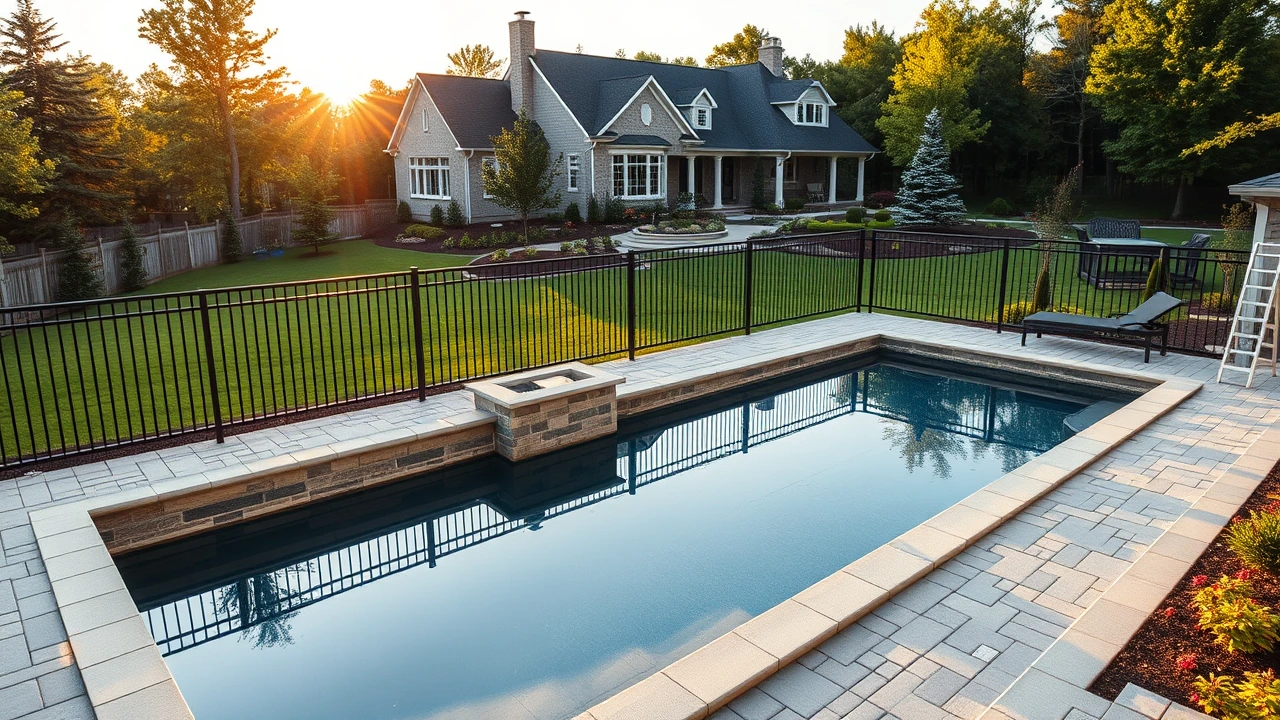
Ancaster is one of the best pool markets in the Hamilton area and one of the most demanding to build in. Lot sizes from Meadowlands through Ancaster Heights and the Mohawk Road estate streets carry the budget for proper concrete or premium fibreglass builds, with deck packages that rival anything in Oakville or Burlington. But the site conditions are punishing. Heavy clay subsoil holds water through every spring thaw, escarpment-edge bluff lots near the Dundas Valley Conservation Area add slope and runoff load behind any pool basin, and Old Ancaster Village heritage lots add mature tree bylaws and natural-stone matching to the deck spec. Layered on top of that, the City of Hamilton pool enclosure bylaw is strict and inspected, the ESA electrical permit is real, and any heated pool needs an Enbridge gas permit and inspection before the heater fires. A turnkey Ancaster pool that lasts 30 years starts with the right build type, the right deck spec and a permit path booked before the first dig.
Quick verdict for Ancaster homeowners
For a properly built, code-compliant inground pool in Ancaster in 2026, expect to budget $80,000 to $140,000 turnkey for a mid-size fibreglass build with a basic deck and enclosure, and $120,000 to $250,000+ for a concrete gunite build on an estate lot with a premium deck, fire features and an outdoor kitchen. A typical Ancaster pool project runs 8 to 14 weeks from permit issue to swim-ready, weather permitting. Every Ancaster pool requires a City of Hamilton pool enclosure permit, an ESA electrical permit and an Enbridge gas permit if heated, and pools near the Dundas Valley Conservation Area or Sulphur Springs Conservation lands need Conservation Hamilton review on top. Always get a written scope showing pool type, deck spec, enclosure detail, equipment pad placement and permit path before signing.
2026 Ancaster pool installation cost
Prices below are turnkey installed costs for Ancaster in 2026, including excavation, pool shell or structure, plumbing rough-in, equipment pad with pump, filter and basic heater, salt or chlorine system, basic deck of 400 to 600 sq ft, code-compliant enclosure fence and gate, ESA electrical inspection and Enbridge gas inspection where heated. They do not include premium deck upgrades beyond the base 400 to 600 sq ft, outdoor kitchens, fire features, automatic covers or extensive landscape integration.
| Tier | Pool type and size | Turnkey cost | Lifespan | Best fit |
|---|---|---|---|---|
| Basic fibreglass | Latham or Leisure Pools 12×24 ft fibreglass shell, basic deck | $80,000 to $110,000 | 25 to 40 years | Meadowlands family yards, Spring Valley starter builds |
| Mid-grade vinyl or fibreglass | 16×32 ft vinyl-liner steel-wall or 14×28 ft premium fibreglass | $100,000 to $140,000 | 30 to 50 years (liner replaced at 10 to 15) | Most Ancaster family backyards, mid-size Ancaster Heights lots |
| Premium concrete | 16×36 ft gunite concrete with tile waterline, premium 80mm paver deck | $150,000 to $200,000 | 50 to 75 years | Ancaster Heights estate lots, Mohawk Road premium builds |
| Luxury concrete | Custom gunite with vanishing edge, integrated spa, outdoor kitchen, fire features, full landscape | $220,000 to $400,000+ | 75+ years | Estate Ancaster Heights bluff lots, heritage Old Ancaster showcase builds |
Still weighing pool types? Our inground vs above-ground vs semi-inground comparison guide walks through how each option changes the build cost, the deck plan and the long-term maintenance picture.
Common Ancaster pool projects we build
Heritage-sensitive fibreglass pools in Old Ancaster Village
Old Ancaster Village heritage lots around Wilson Street East carry mature tree bylaws and a streetscape that does not accept a generic suburban pool surround. We design these as mid-size 12×24 ft or 14×28 ft fibreglass pools because the shorter dig window and smaller equipment footprint protect critical tree roots better than gunite. The deck is hand-set Wiarton ledgerock or Ontario limestone on a compacted granular base. The enclosure is wrought iron or natural-stone columns with powder-coated steel infill to meet the 1.2 m non-climbable Hamilton bylaw without clashing with heritage character. Tree-protection fencing and arborist sign-off on roots over 50 mm are standard.
Family-yard vinyl and fibreglass pools in Meadowlands and Spring Valley
Meadowlands and Spring Valley have the lot sizes for full-size 16×32 ft vinyl-liner or 14×28 ft fibreglass family pools. Clay subsoil drains poorly here, so excavation over-digs 600 mm beyond the shell for a 3/4 clear drainage envelope wrapped in geotextile, with a perforated weeping tile at the deep end piped to discharge. The deck is usually 600 to 1,000 sq ft of mid-grade Unilock or Techo-Bloc 60mm paver with 2 percent slope away from the coping. Enclosure is a 1.5 m black aluminum picket fence with self-closing, self-latching gate meeting the 4 inch maximum gap. Salt chlorination is the default, which drives premium paver spec because salt splash pits cheaper pavers within a decade.
Engineered concrete gunite pools on Ancaster Heights estate lots
Ancaster Heights and the streets backing onto the Dundas Valley Conservation Area are estate lots with the budget and grade for 16×36 ft to 20×40 ft concrete gunite pools with deep ends, integrated spas and vanishing-edge details. These are 12 to 14 week builds, engineered together with the deck, retaining walls and landscape so equipment pad, gas chase, ESA conduit and deck drainage all coordinate before the gunite is shot. Premium 80mm pavers in Unilock SienaStone or Techo-Bloc Aberdeen, often 1,200 to 2,000 sq ft of deck. Conservation Hamilton review is standard within the regulated escarpment area.
Integrated pool, kitchen and fire-feature builds in Mohawk Road estate lots
Estate streets off Mohawk Road carry the budget for full outdoor-living builds where the pool is one component of an assembly with an outdoor kitchen, covered cabana, fire feature and spa. We design these as a single project: deck flows into kitchen counter, gas line for heater shares the chase with kitchen propane, fire feature shares the structural pad with the cabana, lighting is one ESA-permitted circuit. Deck is premium 80mm paver in 1,500+ sq ft. Same crew handles the pool, the patio and any retaining wall in a single mobilisation, one warranty across the whole assembly.
Why DIY pool surrounds fail in Ancaster (and what we do differently)
We partner with established Ancaster pool builders for the shell, plumbing and equipment, but own the whole deck and landscape side. The four failure modes on torn-out Ancaster pool decks repeat every season. First, deck base failure: 3 inches of bagged paver base on native clay with no geotextile. The clay pumps fines up over three winters, the deck dishes around the coping, and the pool looks ten years old at year four. Second, salt damage to cheap pavers: chlorinated salt splash pits lower-tier concrete pavers within five to ten years even with sealing. The fix is paver spec, not maintenance.
Third, coping-to-deck movement: coping and deck pavers are two different assemblies on two different bases, and without a proper expansion joint detail differential movement opens cracks along the coping by year three. Fourth, drainage missed at the deep end: water shedding off the deck has to be captured away from the basin, or every spring thaw stacks groundwater against the deep-end wall. We do it differently: 6 to 8 inches of 3/4 clear over geotextile around the full perimeter, salt-rated 80mm pavers around any salt pool, expansion joint at the coping interface, perimeter weeping tile at the deep end piped to discharge.
The Ancaster pool install timeline
- Free on-site visit and design. We measure the yard, probe the soil, check existing drainage, photograph grades and tree locations, and talk through how you want to use the pool. You leave with a realistic Ancaster 2026 cost band, a pool-type recommendation and a deck concept.
- Design and written quote. We send a fixed scope with pool spec (size, type, shell brand or gunite engineering), deck spec, enclosure detail, equipment pad placement, gas and electrical chase routing, timeline and a coordinated pool-builder quote where the shell is a partner trade.
- Permits and Conservation review. City of Hamilton pool enclosure permit, ESA electrical permit, Enbridge gas permit if heated, and Conservation Hamilton review where the lot is near the Dundas Valley Conservation Area, Sulphur Springs Conservation lands or the regulated escarpment. We handle the full permit path.
- Excavation and shell or structure. Excavator on site for 2 to 5 days depending on pool size, fibreglass shell delivered and set on engineered base or gunite cage tied and shot in place over 1 to 2 weeks. Plumbing and equipment rough-in coordinated through the dig.
- Deck base, enclosure rough-in and inspections. Non-woven geotextile and 6 to 8 inches of 3/4 clear compacted around the deck footprint, enclosure fence posts set, ESA electrical inspection on the equipment pad, Enbridge gas inspection on the heater line, perimeter weeping tile installed.
- Deck pavers, coping detail, enclosure close-out and final inspection. Bedding sand screeded to 1 inch, pavers laid with the agreed pattern, coping-to-deck expansion joint set, polymeric joint sand activated, enclosure gate hardware installed with self-closing self-latching mechanism, City of Hamilton pool enclosure final inspection and homeowner walk-through.
Permits and bylaws in Ancaster
Every inground pool in Ancaster needs three permits at minimum and often a fourth. First, the City of Hamilton pool enclosure permit, which requires a 1.2 m non-climbable fence around the full pool area, a maximum 100 mm (4 inch) gap at the bottom of the fence and between pickets, and a self-closing, self-latching gate with the latch mounted at least 1.5 m above grade on the inside of the gate. The City inspects the enclosure before the pool can be filled. Second, an ESA electrical permit for the bonding grid, the pump and heater circuit, and any pool lighting, with an ESA inspector signing off before the equipment is energized. Third, an Enbridge gas permit and inspection if the pool is heated by natural gas. Fourth, where the lot is within the regulated areas of the Dundas Valley Conservation Area, Sulphur Springs Conservation lands or the Niagara Escarpment, Conservation Hamilton review is mandatory and can add 4 to 8 weeks. For a full breakdown of the permit path across Hamilton, Burlington and Oakville, see our landscaping permits guide.
Two extra Ancaster rules catch heritage and estate lots. The mature tree bylaw protects healthy trees over 30 cm DBH, requiring tree-protection fencing and arborist sign-off before any root over 50 mm is cut. And any pool that materially changes grading triggers re-certified lot-grading at permit close-out. We handle the full permit path, Conservation review, tree-protection plan and lot-grading re-certification as part of the build.
Frequently asked questions
What kind of warranty do you offer on an Ancaster pool?
The pool shell itself carries the manufacturer warranty (Latham, Leisure Pools and Imagine Pools all carry transferable structural warranties on fibreglass shells, with vinyl liners separately warranted for 20 to 25 years prorated). Our Peace Love Landscaping warranty covers the deck, the enclosure, the drainage and the landscape integration: 1 to 2 years on workmanship across the assembly, plus the paver manufacturer warranty on the deck pavers (Unilock, Techo-Bloc and Permacon all carry 25-year to lifetime transferable warranties). Full terms are in the signed contract.
Fibreglass vs vinyl vs concrete gunite, which is right for my Ancaster lot?
Fibreglass is fastest to install (3 to 6 weeks), needs the least maintenance over the long term, and runs $80k to $140k turnkey for most family builds. Vinyl-liner is the most flexible on shape and size and the cheapest to start, but the liner is a wear item replaced at 10 to 15 years for $5k to $10k each time. Concrete gunite is the most expensive ($150k to $400k+) and the longest build (10 to 14 weeks), but it is the only option for custom shapes, vanishing edges, integrated spas and the long lifespan estate builds. Our pool comparison guide walks through the full trade-off matrix.
Can you build a pool in winter in Ancaster?
No. Our Ancaster pool install season is roughly April through October for excavation and shell or gunite work, with deck and enclosure close-out running into early November where weather allows. We do not excavate frozen ground, set fibreglass shells onto frozen base, or shoot gunite in cold conditions. Most clients book in late winter or early spring for a May to September build, with swim-ready timing in July or August.
What does the Hamilton pool enclosure bylaw require?
A 1.2 m minimum non-climbable fence, a maximum 100 mm gap at the bottom and between pickets, and a self-closing, self-latching gate with the latch at least 1.5 m above grade on the inside. Pool covers do not satisfy the bylaw. Fence height is measured from the top of any hardscape within 1.2 m of the water, so a raised deck shortens effective fence height and has to be planned into the enclosure design.
Do I need an ESA electrical permit and a gas permit too?
Yes. ESA permits are required for the equipotential bonding grid, pump and heater circuit, pool lighting and any landscape lighting on the same circuit, with an inspector sign-off before energizing. If the pool is heated by natural gas, Enbridge requires a gas permit and inspection before commissioning. We coordinate both as part of the build.
Should I go salt or chlorine, and does it change the deck spec?
Salt is the default now because it is gentler on swimmers, but it changes the deck spec. Chlorinated salt splash will pit lower-tier concrete pavers within five to ten years, so any salt pool needs a salt-rated premium paver. We recommend premium 80mm large-format pavers around salt pools with sealing every 3 to 5 years.
How do you handle drainage and the equipment pad on Ancaster clay?
The excavation is over-dug 600 mm beyond the shell for a 3/4 clear drainage envelope wrapped in geotextile, with a perforated weeping tile at the deep end piped to discharge. The deck has 2 percent slope away from the coping. The equipment pad sits on compacted granular above the water table, within reach of the ESA and Enbridge runs. On bluff lots we coordinate pool drainage with any retaining wall drainage.
Can you tie the pool into a new patio, kitchen and retaining wall?
Yes, and on most estate lots it is the right call. One project saves three to six weeks of separate mobilisations, coordinates gas, electrical and drainage chases through a single design, and gives one warranty across the assembly. Our Ontario paver patio cost guide covers the deck-spec trade-offs.
Ready to talk about your Ancaster pool? Request a free quote and we will book a site visit, usually within 2 business days. The Ancaster landscaping hub shows the rest of what we build, the pool building service page covers shell types and enclosure design, and the inground vs above-ground vs semi-inground comparison walks through build-type trade-offs. For the deck, the Ontario paver patio cost guide covers spec and 2026 pricing, and the landscaping permits guide details the Hamilton permit path. Planning hardscape too? Our Ancaster patio page covers the surround.