
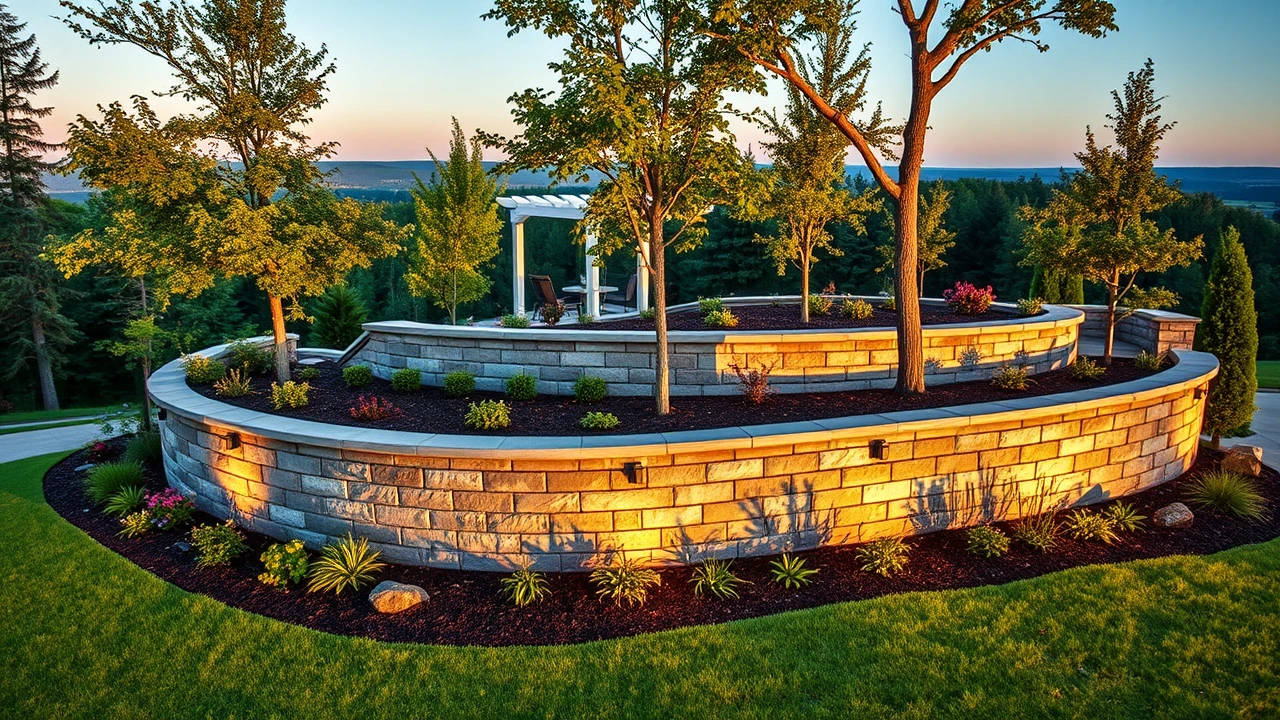
Ancaster is one of the toughest retaining wall environments in the Hamilton area. Old Ancaster Village sits on heritage lots where natural stone has to match a century of streetscape and mature tree bylaws shape every excavation. Meadowlands and Spring Valley were carved into clay slopes during the 2000s build-out, and a decade later the original builder-grade walls are bulging, leaning or stepping out of plane. Ancaster Heights and the streets running up toward the Dundas Valley Conservation Area are estate lots with grade changes of 2 m to 6 m, where a single decorative course is never enough. The clay subsoil holds water through every spring thaw, the escarpment-edge bluff lots add hydrostatic load behind any wall, and 80 to 100 freeze-thaw cycles a season finish off whatever the soil started. A DIY wall on Ancaster clay rarely survives ten winters. Doing it right means engineered drainage, geogrid and proper batter long before the first block lands.
Quick verdict for Ancaster homeowners
For a properly built, code-compliant segmental retaining wall in Ancaster in 2026, expect to budget $250 to $500 per linear metre for standard residential walls under 1.2 m, with engineered estate walls between 1.2 m and 2.5 m running $600 to $1,000 per linear metre installed. A typical 8 to 15 m Ancaster wall takes 4 to 10 working days on site, weather permitting. Anything above 1.2 m in Ontario requires a stamped engineered drawing and a building permit through the City of Hamilton, and walls on Ancaster Heights bluff lots or near the Dundas Valley Conservation Area almost always need geogrid reinforcement and a drainage plan reviewed by a P.Eng. Always get a written scope showing base depth, geogrid layers, drainage stone, weeping tile and capstone spec before signing.
2026 Ancaster retaining wall cost
Prices below are turnkey installed costs for Ancaster in 2026, including excavation, geotextile, compacted granular base, drainage stone behind the wall, perforated weeping tile piped to discharge, block supply, capstones, geogrid reinforcement where required and final backfill. They do not include engineered drawings (typically $1,500 to $4,000 for walls over 1.2 m), Conservation Hamilton review fees, or tree-protection fencing where mature tree bylaws apply.
| Tier | Block brand and height | Cost per linear m | Lifespan | Best fit |
|---|---|---|---|---|
| Basic | Permacon StackStone or Techo-Bloc Mini-Creta, walls under 600 mm | $250 to $400 | 25 to 40 years | Garden edging, low Meadowlands front-yard terraces |
| Mid-grade | Unilock Pisa2, Techo-Bloc Mini-Creta or Belvedere, walls 600 mm to 1.2 m | $350 to $500 | 40 to 60 years | Most Ancaster sloped backyards, Spring Valley terracing |
| Premium engineered | Unilock SienaStone, Techo-Bloc Mini-Creta with geogrid, walls 1.2 m to 2 m | $600 to $850 | 60 to 80 years | Ancaster Heights bluff lots, escarpment-edge estate walls |
| Luxury natural stone | Armour stone, hand-set Wiarton ledgerock, heritage limestone | $800 to $1,000+ | 80+ years | Old Ancaster Village heritage builds, estate showcase walls |
To sanity check a quote on your own linear metres and wall height, run the numbers through our retaining wall cost calculator and read the full retaining wall cost guide for a complete line-item breakdown.
Common Ancaster retaining wall projects we build
Heritage natural-stone walls in Old Ancaster Village
Old Ancaster Village around Wilson Street East has century homes on lots terraced by hand a hundred years ago in fieldstone and limestone. When those originals fail, City of Hamilton heritage guidelines push for replacement in natural stone rather than modern concrete block. We hand-set Wiarton ledgerock or matching Ontario limestone on a compacted granular base, with a hidden geogrid layer for walls over 600 mm and a French drain along the back face piped to a side-yard discharge. Mature tree bylaws are real here: we tunnel under critical roots, set tree-protection fencing during excavation, and coordinate with the City arborist on any tree over 30 cm DBH in the work zone.
Sloped-yard terraced walls in Meadowlands and Spring Valley
Meadowlands and Spring Valley were graded on clay slopes during the 2000s, and a decade and a half later most builder-grade walls are visibly leaning, bulging or losing capstones. The standard failure is the same: a single 1.2 m wall in 100 mm pin-set block on 100 mm of screening, no geogrid, no drainage stone, no weeping tile. We rebuild these as two- or three-tier terraced systems, each tier 600 mm to 900 mm tall, with geogrid tying back 1.5 m to 2 m into the slope, 300 mm of 3/4 clear drainage stone behind every course, and a perforated weeping tile at the base piped to daylight. Terracing creates planting shelves and often keeps each tier under the 1.2 m engineered-drawing threshold.
Engineered bluff-lot walls in Ancaster Heights
Ancaster Heights and the streets backing onto the Dundas Valley Conservation Area sit on bluff lots with grade changes of 3 m to 6 m. These are not DIY walls. We design them as engineered segmental systems in Unilock SienaStone or Techo-Bloc with stamped P.Eng. drawings, geogrid layers every two courses tying back 2 m to 3 m into the slope, a full drainage chimney of 3/4 clear behind the face, and a perforated weeping tile piped to a manhole at the base. The base course is often 600 mm into undisturbed clay, well below the 4 ft Ontario frost depth. Conservation Hamilton review is standard for any work near the regulated escarpment edge.
Integrated wall and patio builds in Mohawk Road estate lots
The estate streets off Mohawk Road carry the budget for full landscape rebuilds where a 1 m to 1.8 m retaining wall ties directly into an entertaining patio, an outdoor kitchen and a fire feature. We design these as one assembly: the wall doubles as patio seating edge, capstones become the bench surface, and drainage from behind the wall is integrated with the patio sub-base sharing one French drain. Premium block here is usually Unilock SienaStone or Techo-Bloc Mini-Creta with matching 80 mm pavers. The same crew handles the wall, the patio, planting and tie-in to existing hardscape in a single mobilisation, with one warranty across the whole build.
Why DIY walls fail on Ancaster clay (and what we do differently)
The four failure modes we see again and again on torn-out Ancaster DIY walls are the same every season. First, missing drainage: a wall built directly against native clay with no 3/4 clear drainage stone behind it. Spring thaw saturates the clay, hydrostatic pressure builds behind the wall face, and within five years the wall is bulging out at mid-height. Second, no geogrid: any wall over 600 mm on a sloped lot needs geogrid layers tying back into the retained soil. Without it, the wall is just stacked blocks held up by gravity, and on a Spring Valley clay slope gravity always loses to a wet spring. For a deeper look at why walls fail, our leaning, bulging and cracking wall diagnostic walks through every symptom and root cause.
Third, shallow base: walls dropped on 100 mm of screening sit inside the active frost zone. Ontario frost depth is 4 ft, and the base course has to be set 150 mm to 300 mm into undisturbed soil with 200 mm to 300 mm of compacted granular below. Fourth, no batter: walls built dead vertical have zero margin for the inevitable lean as soil consolidates. A proper segmental wall is set with 1 to 2 degrees of batter into the slope. We do it differently every job: engineered drainage stone and weeping tile, geogrid layers per the stamped drawing, base below frost, manufacturer batter on every course.
The Ancaster retaining wall install timeline
- Free on-site visit. We measure the grade change, probe the soil, check existing drainage, photograph any signs of slope movement, and talk through how the wall ties into the rest of the yard. You leave with a realistic Ancaster 2026 cost band.
- Design and engineered drawings. For any wall over 1.2 m, we coordinate a stamped P.Eng. drawing covering geogrid layout, drainage and base detail. The fixed scope shows block spec, base depth, geogrid courses, drainage stone, weeping tile and capstone product.
- Permit and Conservation check. Walls over 1.2 m require a City of Hamilton building permit. Anything near the Dundas Valley Conservation Area, Sulphur Springs Conservation lands or a regulated escarpment edge needs Conservation Hamilton review, which can add 4 to 8 weeks to the timeline.
- Excavation and base. We cut back into the slope to engineered dimensions, set tree-protection fencing where mature trees are within the work zone, and build a compacted granular base 200 to 300 mm deep into undisturbed clay below the 4 ft frost line.
- Block, geogrid and drainage. Base course set to laser-level, geogrid layers placed per the stamped drawing, 300 mm of 3/4 clear drainage stone behind every course, perforated weeping tile at the base piped to daylight, and a non-woven geotextile cap separating drainage stone from backfill soil.
- Capstones, backfill and site cleanup. Capstones glued with manufacturer adhesive, final backfill placed and graded to shed water away from the wall face, planting shelves shaped between tiers where the design calls for them, and a walk-through with you before the crew leaves.
Permits and bylaws in Ancaster
The City of Hamilton requires a building permit for any retaining wall over 1.2 m measured from the bottom of the footing to the top of the wall, and the permit application has to include a stamped P.Eng. drawing showing geogrid layout, drainage detail and base spec. Walls under 1.2 m typically do not need a permit, but the City lot-grading bylaw still applies: a wall cannot push surface water onto a neighbouring property, and re-grading enough to require a new grading certificate triggers a separate review. For a full breakdown of what triggers a permit across the Hamilton, Burlington and Oakville municipalities, see our landscaping permits guide.
Ancaster has two extra layers. First, Conservation Hamilton review is mandatory for work within the regulated areas of the Dundas Valley Conservation Area, Sulphur Springs Conservation lands and the Niagara Escarpment, catching many bluff lots in Ancaster Heights and streets backing onto Tiffany Falls. Conservation review can add 4 to 8 weeks plus erosion and sediment control measures. Second, the mature tree bylaw protects healthy trees over 30 cm DBH, requiring tree-protection fencing and arborist sign-off before cutting roots over 50 mm. We handle the permit path, Conservation review, tree-protection plan and inspections as part of the build.
Frequently asked questions
What kind of warranty do you offer on an Ancaster retaining wall?
Our standard Peace Love Landscaping warranty is 1 to 2 years on workmanship across the assembly (base, geogrid, drainage stone, weeping tile, block layout, capstone adhesion), on top of the manufacturer warranty on the block itself (Unilock, Techo-Bloc and Permacon all carry 25-year to lifetime transferable warranties against structural defects in the block). For engineered walls over 1.2 m, the stamped P.Eng. drawing carries its own professional liability coverage. Full terms are in the signed contract.
Do I really need engineered drawings for a wall over 1.2 m?
Yes. The Ontario Building Code and the City of Hamilton building bylaw both require stamped P.Eng. drawings for any retaining wall over 1.2 m measured from the bottom of the footing to the top of the wall. The drawings cover geogrid layout, base depth, drainage detail and surcharge loading from anything above the wall (driveways, pools, structures). On Ancaster bluff lots and Conservation-regulated lands, the engineering is non-negotiable and the permit will not be issued without it.
Can you build a retaining wall in winter in Ancaster?
No. Our Ancaster wall install season is roughly April through November, with the bulk of structural wall work in May through October. We do not place block on frozen base, set drainage stone into a frozen excavation, or backfill onto frozen subgrade, because the spring thaw will move the assembly and undo the compaction. Most clients book in late winter for a May to August build slot.
How do you handle drainage behind the wall on Ancaster clay?
Three layers of defence. A 300 mm chimney of 3/4 clear drainage stone behind the full height of the wall face, separated from native clay by non-woven geotextile so clay fines cannot migrate into the drainage. A perforated weeping tile at the base, wrapped in filter sock, piped continuously to daylight at a side-yard discharge or a captured drainage point. And a positive 2 percent slope on the final backfill above the wall to shed surface water away from the wall face before it ever reaches the chimney.
What is geogrid and when do I need it?
Geogrid is a structural polymer mesh that ties the wall back into the retained soil mass, turning the wall and the soil behind it into a single reinforced gravity structure. It is required on any segmental block wall over about 1 m, and on shorter walls anywhere a slope, a driveway, a pool or a structure sits above the wall and adds surcharge load. The geogrid layers are placed between block courses and extend 1.5 m to 3 m back into the slope per the engineered drawing. Without geogrid, a tall wall on clay is just stacked blocks waiting for the next wet spring.
Do mature tree bylaws really apply to my Ancaster wall?
Yes, especially on Old Ancaster Village and Ancaster Heights heritage lots. The City of Hamilton mature tree bylaw protects healthy trees over 30 cm DBH on private property, requiring tree-protection fencing and arborist sign-off before roots over 50 mm can be cut. Cutting a protected tree without permission can run $5,000 or more in fines plus a replacement order.
Will my wall affect my lot grading?
Properly designed it improves it. A wall changes the elevation profile, so post-build surface water has to be routed to existing swales, side-yard discharges or downspout extensions. We confirm post-build grades still send water off your lot the way the original grading certificate intended, and coordinate any re-certification with the City of Hamilton at permit close-out.
Can you tie the wall into a new patio, pool or driveway?
Yes, and on most Ancaster estate lots it is the right call. Combining wall, patio, pool surround or driveway into one mobilisation saves three to five days of setup costs and gives a single warranty across the assembly.
Ready to talk about your Ancaster retaining wall? Request a free quote and we will book a site visit, usually within 2 business days. While you are scoping the project, the Ancaster landscaping hub shows the rest of what we build across town, the retaining walls and hardscaping service page covers block options and engineering, and the retaining wall cost guide plus retaining wall cost calculator let you sanity-check any quote you receive. If your existing wall is already moving, the leaning, bulging and cracking diagnostic tells you whether to repair or rebuild, and if you are planning a wall and patio together, our Ancaster patio page covers the surface side of the build.