
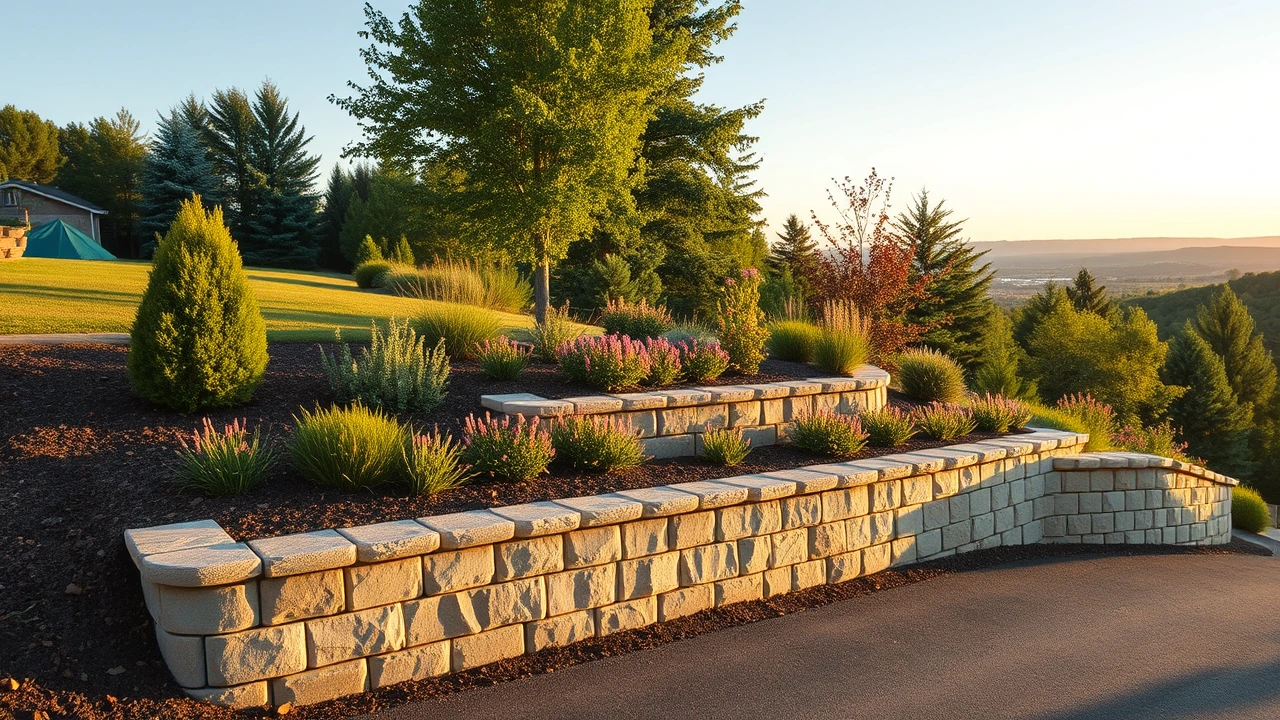
Hamilton is built on a slope, and almost every Hamilton retaining wall job is a soil and water problem first. The Mountain sits on a shale and limestone shelf where shallow bedrock makes deep frost-depth excavation harder than it looks. Stoney Creek hillside lots drop aggressively from the brow toward Lake Ontario, with thin glacial till over clay that slips after heavy rain. Ancaster cliff-edge properties along Wilson Street and Sulphur Springs back onto ravines where any wall doubles as erosion control. Dundas valley clay is some of the worst in the GTA for slope creep, lubricated by groundwater seeping out of the escarpment face. Add a 4 ft frost depth, the City of Hamilton permit threshold over 1 m, and lot-grading certification rules, and a wall here is engineering, drainage and permit work before it is ever masonry.
Quick verdict for Hamilton homeowners
For most projects in Hamilton, expect to budget $95 to $280 per linear foot for a properly drained, code-compliant retaining wall in 2026, with engineered walls over 1 m and Ancaster cliff stabilisation projects landing at the high end. A typical Hamilton backyard wall takes 1 to 3 weeks on site, plus 2 to 8 weeks of lead time if engineered drawings and a City permit are required. Anything over 1 m, anything holding back a driveway on the Mountain, and any wall on a slope feeding a neighbour lot should never be DIY here. Get a written scope, a stamped drawing where required, and a drainage plan before any blocks land on your driveway.
2026 Hamilton retaining wall cost
Costs below reflect installed pricing in Hamilton for 2026, including excavation, granular base, drainage stone, perforated weeping tile, geogrid where required and site restoration. They do not include engineered drawings (typically $1,200 to $3,800) or City of Hamilton permit fees.
| Wall type | Cost per linear ft | Lifespan | Engineering needed | Best fit |
|---|---|---|---|---|
| Segmental concrete block (Unilock, Techo-Bloc, Permacon) | $95 to $170 | 40 to 75 years | Only above 1 m | Mountain backyards, terraced gardens, pool surrounds |
| Natural stone (Wiarton, Eramosa, armour) | $190 to $340 | 75 to 100+ years | Above 1 m | Ancaster heritage lots, Dundas curb-appeal walls |
| Boulder / armour stone wall | $170 to $280 | 50 to 75 years | Above 1 m or on slope | Stoney Creek hillside, ravine-edge Ancaster lots |
| Engineered wall over 1 m (poured concrete or block with geogrid) | $230 to $420 | 60 to 100 years | Always, stamped P.Eng | Mountain driveway walls, cliff-edge stabilisation, pool decks |
Want to sanity-check the numbers? Our retaining wall cost calculator uses the same 2026 Hamilton inputs, and the full retaining wall cost guide breaks down what each line item actually pays for.
Common Hamilton retaining wall projects we build
Terraced garden walls on the Hamilton Mountain
The Mountain, from Concession to Rymal and across to Stoney Creek Mountain, is full of postwar and 1970s homes built on lots that step up or down 600 mm to 1.5 m from front to back. Many original yards were just sodded slopes, and four decades later the lawn is sliding, the patio is sinking, and the back fence is leaning. We almost always redesign these as a two or three tier segmental block system, 450 to 750 mm per tier, with planting beds between courses. Keeping each tier under the 1 m threshold avoids the City of Hamilton permit trigger on most builds, distributes the lateral load, and turns a useless slope into real garden space. Geogrid layers tie each tier back into the retained soil, and weeping tile from every tier feeds a single side-yard discharge so spring runoff never stacks behind the lowest wall.
Driveway retaining walls on Ancaster cliff lots
Ancaster, especially the streets running off Wilson and Mohawk near Sulphur Springs and the cliff-edge lots backing onto the Dundas Valley Conservation Area, often need driveway walls that are doing serious structural work. They hold back the front lawn, take wheel loads from cars parked tight to the cliff edge, and they sit above the ravine where any failure could pull the front yard with it. For these we spec a poured reinforced concrete core with a Wiarton or Eramosa stone veneer, a continuous footing below the 4 ft frost line keyed into competent soil or shale, and a positive drainage line piped well clear of the slope. Conservation Hamilton review is almost always required on these lots, and we coordinate the geotechnical assessment, the engineered drawings and the permit submission as one package.
Garden-bed retaining walls (3 to 4 ft) across Hamilton
The most common Hamilton wall we build is the 900 mm to 1.2 m garden-bed retainer, used to flatten a backyard slope, frame a patio, or terrace a sloped front yard. These show up everywhere from Westdale and Kirkendall through Dundas, Rosedale and Stoney Creek. Material choice is usually Unilock or Techo-Bloc segmental block for cost and consistency, or Wiarton flagstone where the curb appeal demands a natural face. The structural ask is moderate, but the drainage detail is identical to a taller wall: granular base below frost, clean drainage stone behind the wall wrapped in geotextile, perforated weeping tile at the base sloped to daylight, and a compacted clay or impermeable cap on top to shed surface water away from the joint.
Pool-area retaining walls in Stoney Creek
Stoney Creek pool yards, especially through the hillside neighbourhoods above the QEW and the newer subdivisions around Winona, sit on lots that drop 2 to 4 ft from house to back fence. To get a flat pool pad and a usable lounging deck, we terrace the yard with a pool-side retaining wall, then a secondary garden wall against the rear lot line. The Hamilton pool enclosure bylaw measures fence height from the highest ground within 1.0 m of the fence, so a 600 mm retaining wall can effectively shorten your pool fence and force a redesign. We size the wall, the setback and the fence as a single system, run engineered drainage out to the side yard, and coordinate with the pool builder so excavation and plumbing chases clear the wall footprint.
Engineered walls over 1 m: Dundas valley and Mountain brow
Anything over 1 m in exposed height in Hamilton triggers full engineering, a building permit, and lot-grading certification. The most common spots for these are Dundas valley lots fighting clay slip, Mountain brow properties along the escarpment edge, and Ancaster ravine lots. We build these as either poured reinforced concrete with veneer, or engineered segmental block with multiple geogrid layers, depending on the geotechnical report. Stamped drawings from an Ontario P.Eng, a geotechnical assessment where the soil is suspect, and a positive piped discharge to the City storm connection are non-negotiable. If your wall is already moving, our leaning, bulging, cracking retaining wall guide covers what is salvageable and what needs a full rebuild.
Why Hamilton yards need professional retaining walls
Half the failed walls we replace in Hamilton did not fail because the blocks were wrong. They failed because nothing was done about water. The Mountain sits on shale and clay that does not drain on its own. Dundas valley clay holds water like a sponge. Stoney Creek hillsides have groundwater seeping out of the escarpment face year-round. When spring runoff or a wet October week saturates the backfill behind a wall, the hydrostatic pressure pushing on the back of your wall climbs fast, and the freeze-thaw cycle through our 4 ft frost depth heaves the soil up against the blocks every winter.
A properly engineered Hamilton wall has four lines of defence. First, a granular base below frost depth, compacted in lifts. Second, a clean drainage stone chimney directly behind the wall, wrapped in non-woven geotextile so clay fines cannot migrate into it. Third, a perforated weeping tile at the base, sloped to daylight or piped to a side-yard discharge. Fourth, on anything tall or holding back a slope, geogrid layers extending back into the retained soil to tie the wall and the hill together as one reinforced mass. If a Hamilton contractor is quoting a 1.4 m wall without a structural drawing and a drainage detail, that is the quote to walk away from.
The Hamilton retaining wall install process
- Free on-site consult. We meet at your Hamilton property, measure the grade, check the soil with a hand auger, photograph the existing drainage, and talk through what the wall actually needs to do. You leave with a realistic cost band, not a sales pitch.
- Design, quote and engineering. We send a fixed-price scope, a wall section drawing, the material spec, the drainage detail and the timeline. If the wall needs engineering, we coordinate the stamped drawings and any geotechnical assessment.
- Permit and lot grading. Where required, we submit the City of Hamilton building permit package, handle the lot-grading review, and book Conservation Hamilton or Niagara Peninsula Conservation review for any regulated-area sites in Dundas, Ancaster or Stoney Creek.
- Excavation and base prep. We strip topsoil, dig the trench below frost depth, place and compact granular base in lifts, and set the first course dead level. Every wall here lives or dies on this step, especially on Mountain shale where the base must key into competent material.
- Wall construction. Block, stone or armour goes in course by course, with drainage stone, geotextile and geogrid placed as we climb. Coping and cap details are dry-laid first, adjusted, then set with polymer-modified adhesive on the final pass.
- Restoration and final grading. We tie weeping tile to a discharge point, restore lawn and beds, blow off the driveway, walk the site with you, and book the City inspection if a permit was pulled.
Permits and code in Hamilton
Permitting in Hamilton for retaining walls is straightforward once you know the triggers. Walls under 1 m in exposed height, fully on your own property, away from the pool enclosure and not affecting lot grading, generally do not require a permit. Anything above 1 m needs a City of Hamilton building permit, engineered drawings stamped by an Ontario P.Eng, a site plan showing the wall in relation to property lines and easements, and confirmation that lot grading certification will be maintained after construction.
If your wall sits closer than 0.6 m to a property line, or if it changes drainage patterns onto a neighbour lot, the City can ask for written acknowledgement from the affected neighbour before issuing the permit. Walls inside regulated areas, especially along the escarpment edge, in the Dundas valley, near Red Hill Creek, Stoney Creek itself, or the Lake Ontario shoreline, also trigger Conservation Hamilton review, which adds 4 to 8 weeks. We handle the full package: drawings, lot-grading review, permit submission and inspections, so you are not chasing forms while the excavator sits idle on your Hamilton driveway.
Frequently asked questions
Do I need a permit for my Hamilton retaining wall?
If the exposed wall height is over 1 m anywhere along the run, yes. The City of Hamilton requires a building permit and engineered drawings. Walls under 1 m generally do not need a permit, but if they affect lot grading, sit near a property line, or are part of a pool enclosure, we still review them against the bylaw before quoting.
How long does construction take?
A straightforward 10 to 20 m Hamilton backyard wall is usually 1 to 2 weeks on site. Larger projects, terraced systems on the Mountain, or walls combined with patios and pool work in Stoney Creek run 3 to 6 weeks. Add 2 to 8 weeks of lead time before that if engineering or City permitting is required.
Can you build walls in winter?
We can build into late November in Hamilton if the ground is workable, and we sometimes pour footings under hoarding in December. We do not place block on frozen base or set walls in active frost because the spring thaw will move them. Most clients book in spring for a May to October build window.
Do I need engineered drawings?
Anything over 1 m in exposed height needs stamped drawings from an Ontario P.Eng. We also recommend engineering for any wall holding back an Ancaster driveway, sitting above a sidewalk, supporting a pool deck, or built into Dundas valley clay, even when under 1 m. The drawings are typically $1,200 to $3,800 depending on complexity.
What about the pool fence requirement?
The City of Hamilton pool enclosure bylaw measures fence height from the highest ground within 1.0 m of the fence. A 600 mm wall right beside the fence effectively shortens your 1.5 m fence, which does not comply. We design the wall location, fence height and pool setback together to keep everything code-compliant on the first try.
How much warranty do you offer?
Our standard Peace Love Landscaping retaining wall warranty in Hamilton is 5 years on workmanship, structure and drainage, on top of the manufacturer warranty on the block or stone (often 25 years plus). Engineered walls carry their own designer warranty as well. Full terms are in the signed contract.
Will I lose lot grading certification?
Not if the wall is designed and built properly. For permitted walls, the City requires a lot grading plan showing that surface water still leaves your property the way it was originally certified. We size the wall, swales and discharge points so your Hamilton lot grading stays compliant, and we coordinate the re-certification with the City when the project closes.
Can you match an existing wall or hardscape?
Usually yes. Most projects in Hamilton use Unilock, Techo-Bloc, Permacon or Wiarton stone, and we can almost always source matching or complementary product. If the original material is discontinued, we will lay out a contrasting band that looks intentional rather than mismatched.
What about Conservation Hamilton or Niagara Peninsula Conservation?
Walls inside regulated areas along the escarpment, in the Dundas valley, near Red Hill Creek, Stoney Creek or the Lake Ontario shoreline require Conservation Authority review on top of the City permit. We handle the submission and coordinate the geotechnical assessment where required.
Where we work across the City of Hamilton
Hamilton amalgamated in 2001, so the city limits reach a long way past the lower city. We take on retaining walls right across it, and the ground changes more than most homeowners expect between one community and the next.
- Ancaster: escarpment-side lots with heavier clay and long approach driveways.
- Dundas: valley properties with mature tree canopy and tight rear access.
- Stoney Creek: benchland above the escarpment with a lake-moderated microclimate.
- Waterdown: newer subdivisions on former farmland, often shallow topsoil over till.
- Flamborough: larger rural properties where well and septic locations dictate layout.
- Glanbrook: flat former farmland with heavy clay and slow natural drainage.
If you are in any of those communities, you are inside our core service area and the pricing on this page applies to your property.
Ready to talk about your Hamilton retaining wall? Request a free quote and we will book a site visit, usually within the week. While you are scoping the project, the Hamilton landscaping hub covers the rest of what we build across town, the retaining walls and hardscaping service page walks through materials and finishes, the retaining wall cost guide and cost calculator will help you sanity-check any other quote you receive, and if your current wall is already moving, our leaning wall diagnostic will tell you whether to repair or rebuild. If you are also weighing a project in a neighbouring town, our Oakville retaining wall page covers the same scope across Halton.