
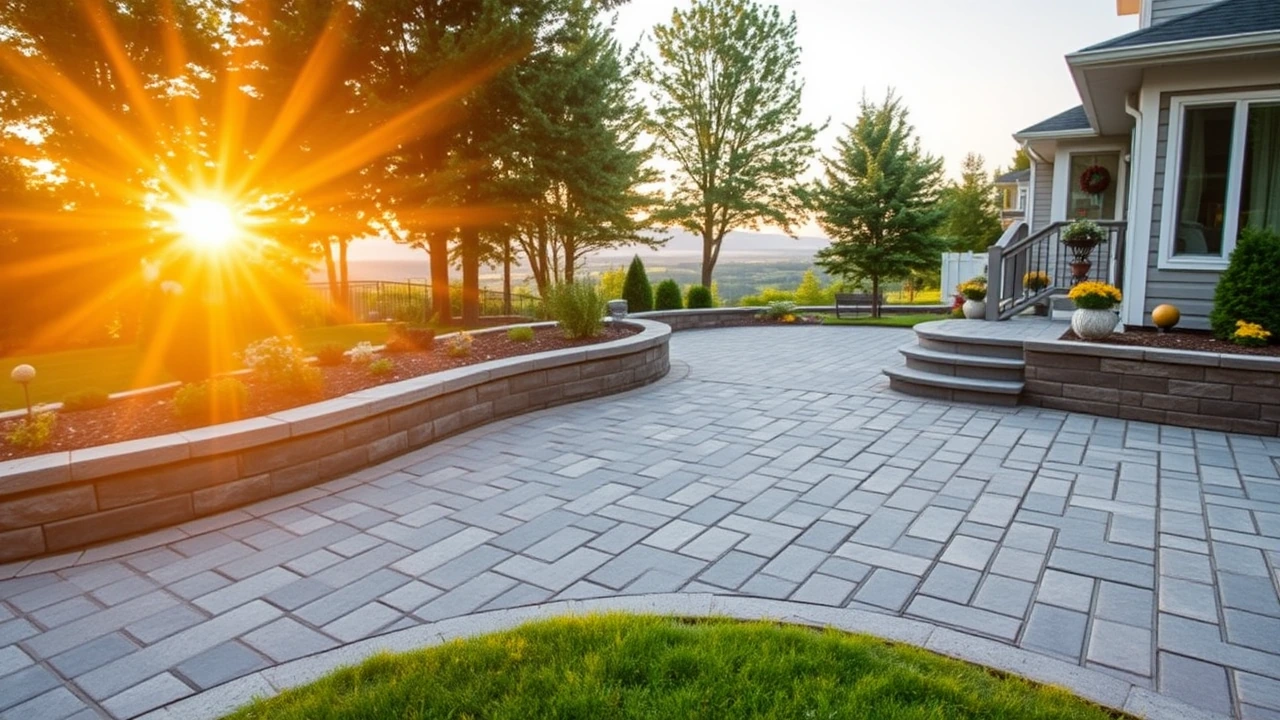
Hamilton is a punishing town for interlocking patios. The clay subsoil across the Mountain holds water like a sponge through every spring thaw, the escarpment edge from Stoney Creek to Ancaster cycles through 80 to 100 freeze-thaw events a season, and the older Stoney Creek and east-end neighbourhoods sit on lots that were graded for drainage to the street, not for a flat rear patio. Westdale and the lower city have their own quirks: tight side-yard access, mature trees with shallow roots, and original concrete walks heaving every five years. A DIY patio dropped on Hamilton clay almost always sinks, tilts or pumps polymeric sand out of the joints by year three. Doing it right means base prep, drainage and edge restraint long before the first paver lands.
Quick verdict for Hamilton homeowners
For a properly built, code-friendly interlocking patio in Hamilton in 2026, expect to budget $40 to $90 per square foot turnkey on most residential projects, with premium paver lines and complex sites pushing $100 to $160. A typical 300 to 500 sq ft Hamilton backyard patio runs 5 to 12 working days on site, weather permitting. Anything on a sloped Stoney Creek lot or a Mountain clay yard with poor drainage needs an engineered base, not a homeowner-grade 4-inch gravel pad. Always get a written scope showing base depth, geotextile, edge restraint and polymeric joint product before signing.
2026 Hamilton interlocking patio cost
Prices below are turnkey installed costs for Hamilton in 2026, including demolition of existing surfaces, excavation, geotextile, 6 to 8 inches of compacted 3/4 clear stone, bedding sand, paver supply, polymeric joint sand, edge restraint and site cleanup. They do not include lighting, built-ins, or pool-deck code work.
| Tier | Paver brand and size | Cost per sq ft | Lifespan | Best fit |
|---|---|---|---|---|
| Basic | Permacon Melville or Techo-Bloc Blu 60mm, standard rectangular | $25 to $45 | 20 to 30 years | Side yards, utility patios, basic Mountain backyards |
| Mid-grade | Unilock Beacon Hill, Techo-Bloc Industria 60mm | $40 to $70 | 30 to 50 years | Most Hamilton family backyards, Westdale walkway and patio combos |
| Premium | Unilock Series 3000, Techo-Bloc Blu Slate, large-format 80mm | $65 to $110 | 50 to 75 years | Ancaster entertaining patios, pool surrounds, premium Stoney Creek builds |
| Luxury | Unilock Umbriano, Techo-Bloc Aberdeen, Permacon Lamina XL | $100 to $160 | 75+ years | Estate Ancaster lots, escarpment-view patios, integrated outdoor kitchens |
To sanity check a quote on your own square footage, run the numbers through our patio cost calculator and read the full paver patio cost guide for Ontario for the line-item breakdown.
Common Hamilton interlocking patio projects we build
Rear-yard entertaining patios on Hamilton Mountain clay
Most of the Mountain, from Gourley and Eastmount through Gilkson and Rolston, sits on heavy clay subsoil that does not drain on its own. The standard 1970s and 80s build here was a slab of concrete poured directly on lawn, and 30 years later it is cracked, heaved or sinking toward the house. We rebuild these as 300 to 600 sq ft entertaining patios in mid-grade Techo-Bloc or Unilock product, with an engineered base that goes 8 inches deep into the clay, wrapped in non-woven geotextile so the clay fines cannot pump up into the gravel through freeze-thaw. The patio is pitched 1 to 2 percent away from the foundation, edge-restrained on all open sides with spiked aluminum, and finished with a quality polymeric joint sand that locks the surface against ant tunnels and weed growth. Done this way, a Hamilton Mountain patio in 2026 will outlast its owners.
Sloped-lot terraced patios in Stoney Creek
Old Stoney Creek, the streets climbing up from Highway 8 toward the escarpment around Lake Avenue, King Street East and Centennial Parkway, has lots that drop 1 m to 3 m from the back door to the rear fence. A single flat patio is impossible. We terrace these yards with a lower entertaining patio at door level, a 600 to 900 mm segmental block retaining wall, and an upper garden patio or fire-pit landing tied into the slope with geogrid. Each tier gets its own engineered base and weeping tile, and the wall drainage is piped out to a side-yard discharge so spring runoff cannot stack behind the lower wall. If your slope needs structural work as well, the same crew handles the retaining wall and hardscaping piece in a single mobilisation. The result is a Stoney Creek yard that finally has usable outdoor space at multiple levels.
Front-yard walkway and patio combos in Westdale
Westdale and Kirkendall around McMaster have tight, character lots where the front yard is the only place to set a real welcome patio. We build coursed Unilock or Techo-Bloc walkways from sidewalk to porch, often widening into a 60 to 100 sq ft front-step patio with a pair of planter piers framing the entry. The trick in Westdale is the mature trees: we tunnel under roots rather than cutting them, use a flexible bedding course over geogrid where roots run shallow, and pick patterns and colours that complement the brick and stone heritage of the neighbourhood instead of clashing with it. Front-yard work also has to respect City of Hamilton boulevard rules where the public right-of-way starts.
Pool-area surround patios in Ancaster
Ancaster from Meadowlands through to Mohawk Road has the lot sizes for proper pool-deck patios, often 600 to 1,200 sq ft of paver work wrapping a vinyl or fibreglass pool. The code work here is real: the City of Hamilton pool enclosure bylaw measures its 1.5 m fence height from the highest ground or hardscape within 1.0 m of the fence, the deck has to drain away from the pool basin without ponding on the lounging area, and any salt-water pool changes the paver spec because chlorinated and salt splash will pit cheaper concrete pavers within a decade. We spec premium 80mm Unilock or Techo-Bloc large-format pavers, set a 2 percent slope away from the coping, and coordinate with the pool builder so the deck, the fence, the equipment pad and the gas and electrical chases all line up before the gravel goes down. For homeowners still choosing a pool style, our pool comparison guide covers how each option changes the deck plan.
Why DIY patios fail on Hamilton clay (and what we do differently)
The four failure modes we see again and again on torn-out Hamilton DIY patios are the same every season. First, base failure: a 3 to 4 inch layer of bagged paver base dropped on top of native Hamilton clay without geotextile. The clay pumps fines up through the gravel over the first three freeze-thaw cycles, the base loses bearing capacity, and pavers start to dish toward the centre of the patio. Second, frost heave: Ontario frost depth is 4 ft, and any patio with a base shallower than 6 inches of compacted 3/4 clear sits inside the active frost zone. Each winter, the wet clay below freezes and lifts pavers out of plane, then drops them unevenly in the spring.
Third, missing edge restraint: pavers held in place by a row of cedar 1x4s or a strip of plastic snap-edge spiked into clay. Within two seasons the wood rots, the spikes pull, and the perimeter pavers walk outward, opening joints across the entire field. Fourth, polymeric joint mistakes: cheap big-box polymeric sand applied to wet pavers or over-watered during activation. It crusts on the surface, never bonds in the joint, and washes out by year two. We do it differently on every Hamilton job: 6 to 8 inches of compacted 3/4 clear over non-woven geotextile, bedding sand screeded to 1 inch, factory-grade pavers cut on a wet saw, spiked aluminum or steel edge restraint, and a contractor-grade polymeric joint product activated in dry conditions.
The Hamilton patio install timeline
- Free on-site visit. We measure the space, probe the soil, check drainage from the foundation, photograph existing grades and downspout locations, and talk through how you will use the patio. You leave with a realistic Hamilton 2026 cost band.
- Design and written quote. We send a fixed scope with paver spec, base depth, drainage detail, edge restraint type, polymeric product, square footage and timeline. No vague single-line quotes.
- Permit check. Most residential patios in Hamilton do not need a building permit, but if your patio attaches to a deck, sits inside a pool enclosure, or changes lot drainage onto a neighbour, we confirm the permit path with the City before mobilising.
- Demo and excavation. We strip sod or break out the failing concrete or existing pavers, excavate 10 to 14 inches below finished grade depending on use, and haul away the spoils.
- Base and compaction. Non-woven geotextile goes on the clay, then 6 to 8 inches of 3/4 clear stone placed in 2-inch lifts and compacted with a reversible plate compactor. Final base is dead-flat and pitched 1 to 2 percent away from the house.
- Bedding, pavers and polymeric. We screed 1 inch of bedding sand, lay the field in the agreed pattern, cut the perimeter on a wet saw, set spiked aluminum edge restraint, sweep and activate polymeric joint sand, and walk the site with you before final cleanup.
Permits and bylaws in Hamilton
The City of Hamilton does not require a building permit for most at-grade residential interlocking patios that sit on the ground, are not attached to a deck or dwelling, and do not affect drainage onto neighbouring properties. The triggers that do require a permit or site-plan review: a patio that is structurally attached to a deck above 600 mm, a patio inside a pool enclosure (which then falls under the pool fence and grading bylaws), and any patio installation that re-routes surface water across a property line. The City of Hamilton drainage bylaw and lot-grading requirements still apply even when no permit is needed: your patio cannot push runoff onto a neighbour or back toward a foundation.
For Hamilton patios near the escarpment, the Mountain brow, or any regulated watercourse, Conservation Hamilton review can add 4 to 8 weeks to the timeline. We handle the permit path, drainage review and inspection coordination as part of the build, so you are not chasing City forms while the crew waits.
Frequently asked questions
What kind of warranty do you offer on a Hamilton patio?
Our standard Peace Love Landscaping warranty is 1 to 2 years on workmanship across the assembly (base, bedding, paver layout, edge restraint, polymeric activation), on top of the manufacturer warranty on the pavers themselves (Unilock, Techo-Bloc and Permacon all carry 25-year to lifetime transferable warranties against structural defects). Full terms are in the signed contract.
When should I seal my new interlocking patio?
Wait 6 to 12 months before sealing. New pavers need a full freeze-thaw cycle and a summer of weathering to outgas efflorescence from the concrete. Sealing too early traps moisture and can cause cloudy white blooms that are nearly impossible to remove. After that first year, a quality joint-stabilising sealer every 3 to 5 years extends the life of the polymeric and deepens the colour.
Can you build a patio in winter in Hamilton?
No. Our Hamilton patio install season is roughly May through October, with some flexibility into early November. We do not place pavers on frozen base or set polymeric in cold or wet conditions, because the spring thaw will shift the assembly and the polymeric will never bond. Most clients book in late winter for a May to July build slot.
How do you handle drainage on Hamilton clay?
Three layers of defence. Non-woven geotextile between the clay subsoil and the gravel base, so clay fines cannot migrate up. Six to 8 inches of 3/4 clear stone compacted in lifts, which both supports the load and drains laterally. And a positive 1 to 2 percent surface pitch away from the house, with edge restraint set so water leaves the field instead of ponding behind it.
What maintenance do polymeric joints need?
Very little if installed correctly. Sweep debris off the patio a few times a season, hose it down occasionally, and watch the joints for any spots that have washed low. Top up with matching polymeric sand every 5 to 8 years on a typical Hamilton patio. Avoid pressure-washing the joints directly, which will erode the polymeric.
Are there code requirements for a pool-deck patio in Hamilton?
Yes. The City of Hamilton pool enclosure bylaw measures its 1.5 m fence height from the highest ground or hardscape within 1.0 m of the fence, so a raised patio built up to the fence shortens your effective fence height. The deck must drain away from the pool, and salt-water pools require a paver spec rated for chloride exposure. We design the patio, fence and pool together to keep everything compliant on the first inspection.
Will my patio affect my lot grading?
Not if it is designed properly. We pitch the patio surface away from your foundation at 1 to 2 percent, route any captured water to existing swales or downspout extensions, and confirm the post-build grades still send surface water off your lot the way the original grading certificate intended. For pool-deck and attached-to-deck patios in Hamilton, we coordinate any re-certification with the City.
How do you keep noise and disruption down on tight Hamilton streets?
We schedule plate-compactor work and wet-saw cutting inside City noise-bylaw hours, set up the cut station away from neighbour windows where the layout allows, and damp-cut all paver chamfers so dust does not drift across fences. On tight Westdale or lower-city blocks we coordinate with neighbours on the dumpster and material drop location before the truck arrives.
Can you tie the patio into a new retaining wall or driveway?
Yes, and on most sloped Hamilton lots it is the right call. Combining the patio, retaining wall and any driveway replacement into one mobilisation saves two or three days of setup costs and gives a single warranty across the whole assembly. The same crew that builds the patio handles the wall and driveway work.
Where we work across the City of Hamilton
Hamilton amalgamated in 2001, so the city limits reach a long way past the lower city. We take on patios, driveways and walkways right across it, and the ground changes more than most homeowners expect between one community and the next.
- Ancaster: escarpment-side lots with heavier clay and long approach driveways.
- Dundas: valley properties with mature tree canopy and tight rear access.
- Stoney Creek: benchland above the escarpment with a lake-moderated microclimate.
- Waterdown: newer subdivisions on former farmland, often shallow topsoil over till.
- Flamborough: larger rural properties where well and septic locations dictate layout.
- Glanbrook: flat former farmland with heavy clay and slow natural drainage.
If you are in any of those communities, you are inside our core service area and the pricing on this page applies to your property.
Ready to talk about your Hamilton interlocking patio? Request a free quote and we will book a site visit, usually within 2 business days. While you are scoping the project, the Hamilton landscaping hub shows the rest of what we build across town, the interlocking patios and driveways service page covers materials and finishes, and the Ontario paver patio cost guide plus patio cost calculator let you sanity-check any quote you receive. Still weighing surface options? Our interlock vs concrete vs natural stone comparison walks through the trade-offs, and if your current patio is already moving, the sinking patio diagnostic tells you whether to repair or rebuild.
Planning the layout? See patio ideas and sizes before you pick a paver.
Budget patio? See patio stones and slabs for Hamilton yards.
Doing the driveway too? See interlock driveways in Hamilton built on a full driveway base.