
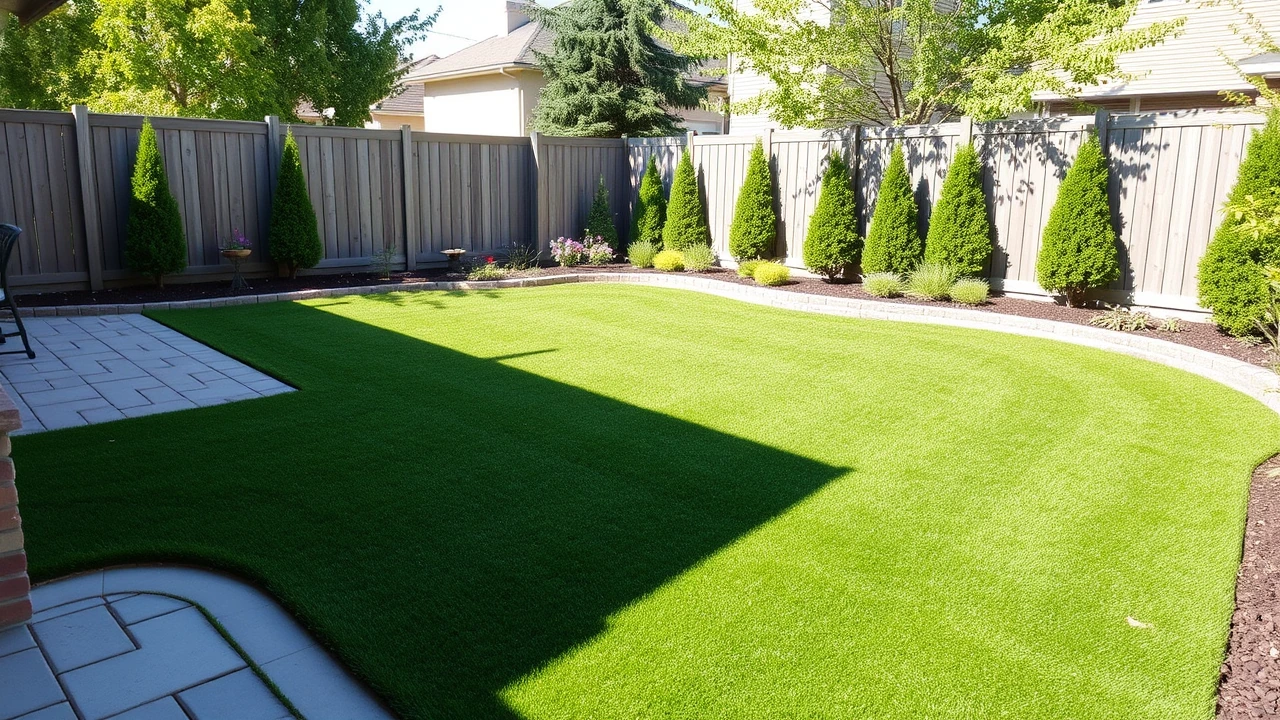
Turf is one of those upgrades where two yards of the same size can quote thousands of dollars apart. The reason is almost never the turf roll itself. It is the work underneath and around it. This guide walks through what artificial turf actually costs installed in Ontario in 2026, by grade, by base prep, and by use case.
2026 Ontario artificial turf price summary
Prices below are installed figures for residential projects in Hamilton, Burlington, Oakville, and the broader GTA / Niagara region. They include excavation, a proper compacted limestone screenings base, geotextile, edging, turf, infill, seaming, and labour. They assume reasonable site access and a project size of 300 to 1,500 sqft.
| Grade | Per sqft installed | Per sqm installed | Best for |
|---|---|---|---|
| Budget turf | $10 to $14 | $108 to $151 | Rental units, side yards, low-traffic patches |
| Mid-grade (premium fibre, looks-like-grass) | $14 to $20 | $151 to $215 | Most residential front and back lawns |
| Pet area / dog run specialty | $15 to $22 | $161 to $237 | Dog runs, full pet yards, daycares |
| Premium (multi-tone, putting-green, top pet-rated) | $20 to $28 | $215 to $301 | Showpiece backyards, putting greens, high-end pet zones |
For a typical 600 sqft Hamilton backyard in mid-grade turf, that works out to roughly $8,400 to $12,000 installed. A 1,000 sqft Oakville yard in premium turf can land between $20,000 and $28,000.
What actually drives the cost
Square footage
Per-foot pricing drops as the project gets bigger. A 150 sqft strip might quote at $18/sqft for mid-grade turf because the crew still needs a full day on site, a dump trip, and a roll minimum. The same turf on a 1,200 sqft yard can come in at $15/sqft.
Base prep depth
A correct Ontario install removes 4 to 5 inches of native soil, lays geotextile, then compacts 3 to 4 inches of limestone screenings. On clay-heavy Hamilton Mountain or Stoney Creek lots, this depth is non-negotiable. If a quote is suspiciously cheap, the base is usually where the cuts were made.
Grading and drainage complexity
Flat rectangles are cheap. Sloped yards, multi-level zones, and drains that need to be tied in all add labour hours. A 1 to 2 percent slope away from the house is the target.
Edging
Turf needs something to nail or staple into at the perimeter. Aluminum looks cleanest and lasts longest but adds $6 to $12 per linear foot.
Infill type
Plain silica sand is the cheapest. Antimicrobial coated sand (Envirofill, Zeofill style) is the standard for pet zones. Cork or cork-and-coconut infill stays cooler in Niagara heat and is the premium option, adding $1.50 to $3.00 per sqft.
Seaming and cuts
Turf rolls are typically 12 or 15 feet wide. Any yard wider than the roll needs a seam. Done well, seams disappear. Done poorly, they grin open within a year.
Material grades explained
When a salesperson quotes turf, four specs matter.
Face weight
Measured in ounces per square yard. Budget turf is 40 to 55 oz. Mid-grade is 60 to 80 oz. Premium turf runs 80 to 100+ oz.
Pile height
For Ontario lawns, 35 to 42 mm (1.4 to 1.65 inches) is the sweet spot. Too short and it looks like indoor-outdoor carpet. Too long and the blades flop over and trap debris.
Blade shape
Cheap turf uses slit-film blades, which look fine at install but mat down within a season. Quality turf uses memory monofilament blades, often with a stiffening spine (S-shape, W-shape, V-shape, diamond).
Backing
Polyurethane backing is more dimensionally stable in Ontario's freeze-thaw cycle than older latex backing.
The sub-base: where good installs are made or lost
Roughly 60 to 70 percent of the project cost is base prep and labour. A correct artificial turf base in Ontario looks like this:
- Strip 4 to 5 inches of native soil and sod. Haul it off site.
- Grade the sub-soil to 1 to 2 percent fall away from the house.
- Lay non-woven geotextile fabric over the full footprint.
- Spread 3 to 4 inches of crushed limestone screenings.
- Compact in 2-inch lifts with a plate compactor.
- Screed the top to a tight finish.
Skipping the geotextile saves $0.30/sqft and ruins the install. Skipping compaction creates dips. Using paver sand instead of screenings turns to soup the first wet spring.
Pet-rated turf: what is actually different
Drainage perforations
Pet turf uses a fully permeable backing that lets urine pass straight through the backing rather than running sideways to the nearest perforation.
Antimicrobial infill
The infill of choice is a zeolite-based or coated quartz product. Zeolite absorbs ammonia from urine and slowly releases it back out as a neutral nitrogen compound during rainfall.
Disinfecting routine
A monthly rinse with an enzyme-based pet turf cleaner keeps a pet zone fresh.
Lifespan and warranty
Reputable residential artificial turf in Ontario should last 15 to 25 years. Warranties from major mills typically cover 15 years against UV degradation, fibre loss, and backing failure.
What voids warranty: reflected heat from low-E house windows (the magnifying-glass effect can melt blades in minutes); BBQ grease, fire pit embers, cigarette burns; sharp metal furniture legs without glides; improper base prep done by a different contractor or DIY (the most common warranty denial); chemical spills.
Maintenance reality
- Weekly to bi-weekly: blow off leaves and debris.
- Monthly: stiff power-broom against the grain to lift blades and redistribute infill.
- Every 3 to 5 years: top up infill.
- Pet zones: rinse weekly, enzyme clean monthly, pick up solid waste daily.
- Spring: check edging and seams.
Turf vs sod: the 10-year math
Sod (600 sqft Ontario lawn): Install $900 to $1,800; mowing $1,200/year if hired out; fertilizer $300 to $600/year; water $200 to $500/year; aeration $300 to $500 every other year. Ten-year hired-out total: roughly $18,000 to $26,000.
Mid-grade turf (same 600 sqft): Install $8,400 to $12,000; infill top-up at year 5 $300 to $600; power-broom $0 to $200/year; water effectively $0. Ten-year total: roughly $9,000 to $14,000.
The crossover usually lands at year 5 to 7 depending on how aggressively the lawn was maintained.
Where turf shines and where it does not
Strong fits
- Small urban yards under 500 sqft.
- Shaded yards where sod struggles.
- Dog runs and full pet yards.
- Putting greens.
- Rooftop terraces, balcony decks, pool surrounds.
- Rental properties.
Weak fits
- Large full-sun open lawns - on a 30-degree Niagara afternoon, turf surface temperature can hit 60 to 70 degrees Celsius.
- Directly beside low-E house windows that reflect a concentrated beam.
- Pollinator-focused yards.
- Vegetable-garden adjacent zones where heat retention can stress nearby beds.
Regional notes
Clay drainage in Hamilton and Ancaster
Hamilton Mountain, Ancaster, and Stoney Creek sit on heavy clay subsoil. Base prep here often needs an extra inch of screenings and, on the worst lots, a 4-inch perforated drain tile running to a discharge point.
Niagara summer surface temperature
St. Catharines, Niagara Falls, and southern Hamilton see July and August surface temperatures that make non-cooling turf uncomfortable barefoot in mid-afternoon. Specify a lighter blade colour, cork or coated cooling infill, and consider a partial shade structure.
Municipal water restrictions
Several Halton and Niagara municipalities run odd/even day watering or full lawn-watering bans during drought. For homeowners on metered municipal water, turf often pencils out faster in these areas than in Hamilton proper.
Frequently asked questions
Does artificial turf increase home value in Ontario?
It depends on the buyer. In small urban GTA yards, pet-heavy households, and townhomes, well-installed turf is a clear positive. In larger suburban or rural lots where buyers expect natural lawn, it is closer to neutral.
How long does artificial turf actually last in Ontario's freeze-thaw climate?
Quality turf on a properly compacted limestone-screenings base lasts 15 to 25 years here. The freeze-thaw cycle is harder on the base than on the turf itself.
Can I install artificial turf myself?
Physically, yes. Successfully, rarely. The base prep is what separates a turf install that looks like a magazine from one that looks like a wrinkled carpet.
Is artificial turf safe for dogs?
Yes, when specified correctly. Pet-rated turf with full-drainage backing, antimicrobial coated infill, and a properly draining base is used in dog daycares across Ontario.
How hot does it actually get in summer?
On a 30 C Niagara afternoon, dark-coloured standard turf can read 55 to 70 C at the surface. Cooling infills bring that down 10 to 20 degrees.
What does a fair quote look like for a 500 sqft Hamilton backyard?
For mid-grade looks-like-grass turf, expect $7,500 to $10,000 installed, all in. Anything under $6,000 is cutting corners. Anything over $14,000 is either premium turf or a difficult site.
- Our artificial turf service
- Sod installation & new lawns
- Low-maintenance backyard ideas
- Small backyard ideas for Ontario
Pricing a local job? See artificial turf in Hamilton or Oakville and Burlington.