
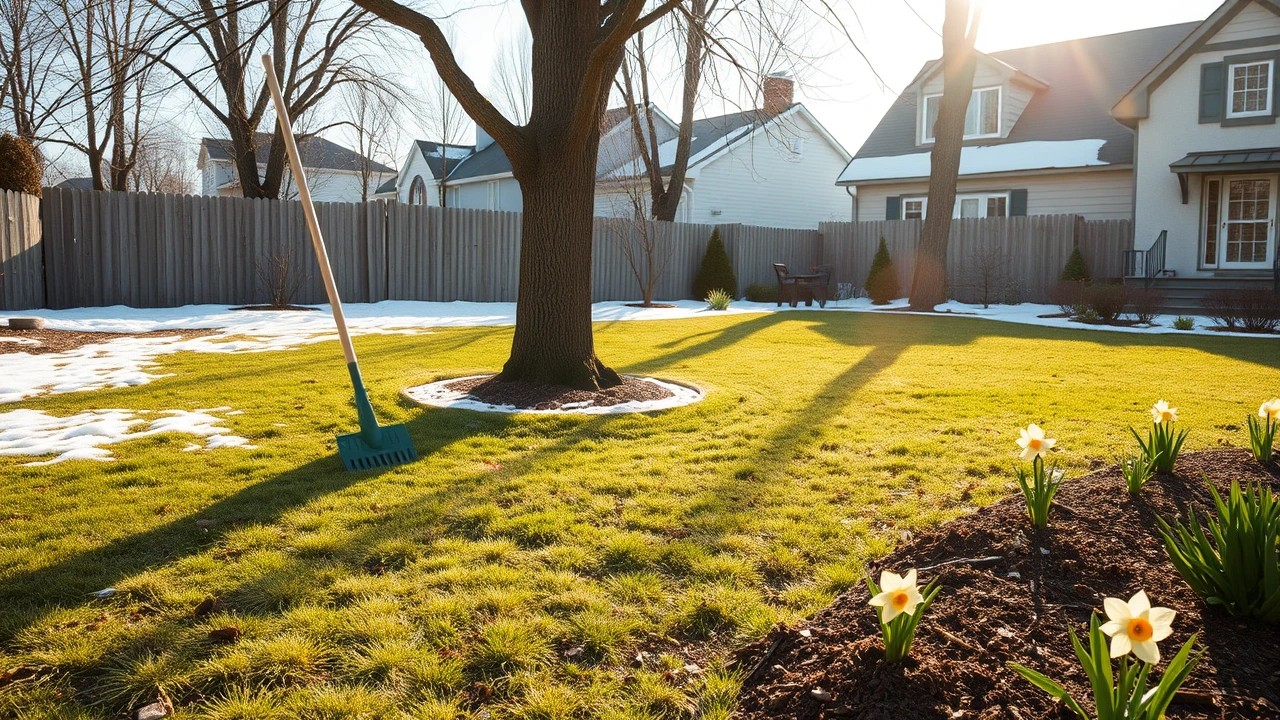
Spring in southern Ontario is short, wet and unpredictable. One week the lawn is still under crusty snow, the next it is 18 degrees and your neighbour is already mowing. A proper spring startup is not one busy Saturday: it is a six to eight week sequence that protects the work you paid for, sets the lawn up for a strong May, and catches winter damage before it turns into a five-figure repair. This checklist is the same sequence the Peace Love Landscaping crew runs on our Hamilton, Halton and Niagara maintenance accounts.
Quick TL;DR
Wait until the soil is no longer soggy before you walk on the lawn, or you compact it for the season. Do a damage walk first, then cleanup, then aeration and overseeding, then edges, then beds, then fertilizer, then irrigation. Most Ontario yards need six to eight weekends of light work, not one heroic push. Skipping the early damage check is the single most expensive mistake homeowners make.
Week-by-week timeline
| Week | Task | Why it matters | Time required |
|---|---|---|---|
| Week 1 (mid-March) | Snow-melt damage walk, photograph everything | Catches plow gouges, salt burn, heaved pavers, fence panels and shifted retaining walls while you can still document the cause | 45 to 60 minutes |
| Week 2 | Light cleanup: rake debris, pick up branches, clear catch basins | Lets the lawn dry, prevents matted grass and snow mould | 2 to 3 hours |
| Week 3 (late March) | Hardscape inspection: pavers, steps, retaining walls, deck | Frost heave is most visible now, before plants leaf out and hide problems | 1 hour |
| Week 4 (early April) | Aeration and dethatch, then overseed bare spots | Cool soil and consistent moisture give seed the best window of the year | 3 to 4 hours |
| Week 5 | Edge resetting along beds, driveway, walkways | Crisp edges hold mulch in, keep grass out of beds, lift curb appeal instantly | 2 to 3 hours |
| Week 6 (mid-April) | Paver joint top-up with polymeric sand, re-level wobbly stones | Stops weeds and ants for the season, prevents trip hazards | 2 to 4 hours |
| Week 7 | Garden bed prep, cut back perennials, top up mulch to 2 to 3 inches | Locks in moisture before summer, suppresses weed germination | 3 to 5 hours |
| Week 8 (late April to early May) | First fertilizer pass, irrigation startup and zone test | Feeds the spring flush, catches winter line breaks before peak season | 2 hours |
Snow-melt damage check
The first dry weekend in March, walk every square foot of your property with your phone out. You are looking for plow scrapes along the driveway edge, salt burn on lawn margins, snow mould (matted greyish-pink patches), heaved interlock, cracked concrete, broken fence panels and shifted retaining wall blocks. Photograph everything with the date stamp on. If your driveway was plowed by a contractor and you find gouged sod, this is when you make the claim, not in June when nobody remembers which storm did it.
Pay special attention to anywhere water collected and refroze repeatedly. North-facing slopes, low spots near downspouts and the shaded side of retaining walls take the worst beating. Heaved pavers within a couple of feet of a wall or step almost always point at a base or drainage failure underneath, not just a surface fix. If you see sinking or rocking pavers, read our interlock sinking diagnostic before you call anyone.
Lawn aeration, dethatch and overseeding
Once the soil can hold your weight without leaving a footprint, the lawn is ready for the most useful 30 minutes of the year. Core aeration pulls plugs of soil out so air, water and nutrients reach the root zone. On the heavy clay common in Stoney Creek, Ancaster and parts of Burlington, aerate every spring without exception. Sandier soils in parts of Oakville and Niagara can go every other year.
Dethatching is only needed if you can feel a spongy mat more than a half-inch thick. Most Ontario lawns do not need it annually. Right after aeration, top-dress thin areas with a quarter-inch of screened compost, then overseed with a tall fescue and Kentucky bluegrass blend at roughly 4 pounds per 1,000 square feet. Water lightly twice a day until germination, which takes 10 to 14 days in cool April soil.
For a fuller walkthrough on which seed beats sod and when, see sod vs hydroseed vs seed.
Edge resetting and bed lines
Crisp edges are the single highest visual return on any spring weekend. A half-moon edger or a sharp flat spade cuts a clean 3-inch vertical line between lawn and bed. The bed side sits about 2 inches lower than the lawn so mulch stays put and grass roots cannot creep in. Reset every bed, every tree ring, every driveway and walkway boundary. Plan on two to three hours for an average suburban lot.
If your beds are bordered by steel, aluminum or stone edging, walk it now and re-seat anything that frost pushed up. Wavy edging looks worse than no edging at all.
Paver joint and hardscape maintenance
Polymeric sand in paver joints is a wear item, not a one-time install. Plan to top it up every two to three years. Sweep dry polymeric sand into the joints on a dry day, blow the paver surfaces completely clean (any residue stains permanently), then mist activate per the bag instructions. Skip this on wet pavers or you will get a haze.
While you are on the patio, check for any pavers that rock under foot weight, joints wider than the original install, efflorescence (white powdery deposits), and step risers that have moved. Catching a sinking corner in April costs a quarter of what it costs once the failure spreads. For retaining walls, sight down the top course. Any bulge, lean past vertical, or block that has slid forward is a same-year repair, not a wait-and-see.
Garden bed prep and mulch top-up
Cut perennials back to 3 to 4 inches if you left them up for winter interest. Pull obvious weeds while the soil is soft, including the taproot. Lightly fork the top 2 inches of soil in bare areas to break the winter crust, then top up mulch to a uniform 2 to 3 inches deep. Never pile mulch against trunks (the dreaded mulch volcano). It rots bark and invites borers.
Shredded cedar holds up best in Ontario weather and resists blowing around in March wind. Pine bark and triple-mix work but break down faster. If you are unsure how much you need, our mulch and topsoil calculator handles the math.
First fertilizer pass and irrigation startup
Wait until the lawn has been actively growing and mowed at least once before the first fertilizer pass, usually late April to early May in Hamilton and Halton. A slow-release nitrogen blend at the rate on the bag is plenty. Heavier rates do not buy you a greener lawn, they buy you mowing twice a week and more disease. If crabgrass was bad last summer, a corn gluten pre-emergent at this stage suppresses germination without synthetic chemicals.
For irrigation, charge the system slowly. Open the main valve a quarter turn, let it pressurize, then open fully. Run each zone for two minutes and walk it. You are looking for geysers (broken heads), low pressure (line break upstream), sunken heads, blocked nozzles and overspray onto hardscape. Calibrate run times before the first heat wave, not during it. If your system has not been serviced in three or more years, a professional startup is cheap insurance. See our irrigation services.
How to apply this on your yard
Most Ontario homeowners try to do everything on one frantic Saturday in April and then wonder why the lawn looks rough in June. The fix is sequencing. Match the work to soil conditions and lawn growth stage:
- If you can leave a footprint in the lawn, it is too wet. Wait a week.
- Hardscape inspection always comes before mulch. You cannot see heave under fresh mulch.
- Aeration and overseed happen in the same session, not weeks apart.
- Fertilizer only after the first mow, never on dormant or stressed turf.
- Irrigation startup is the last step, not the first. Frost can still hit Hamilton in mid-April.
If you only have time for three tasks, pick damage check, aeration plus overseed, and edge resetting. Those three move the needle more than anything else.
Common mistakes we see
- Mowing or raking when the soil is still soggy, which compacts clay for the entire season
- Fertilizing in March on a dormant lawn, which feeds weeds, not turf
- Skipping the polymeric sand top-up, then paying for ant and weed treatments all summer
- Piling mulch against tree trunks (mulch volcanoes rot bark and kill young trees)
- Charging an irrigation system at full pressure, which blows fittings and floods valve boxes
- Overseeding without watering, then blaming the seed when nothing germinates
- Ignoring salt-burned lawn edges instead of flushing them with water and reseeding in April
Frequently asked questions
When can I start mowing in Ontario?
Once the lawn is actively growing and tall enough to remove the top third without scalping, usually late April in Hamilton and Halton. Set the deck to 3 inches for the first cut. Never bag the first mow if the clippings are short and dry. They feed the soil.
Do I really need to aerate every spring?
On heavy clay, yes. On sandy or sandy-loam soils, every other year is fine. If your lawn pools water after a rain or feels rock-hard underfoot, aerate.
What if my lawn is full of brown patches after snow melt?
Most early-spring brown patches are snow mould or salt burn and they recover with raking and light watering. Patches that stay brown past mid-May are usually something else. See why is my lawn brown, patchy or dying.
When should I turn on my irrigation system?
After the last hard frost and once daytime highs are reliably above 10 degrees, typically late April to early May in Hamilton and Halton, slightly earlier in Niagara. Charge the system slowly to avoid water hammer.
Should I dethatch every year?
No. Only dethatch if you have more than a half-inch of spongy thatch you can feel underfoot. Most Ontario lawns do not. Aeration alone is usually enough.
How early can I plant annuals?
After the May long weekend in Hamilton, Halton and most of Niagara. Earlier plantings risk a late frost. Cool-season vegetables and pansies tolerate earlier dates.
Is power raking the same as dethatching?
Power raking is more aggressive and tears out healthy crowns along with thatch. Use a manual dethatching rake or a light hand-held dethatcher unless thatch is severe.
How much does a professional spring cleanup cost?
For a typical Hamilton or Burlington property, full spring cleanup with cleanup, edging, bed prep and mulch top-up runs $600 to $1,500. Larger lots or properties with significant winter damage run higher. See our lawn care services.
If you would rather have the crew handle it, we run full spring startups across Hamilton, Burlington, Oakville, Halton and Niagara from mid-March through May. Pair this checklist with our spring yard cleanup guide, the interlock sinking diagnostic, the brown lawn troubleshooter, or browse our lawn care and maintenance services. Ready to book? Request a free quote and we will scope your property in one visit.
Sprinklers not running after start-up? Follow our step-by-step zone troubleshooting before calling for a repair.
Deck on the spring list? Follow our step-by-step deck cleaning guide for wood and composite.