
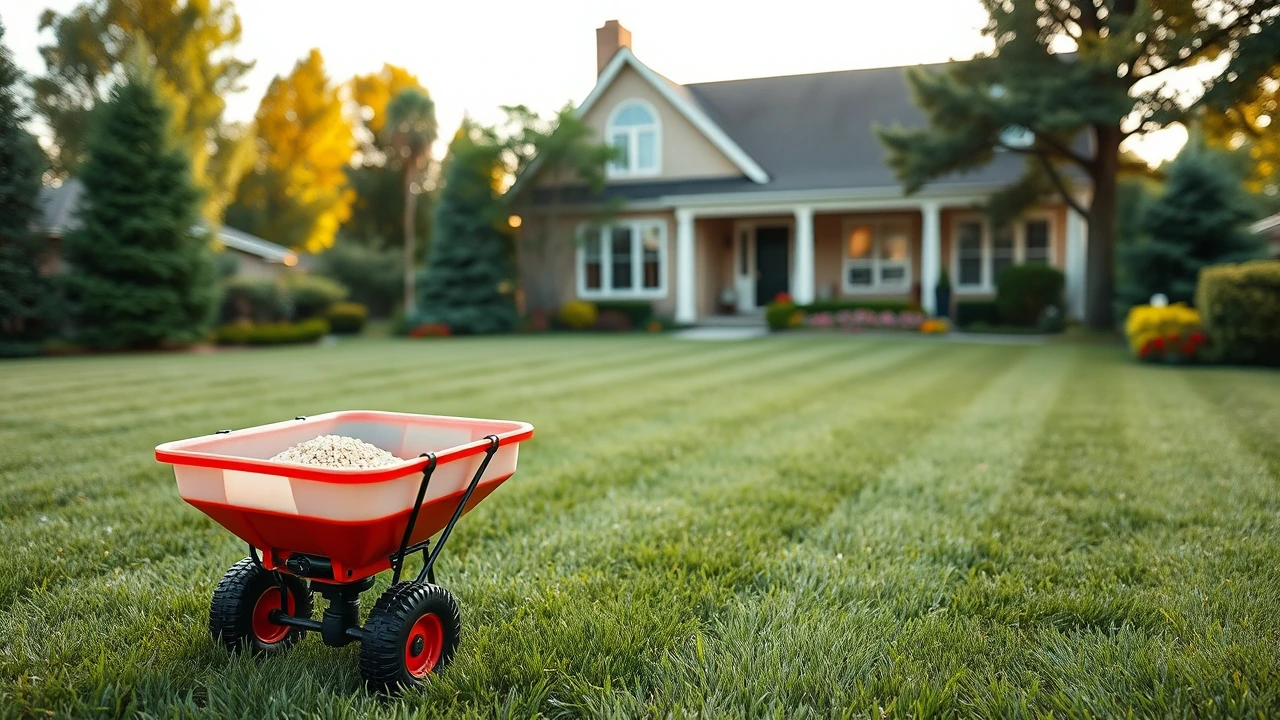
A cool-season Ontario lawn does not need a bag of fertilizer every month. It needs the right nutrient at the right soil temperature, on a schedule that respects how Kentucky bluegrass and fescue actually grow here. Get the timing right and you will out-perform any neighbour who dumps a quick-release 30-0-0 in May and wonders why the lawn burns out by July. Below is the 2026 calendar we use on real Hamilton, Burlington and Oakville lawns, with the exact NPK ranges, the local suppliers we buy from, and a worked cost example for a typical Ancaster lot.
Quick TL;DR
For Ontario cool-season turf, fertilize 3 to 4 times per year, not monthly. The two non-negotiable applications are early fall (Labour Day window) and late fall winterizer (late October to mid November). A spring app goes down only after the lawn greens up on its own, never before. Use slow-release nitrogen (at least 50% SCU, PCU or organic) to avoid the burn, surge growth and runoff you get from quick-release urea.
Hamilton and Halton climate context (why the calendar is what it is)
Hamilton, Burlington, Oakville and most of the western GTA sit in Canadian Plant Hardiness Zone 6b (a strip along the Lake Ontario shore is a warmer 7a; Waterdown, Flamborough and the top of the Escarpment run cooler 6a). Environment Canada's 30-year normals for Hamilton put the average last spring frost around May 3 and the first fall frost around October 20, giving roughly 170 frost-free days. Soil temperatures at a 4 inch depth typically cross the 10C threshold that Kentucky bluegrass needs for active growth in the last week of April, hit their spring peak of 18 to 20C in late June, drop back through 15C around the Labour Day weekend, and fall below 10C in the third week of October.
Every application below is timed to a soil temperature, not a calendar date, because a cold late April (like 2022) can push the spring green-up window two weeks later than a mild one (like 2024). If you own a $12 compost thermometer you can read soil temp in your own back yard in five seconds; if you do not, the Ontario Weather Network and the University of Guelph's Turfgrass Institute both publish weekly soil-temp readings for the region.
The schedule
| App | Window | NPK | Rate per 1000 sq ft | Why this app |
|---|---|---|---|---|
| 1. Spring green-up | Late April to mid May (soil 10-12C) | 20-0-5 or 24-0-6 slow-release | 0.75 lb N (about 3.5-4 lb product) | Wakes roots, supports tillering. Skip if lawn is already deep green. |
| 2. Late spring | Early to mid June | 15-0-15 or 20-0-10 | 0.5 lb N | Pre-summer feed with potassium for heat and drought tolerance. |
| 3. Summer (optional) | Mid July to early August | 10-0-20 organic | 0.25-0.4 lb N | Skip on stressed or dormant lawns. Use only on irrigated turf. |
| 4. Early fall (best app) | Late August to mid September | 24-0-10 with 50% SCU | 1.0 lb N | Heaviest growth window. Pairs with aeration and overseed. |
| 5. Winterizer | Late October to mid November | 10-0-20 or 13-0-25 | 0.75-1.0 lb N | Goes to roots, not blade. Drives spring green-up next April. |
A 4-app schedule drops the summer feed. A 3-app schedule keeps only spring green-up, early fall and winterizer. For most Hamilton-area lawns we run the 3-app.
Month-by-month Hamilton lawn calendar
The table above tells you what to do; this one tells you when. Numbers are pulled from Environment Canada 1991-2020 normals for the Hamilton A station and University of Guelph turfgrass soil-temperature data.
| Month | Air temp (avg high / low, C) | Soil temp at 4in | What to do |
|---|---|---|---|
| March | 4 / -4 | 2-5C | Nothing. Rake lightly if snow mould is present. Do not spread anything. |
| April | 12 / 2 | 5-10C | Watch soil temp weekly. First mow at 3 inches when grass hits 4. No fertilizer yet. |
| May (early) | 17 / 6 | 10-13C | App 1 window opens. Spread 20-0-5 or 24-0-6 slow-release at 0.75 lb N per 1000 sq ft. |
| May (late) | 19 / 8 | 13-16C | Water in the spring app if no rain within 48 hours. Overseed thin areas. |
| June | 24 / 13 | 16-19C | App 2 (optional). 15-0-15 or 20-0-10 at 0.5 lb N. Mow to 3.5 inches. |
| July | 27 / 16 | 19-22C | Skip fertilizer unless irrigated. Mow to 3.5-4 inches. Water 1 inch per week deep, not daily. |
| August (early) | 26 / 15 | 18-21C | Optional light organic feed (10-0-20) only on irrigated turf. Prep for aeration. |
| August (late) | 24 / 13 | 15-18C | App 4 window opens (the best one). Aerate, overseed, then spread 24-0-10 at 1.0 lb N. |
| September | 20 / 10 | 13-16C | Best growing month of the year. Water in the fall app. New seed germinates now. |
| October (early) | 13 / 5 | 10-13C | Second cut lower to 2.5 inches. Rake heavy leaf drop weekly. |
| October (late) / November (early) | 8 / 1 | 5-10C | App 5 (winterizer). 10-0-20 or 13-0-25 at 0.75-1.0 lb N. Last mow at 2.5 inches. |
| December to February | -1 / -8 | 0-2C (frozen) | Nothing. Do not walk on frozen turf. Do not spread anything on snow. |
Soil test first, guess second
Before you buy a single bag, pull a soil test. The University of Guelph Agriculture and Food Laboratory (Laboratory Services Division), A&L Canada Labs in London and Sudbury Environmental Laboratories all run basic residential soil tests for $35 to $60 that tell you pH, organic matter, phosphorus, potassium and CEC. That report changes the math. A lawn at pH 5.8 will not respond to nitrogen until you lime it. A lawn already high in phosphorus does not need a starter fertilizer at all, and Ontario best-practice guidance discourages phosphorus on established lawns anywhere within 300m of a waterway to protect the Great Lakes basin from eutrophication.
We test every property we put on a recurring lawn care maintenance program, because the schedule above is the default. The actual prescription always shifts a little based on what the soil is doing. If your lawn has thin, patchy areas, read why is my lawn brown, patchy or dying first. Fertilizer will not fix a grub problem or compacted clay.
Spring: less is more
The biggest mistake we see in Hamilton is the April rush. Homeowners see the neighbour spreading something green-bagged and they panic. Resist. A cool-season lawn pulls roughly 60% of its annual carbohydrate reserve out of the root crown in April, before soil temps even hit 10C. Hammering it with quick-release nitrogen at that point forces top growth at the expense of roots, and you pay for it in July when the lawn cannot find water.
Wait until the lawn has been actively growing for 2 to 3 weeks and needs its first real mow. That is your green-up window. Spread a slow-release 24-0-6 or 20-0-5 at 0.75 lb N per 1000 sq ft. Water it in with 1/4 inch of irrigation if no rain is forecast within 48 hours. Done.
Summer: skip or feed light
July and August in Hamilton routinely push daytime highs over 28C with stretches of no rain. Cool-season grass goes semi-dormant in that heat. Fertilizing a dormant or stressed lawn is how you burn it. If your turf is irrigated and still actively growing, you can run a light organic feed (corn gluten, alfalfa-based, or a 10-0-20 with 0.25-0.4 lb N). If the lawn is crispy and dormant, do nothing. Water it deeply once a week to keep the crowns alive and wait for fall. See summer lawn watering schedule for the exact timing, and check the City of Hamilton and Halton Region water conservation pages before you set an irrigation controller in July, because Level 1 and Level 2 outdoor watering restrictions get invoked most summers.
Fall is where lawns are won
If you only do one fertilizer application all year, make it the early fall app. Late August through mid September is when soil temperatures sit at 13-18C, top growth slows, and the plant pushes everything into root mass and tillering. A 1.0 lb N application of 24-0-10 with 50% slow-release coated urea (SCU or PCU) at this window does more for density and colour than any other single thing you can do to a lawn. It also pairs perfectly with core aeration and overseed, which we cover in our aerate and overseed guide.
Then circle back in late October or early November for the winterizer. Soil temps drop below 10C, blade growth basically stops, but roots keep working until the ground freezes. A high-potassium, lower-nitrogen feed at this point (10-0-20 or 13-0-25) banks reserves for next April. This is why winterized lawns green up 2 to 3 weeks earlier in spring than their unfed neighbours.
The Ontario Cosmetic Pesticide Ban in 2026
Worth flagging because we get asked weekly. The Ontario Cosmetic Pesticides Ban Act has been in force since 2009. It restricts cosmetic-use pesticides on lawns and gardens, including most synthetic herbicides like 2,4-D and dicamba. Fertilizers are not pesticides and are not banned, but combination "weed and feed" products that pair fertilizer with a restricted herbicide are not legal for cosmetic lawn use in Ontario in 2026. If you see a bag at a big-box store with both, check the label twice. The legal alternatives are corn gluten meal (pre-emergent), iron-based selective products, and FIFRA Class 11 active ingredients. We use only ban-compliant products on client lawns.
Slow-release vs quick-release nitrogen
Quick-release nitrogen sources (urea, ammonium sulfate) hit the plant in 3 to 7 days, push a 2-week surge of top growth, then crash. They are cheap per pound of N but burn easily, leach fast, and force you to mow twice a week. Slow-release sources (sulfur-coated urea, polymer-coated urea, IBDU, methylene urea, organics like feather meal or alfalfa) release N over 8 to 16 weeks. They cost more per bag but feed evenly, do not burn, and produce a denser, more drought-tolerant lawn.
Look at the bag. It should say something like "50% slow-release nitrogen" or list SCU, PCU or methylene urea in the guaranteed analysis. If the only N source is urea or ammonium nitrate, put it back.
Where to buy fertilizer in Hamilton, Burlington and Oakville
You have three practical tiers to shop, and they matter because most homeowners never realise the pro-tier product is available to retail buyers if you ask.
Tier 1: big-box (fast, cheap, mixed quality)
- Home Depot Ancaster (Wilson St W), Home Depot Stoney Creek (Fruitland Rd), Home Depot Burlington (Guelph Line) - Scotts Turf Builder, C-I-L Golfgreen and Miracle-Gro consumer lines. Roughly $30 to $55 for a 5,000 sq ft bag. Check the guaranteed analysis; the good SCU blends are here but you have to read the label.
- Canadian Tire Burlington, Oakville and Ancaster - Golfgreen private label. Convenient, seasonal sales in April and September, but the slow-release percentages are lower than the pro lines.
- Lowe's Burlington (Appleby Line) - similar mix to Home Depot with occasional pallet-pricing on end-of-season winterizer bags.
Tier 2: local garden centres (better product knowledge)
- Terra Greenhouses (Burlington, Waterdown, Milton) - stocks Bradfield Organics and higher-end SCU blends. Staff can name the difference between polymer-coated and sulfur-coated urea, which the big-box staff usually cannot.
- Connon Nurseries (Waterdown) - broad selection including Nutrite bags. Priced $10 to $15 above big-box but noticeably better spread pattern and less dust.
- Sheridan Nurseries (Oakville, Georgetown) - carries Scotts pro tier and organic options like Corn Gluten Plus for pre-emergent weed control that is Ban-compliant.
- Vermeer's Garden Centre and Flower Shop (Welland) - useful for anyone in Grimsby, Beamsville or Niagara. Bulk bags available on request.
Tier 3: professional turf supply (best value if you buy 20kg+)
- Nutrite (Turf Care Products Canada, London/GTA distribution) - the branded 24-0-10 and 13-0-25 winterizer we use. Available to retail buyers at some Landscape Ontario member yards.
- Zander Sod Co. (Waterloo/Halton delivery) - sod farm that also sells starter and maintenance blends by the pallet. If you are re-sodding a full yard, ask them to add a pallet of maintenance fertilizer to the order.
- Green Horizons Sod Farm (Cambridge) - similar model. Their delivery trucks come into Ancaster and Waterdown weekly in growing season.
A rule of thumb: if you are covering more than 4,000 sq ft, the Tier 3 24-0-10 in a 20kg bag will beat Tier 1 pricing per pound of nitrogen by 30 to 40%, before you count the fact that the coated-urea release curve is genuinely better.
How to apply this on your yard
First, measure. A rotary spreader needs to know your square footage to set the rate. Use Google Earth or a measuring wheel. Most Hamilton lots fall into one of these brackets:
- Small urban lot (under 1500 sq ft of lawn): one 7 kg bag of 24-0-10 covers a full year. Hand spreader is fine. Total spend: $80-$130 across the year.
- Typical Hamilton Mountain or Burlington lot (1500-4000 sq ft): two 15 kg bags per year. Rent a rotary spreader or buy one for $80. Total spend: $150-$240.
- Larger Ancaster, Waterdown or Halton lot (4000-10,000 sq ft): three to four 15 kg bags per year. A broadcast spreader is essential, and a soil test pays for itself in product savings. Total spend: $280-$500.
- Estate lots (10,000+ sq ft): get on a maintenance program. The labour and product math no longer favours DIY.
Always calibrate the spreader to the bag, walk at a consistent pace, and overlap edges by half the throw width. Water in within 48 hours unless rain is forecast.
Worked example: a 3,200 sq ft Ancaster lot on the 3-app schedule
Assume a typical Meadowlands-Ancaster property with 2,200 sq ft of back-lawn and 1,000 sq ft of front, all Kentucky bluegrass mix on clay-loam. Three applications, no summer feed, using Nutrite 24-0-10 for spring and fall and Nutrite 13-0-25 for the winterizer.
- App 1 (spring green-up, early May): 3,200 sq ft x 0.75 lb N / 1000 = 2.4 lb N. At 24% N, that is 10 lb of product. One 7 kg (15 lb) bag covers it with a bit spare. Cost at Connon: about $42.
- App 4 (early fall, Labour Day): 3,200 sq ft x 1.0 lb N / 1000 = 3.2 lb N = 13.3 lb of 24-0-10. One 7 kg bag is short by a hair; buy a 15 kg bag and use ~14 lb. Cost: about $68.
- App 5 (winterizer, late October): 3,200 sq ft x 0.9 lb N / 1000 = 2.9 lb N. At 13% N, that is 22 lb of 13-0-25. One 15 kg (33 lb) bag with leftover for the following spring. Cost: about $58.
Total DIY annual spend: about $168, plus a $12 compost thermometer and 3 hours of your time spread across the year. A full-service maintenance program on the same lot with soil test, aeration, overseed and three applications typically quotes at $520 to $780 per season depending on how much extra weed and edge work is included. The DIY save is real, but so is the two-day aeration and overseed pass in September, which is the single biggest lever most homeowners cannot easily rent equipment for.
Common mistakes we see
- Spreading quick-release urea in mid April before the soil hits 10C, burning new growth.
- Fertilizing a dormant or heat-stressed July lawn and frying the crowns.
- Buying "weed and feed" products that are not ban-compliant in Ontario.
- Skipping the winterizer because "the lawn is going dormant anyway" - it is the highest ROI app of the year.
- Applying phosphorus (the middle number) when the soil test shows it is already adequate, which is most established Ontario lawns.
- Not calibrating the spreader, leaving stripes of green and yellow in early summer.
- Treating fertilizer as a fix for compacted soil, thatch, grubs or shade. It is not.
Frequently asked questions
How many times per year should I fertilize my Ontario lawn?
Three to four times. The non-negotiables are early fall (around Labour Day) and a late fall winterizer. Add a spring green-up app after the lawn is actively growing, and optionally a light June or summer feed if the lawn is irrigated.
What is the best fertilizer for an Ontario lawn?
A slow-release granular with an NPK around 24-0-10 or 20-0-5 for spring and fall, and a higher-potassium 10-0-20 or 13-0-25 for the winterizer. Look for at least 50% slow-release nitrogen on the label. In Hamilton, Nutrite is the pro-tier we run; C-I-L Golfgreen and Scotts Turf Builder are solid retail alternatives.
Is weed and feed legal in Ontario?
Combination products that pair fertilizer with restricted cosmetic-use herbicides like 2,4-D or dicamba are not legal for lawn use under the Cosmetic Pesticides Ban Act. Ban-compliant alternatives (corn gluten, iron-based, certain Class 11 actives) are allowed.
Can I fertilize in July and August?
Only if the lawn is irrigated and still actively growing. A dormant, crispy summer lawn should not be fertilized at all. Wait for the early fall window. And check the City of Hamilton or Halton Region water conservation status first, because summer watering restrictions get invoked most years.
How long after fertilizing can kids and pets use the lawn?
For granular slow-release, once the product is watered in (1/4 inch of irrigation or rain) the lawn is safe. We typically tell clients to wait 24 hours to be conservative.
Do I need to water in fertilizer?
Yes, within 48 hours. Without water, the granules sit on the blade and risk burn, plus the nutrients never reach the root zone where they are needed.
Is organic fertilizer worth the extra cost?
For established lawns on a 3-app schedule, synthetic slow-release is fine and cheaper. For overseeded or new lawns and for homeowners with kids and pets, organic options (alfalfa-based, feather meal, corn gluten) are excellent. They feed soil biology in a way synthetics do not.
Should I fertilize new sod or seed?
Yes, but use a starter fertilizer with phosphorus (something like 18-24-12) at install only, then return to the standard schedule. See our sod vs hydroseed vs seed guide for install-week fertilizer details.
Where can I buy pro-tier lawn fertilizer in Hamilton or Burlington?
Connon Nurseries (Waterdown), Terra Greenhouses (Burlington and Waterdown), Sheridan Nurseries (Oakville) and Landscape Ontario member yards distributing Nutrite. Big-box retailers carry the consumer lines but the pro 24-0-10 with high slow-release percentages is worth the extra $10 to $15 per bag on lots over 4,000 sq ft.
What is the soil temperature threshold for spring fertilizing in Ontario?
10 to 12C at a 4 inch depth. In Hamilton that typically hits in the last week of April or first week of May. A $12 compost thermometer stuck into the lawn tells you in five seconds.
If you want this dialled in without thinking about it, we run recurring lawn care maintenance programs across Hamilton, Burlington, Oakville and Niagara that include soil testing, the right products at the right time, and aeration plus overseed in the fall window. Request a free quote and we will put together a 2026 plan for your property.
Rather have someone else run the program? See what lawn care costs in Ontario in 2026 including standalone fertilizer programs and full-season packages.