
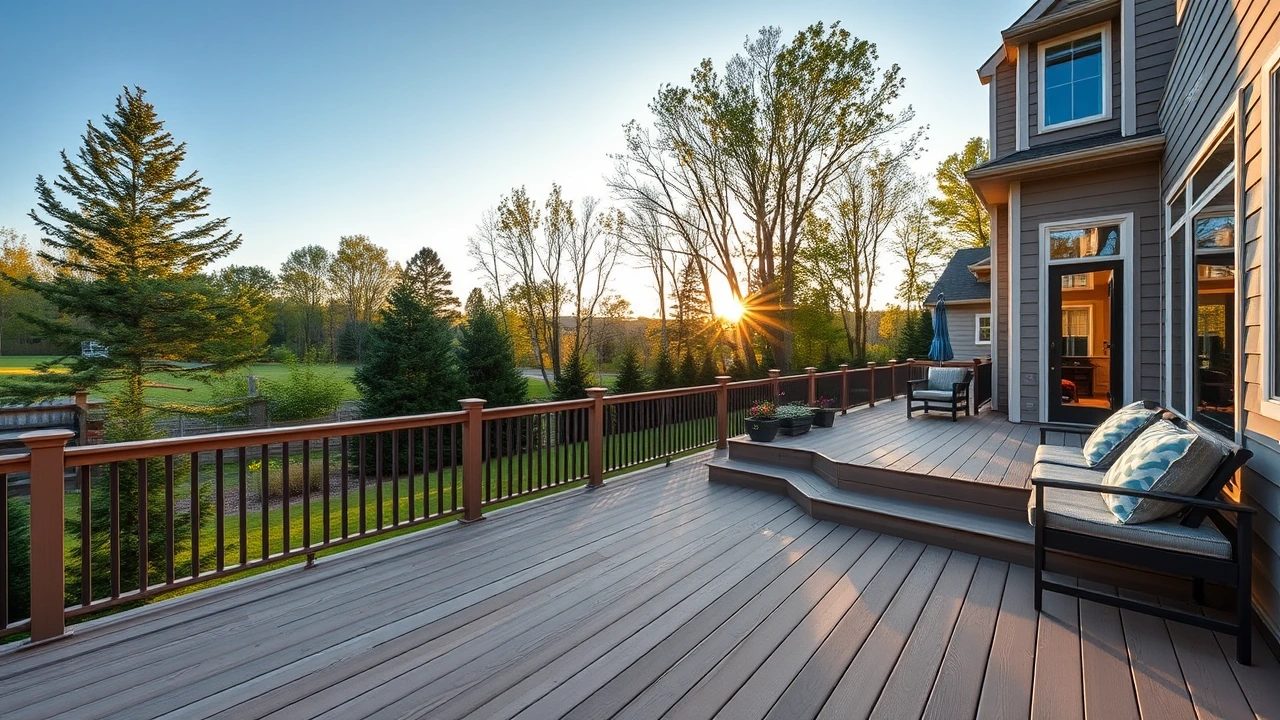
Stoney Creek is the most interesting deck-building town in the GTA west, and the reason is the slope. The grade from Highway 8 up to the escarpment means a huge share of Stoney Creek homes are walkout-basement designs with a main-floor deck off the kitchen, a lower-walkout patio, and sometimes a third landing tied into the yard. Standard one-level builds are the exception, not the rule. Add in the heavy clay subsoil through Old Stoney Creek and Lower Stoney Creek, the violent freeze-thaw cycle along the escarpment, the 4 ft Ontario frost depth, and the Ontario Building Code permit threshold at 600 mm above grade, and a Stoney Creek deck is closer to small-scale structural work than to a weekend DIY. Doing it right means the right footings for the soil, the right framing for the span, and the right surface for the exposure.
Quick verdict for Stoney Creek homeowners
A properly built, permit-friendly deck in Stoney Creek costs $45 to $110 per square foot turnkey in 2026 on most residential projects, with premium composite multi-level walkout builds running $120 to $180. A typical 250 to 450 sq ft Stoney Creek deck takes 6 to 14 working days on site, weather permitting. Any deck over 600 mm above adjacent grade triggers an Ontario Building Code permit and inspection through the City of Hamilton, which is almost every walkout-basement deck in town. Helical piles are usually the right call on Stoney Creek clay instead of sonotube footings. Always get a written scope showing footing type, framing spec, fastener grade, guard rail height, joist spacing and surface product before signing.
2026 Stoney Creek deck cost
Prices below are turnkey installed costs for Stoney Creek in 2026, including permit drawings, footings, framing, surface, fascia, stairs, guard rail and cleanup. They do not include lighting, built-ins, or roof structures over the deck.
| Tier | Surface and framing | Cost per sq ft | Lifespan | Best fit |
|---|---|---|---|---|
| Basic | Pressure-treated SPF framing and pressure-treated decking, 16 inch joist spacing, sonotube footings | $45 to $70 | 15 to 25 years | Lower Stoney Creek single-level decks, Winona utility decks, ground-contact builds |
| Mid-grade | PT framing, western red cedar decking and rail, 16 inch joist spacing, helical piles | $60 to $95 | 20 to 30 years | Old Stoney Creek family decks, Fruitland walkout main-floor decks |
| Premium | PT framing, capped composite decking (Trex Transcend, TimberTech AZEK, Fiberon Concordia), 12 inch joist spacing, helical piles, aluminum rail with glass or cable infill | $95 to $140 | 30 to 50 years | Most Stoney Creek walkout-basement multi-level decks, Mountain Brow entertaining decks |
| Luxury | Engineered LVL or steel framing, premium PVC or composite, 12 inch joist spacing, helical piles, integrated lighting, glass guard, multi-level walkout systems | $130 to $180 | 50+ years | Mountain Brow view decks, Albion Falls properties, complex three-level walkout builds |
To sanity check the numbers on your own square footage and deck height, run them through our deck cost calculator and read the full Ontario deck cost guide for the line-item breakdown.
Common Stoney Creek deck projects we build
Walkout-basement multi-level decks in Old Stoney Creek
Old Stoney Creek, the streets climbing from Highway 8 toward King Street East and Lake Avenue, is wall-to-wall walkout-basement homes built into the slope. The standard deck here is a two-level or three-level build: a main-floor deck off the kitchen at roughly 2.4 m to 3.0 m above grade, an intermediate landing halfway down the stairs, and a lower walkout deck or patio at the basement door. We frame these on helical piles drilled below the 4 ft frost line into the clay, with PT framing at 12 inch joist spacing if the surface is composite or 16 inch if it is PT or cedar, ledger boards Z-flashed and properly through-bolted to the rim joist with a 1/2 inch air gap behind the ledger for drainage. The guard rail is a code-compliant 36 inch residential on the main-floor deck with a 4 inch maximum baluster gap, and the stairs get a continuous handrail to the lower landing. Premium composite is the right call on these decks because the framing exposure to weather is severe and the surface has to last as long as the structure.
Single-level rear-yard decks in Lower Stoney Creek
Lower Stoney Creek, from Centennial Parkway through Green Road to Fifty Road, has 1960s and 70s bungalows where the rear yard is closer to flat and the deck sits 300 to 600 mm above grade off a sliding door. Many dodge the OBC 600 mm permit threshold by design, but framing still has to be right. We use sonotube or helical footings depending on access, PT framing at 16 inch joist spacing, and PT, cedar or mid-grade composite. The two failure points to watch are ledger rot from missing Z-flashing and joist rot from no airflow. We hold framing 150 mm above grade.
View decks along the Mountain Brow and Albion Falls
The streets running along the Mountain Brow from Felker’s Falls through to Albion Falls have the most dramatic deck builds in the city, with views over Lake Ontario and into the ravine. These are 400 to 800 sq ft entertaining decks, often two or three levels tied into terraced landscaping below. The engineering challenge is wind exposure and structural integration with the slope, and Conservation Hamilton review can apply near the escarpment edge. We spec engineered framing for long spans, helical piles drilled below frost, premium composite or PVC decking, and aluminum or glass guard systems that do not block the view.
Family-yard decks in Winona and Fruitland
Winona and Fruitland, between Highway 8 and the QEW from Winona Road through to Fifty Road, have larger lots and a mix of mid-century bungalows and newer two-storey builds. The deck here is usually a 250 to 450 sq ft single-level or walkout build off the kitchen, often tied into a lower patio that handles the pool or fire-pit zone. Helical piles are usually the right call on anything above 600 mm. We spec mid-grade cedar or composite, frame at 16 inch joist spacing on cedar or 12 inch on composite, and integrate the deck with the lower patio through a continuous stair landing. For Winona homeowners weighing surface options, our PT vs cedar vs composite comparison covers the trade-offs, and the deck vs patio guide walks through when each makes more sense.
Why DIY decks fail in Stoney Creek (and what we do differently)
The four failure modes we see again and again on torn-out Stoney Creek DIY decks repeat every season. First, footing failure: sonotube footings poured to 1.5 to 2 ft depth instead of the full 4 ft frost depth, or worse, deck posts sitting on concrete pads at grade. Within three winters the footings heave, the deck twists out of plane, and the door at the top of the stairs stops latching. Helical piles drilled to refusal in the clay solve this on most Stoney Creek soils. Second, ledger-board failure: ledger boards lag-screwed directly to siding with no Z-flashing, no spacers, and no through-bolts. Water gets behind the ledger, the rim joist rots, and within eight years the deck pulls away from the house, usually in a way that is invisible until something catastrophic.
Third, framing under-spec: PT 2×6 joists at 24 inch spacing carrying a composite surface that needs 12 inch spacing, or beams sized for the wrong span. The deck bounces and within five years the composite warranty is voided. Fourth, guard rail non-compliance: 32 inch rails on a 2 m deck instead of the required 36 inch (42 inch over 1.8 m to floor), and baluster gaps over 4 inches. We do it differently: helical piles below 4 ft frost into clay, ledger Z-flashed with a 1/2 inch air gap and through-bolted, framing spec’d to the OBC table, code-compliant guard heights with 4 inch maximum baluster gap, and continuous handrail on every stair run.
The Stoney Creek deck install timeline
- Free on-site visit. We measure the door height, probe the soils, check the ledger condition or design a free-standing option if the rim is questionable, photograph the existing grades and walkout layout, and talk through how you will use the deck. You leave with a realistic Stoney Creek 2026 cost band.
- Design, drawings and written quote. We send a fixed scope with footing type, framing spec, surface product, guard rail and stair detail, square footage and timeline. Any deck above 600 mm includes the OBC permit drawing line item.
- Permit application. Most Stoney Creek decks need a City of Hamilton building permit because of the walkout grades. We submit the drawings, coordinate with the City, and book the framing and final inspections.
- Footings. Helical piles drilled to refusal below the 4 ft frost depth into the Stoney Creek clay, or sonotubes poured to full frost depth on simpler builds. Footings are inspected before framing.
- Framing and ledger. Ledger board through-bolted to the rim joist with Z-flashing and a 1/2 inch drainage gap, beams set on the piles, joists at 12 inch (composite) or 16 inch (PT or cedar) spacing, all hardware galvanized or stainless rated for ACQ-treated lumber. Framing inspection before the surface goes on.
- Surface, rail, stairs and final inspection. Decking installed with hidden fasteners on composite or stainless screws on PT and cedar, fascia wrapped, 36 inch or 42 inch guard rail set with 4 inch maximum baluster gap, continuous handrail on stairs, final cleanup and final City inspection.
Permits and bylaws in Stoney Creek
The Ontario Building Code, enforced through the City of Hamilton, requires a building permit for any deck where the walking surface is more than 600 mm above adjacent grade. Almost every walkout-basement deck in Stoney Creek crosses that threshold. Permit drawings have to show footing type and depth, framing member sizes and spacing, ledger detail, guard rail height and baluster spacing, stair geometry, and surface material. Guard rails are required on any deck over 600 mm above grade: 36 inches on decks up to 1.8 m, 42 inches above that, with a 4 inch maximum baluster gap.
Stoney Creek decks near the escarpment edge, the Mountain Brow, Devil’s Punchbowl, or along Battlefield Creek can trigger Conservation Hamilton review. The regulated allowance is typically 30 m from the watercourse or escarpment edge, and review can add 4 to 8 weeks. Our landscaping permits guide for Hamilton, Burlington and Oakville covers the steps. We handle the permit drawings, application, and inspection coordination as part of the build.
Frequently asked questions
What kind of warranty do you offer on a Stoney Creek deck?
Our standard Peace Love Landscaping warranty is 2 years on workmanship across the structure (footings, framing, ledger, fasteners, guard rail), on top of the manufacturer warranty on the decking and rail systems (Trex, TimberTech and Fiberon carry 25-year to lifetime transferable warranties on their composite and PVC lines). Full terms are in the signed contract.
Helical piles or sonotube footings on Stoney Creek clay?
Helical piles are our default on Stoney Creek clay. They drill in dry, hit a measurable torque-to-refusal load that proves bearing capacity, do not depend on the soil around them for shaft friction, and can be installed in tight access where a sonotube auger cannot fit. Sonotubes still make sense on simple ground-level decks and on lots where the clay is firmer and access is open, but on a 2 to 3 m walkout deck on saturated clay, helicals are the right structural call.
Do I need a permit for my Stoney Creek deck?
If the walking surface is more than 600 mm above adjacent grade, yes, you need a City of Hamilton building permit. That covers almost every walkout-basement deck in Stoney Creek. Decks under 600 mm above grade do not generally need a permit, but they still have to meet OBC framing and guard requirements where applicable, and zoning setback rules still apply.
What joist spacing do composite decks need?
Most capped composite products (Trex Transcend, TimberTech AZEK, Fiberon Concordia) require 12 inch on-centre joist spacing for residential applications, dropping to 16 inch only for some lighter PVC lines. PT and cedar decking can run at 16 inch on-centre. Diagonal layouts always need 12 inch regardless of surface. We size the framing for the surface from the start, so the deck does not bounce or telegraph the joists.
Composite, PT or cedar for Stoney Creek?
Composite is the right call on most walkout-basement decks because the surface is exposed to weather year-round and is hard to access for refinishing. Cedar is the right call on mid-budget family decks where the look matters and the owner is willing to oil it every 2 to 3 years. PT is the right call on utility decks, ground-contact framing, and budget builds where lifespan matters more than appearance. Our PT vs cedar vs composite guide walks through the cost and lifespan trade-offs.
Can you build a deck in winter in Stoney Creek?
Helical piles can be installed year-round, including through frost, which is one of their advantages over sonotubes. Framing and decking work is more limited because of cold-weather fastener performance and snow on the deck. Our active build season runs roughly April through November, with permit and helical work sometimes happening earlier in the spring. Most clients book in late winter for a May to August build slot.
My deck is bouncy and the boards are warping. Repair or rebuild?
It depends on the cause. Bounce usually points to under-spec joists or beams, which is a framing problem, not a surface problem. Warping and splintering on PT or cedar can be a finish problem if the structure is sound, or a sign of deeper rot if water has been getting into the framing. Our warping, splintering and squeaky deck diagnostic walks through the failure modes and what each one means for repair vs rebuild.
Can you tie the deck into a new patio or retaining wall?
Yes, and on walkout-basement lots in Stoney Creek it is almost always the right call. Combining the main-floor deck with the lower walkout patio and any retaining wall into one mobilisation saves two or three days of setup costs, gives a single warranty across the whole assembly, and lets us coordinate the drainage from the deck framing, the patio surface and the wall into one discharge path. The same crew handles all three.
Ready to talk about your Stoney Creek deck? Request a free quote and we will book a site visit, usually within 2 business days. While you are scoping, the Stoney Creek landscaping hub shows the rest of what we build along the slope, the deck building service page covers framing and surface options, and the Ontario deck cost guide plus deck cost calculator let you sanity-check any quote you receive. Still weighing surface options? Our PT vs cedar vs composite comparison walks through the trade-offs, the deck vs patio guide covers when each makes more sense, and the Stoney Creek interlocking patio page covers the lower walkout surface that usually pairs with a new main-floor deck.